Weidanz Ja et al. (OCT 2006)
Journal of Immunology (Baltimore,Md. : 1950) 177 8 5088--97
Levels of specific peptide-HLA class I complex predicts tumor cell susceptibility to CTL killing.
Recognition of tumor-associated Ags (TAAs) on tumor cells by CTLs and the subsequent tumor cell death are assumed to be dependent on TAA protein expression and to correlate directly with the level of peptide displayed in the binding site of the HLA class I molecule. In this study we evaluated whether the levels of Her-2/neu protein expression on human tumor cell lines directly correlate with HLA-A*0201/Her2/neu peptide presentation and CTL recognition. We developed a TCR mimic (TCRm) mAb designated 1B8 that specifically recognizes the HLA-A2.1/Her2/neu peptide (369-377) (Her2(369)-A2) complex. TCRm mAb staining intensity varied for the five human tumor cell lines analyzed,suggesting quantitative differences in levels of the Her2(369)-A2 complex on these cells. Analysis of tumor cell lines pretreated with IFN-gamma and TNF-alpha for Her2/neu protein and HLA-A2 molecule expression did not reveal a direct correlation between the levels of Her2/neu Ag,HLA-A2 molecule,and Her2(369)-A2 complex expression. However,compared with untreated cells,cytokine-treated cell lines showed an increase in Her2(369)-A2 epitope density that directly correlated with enhanced tumor cell death (p = 0.05). Although a trend was observed between tumor cell lysis and the level of the Her2(369)-A2 complex for untreated cells,the association was not significant. These findings suggest that tumor cell susceptibility to CTL-mediated lysis may be predicted based on the level of specific peptide-MHC class I expression rather than on the total level of TAA expression. Further,these studies demonstrate the potential of the TCRm mAb for validation of endogenous HLA-peptide epitopes on tumor cells.
View Publication
产品号#:
03800
03801
03802
03803
03804
03805
03806
03831
产品名:
ClonaCell™-HY杂交瘤试剂盒
ClonaCell™-HY培养基A
ClonaCell™-HY 培养基 B
ClonaCell™-HY 培养基 C
ClonaCell™-HY 培养基 D
ClonaCell™-HY 培养基 E
ClonaCell™-HY PEG
ClonaCell™-HY 液体 HAT 筛选培养基
Szewczyk K et al. (JUN 2016)
Human immunology 77 6 449--55
Flow cytometry crossmatch reactivity with pronase-treated T cells induced by non-HLA autoantibodies in human immunodeficiency virus-infected patients.
Pronase treatment is used in the flow cytometry crossmatch (FCXM) to prevent nonspecific antibody binding on B cells. However,we have observed unexpected positive results with pronase-treated T cells in human immunodeficiency virus (HIV)-infected patients. In this study,25 HIV-infected patients without HLA antibodies were tested with pronase-treated and nontreated cells. HIV-positive sera were pretreated with reducing agents and preabsorbed with pronase-treated and nontreated T or B cells before crossmatching. All patients displayed FCXM reactivity with pronase-treated T cells but not with nontreated T cells. None of the patients exhibited FCXM reactivity with pronase-treated and nontreated B cells. These patients displayed FCXM reactivity with pronase-treated CD4+ and CD8+ T cells but not with their nontreated counterparts. Preabsorption with pronase-treated T cells reduced the T cell FCXM reactivity. Preabsorption with pronase-treated B cells or nontreated T and B cells did not have any effect on the T cell FCXM reactivity. Pretreatment with reducing agents did not affect the T cell FCXM reactivity. 15 of 21 HIV-infected kidney allograft recipients with pronase-treated T cell FCXM reactivity display long-term graft survival (1193±631days). These data indicate that HIV-infected patients have nondeleterious autoantibodies recognizing cryptic epitopes exposed by pronase on T cells.
View Publication
Kaabinejadian S et al. (MAY 2016)
The Journal of Immunology 196 10 4263--73
Immunodominant West Nile virus T cell epitopes are fewer in number and fashionably late
Class I HLA molecules mark infected cells for immune targeting by presenting pathogen-encoded peptides on the cell surface. Characterization of viral peptides unique to infected cells is important for understanding CD8(+) T cell responses and for the development of T cell-based immunotherapies. Having previously reported a series of West Nile virus (WNV) epitopes that are naturally presented by HLA-A*02:01,in this study we generated TCR mimic (TCRm) mAbs to three of these peptide/HLA complexes-the immunodominant SVG9 (E protein),the subdominant SLF9 (NS4B protein),and the immunorecessive YTM9 (NS3 protein)-and used these TCRm mAbs to stain WNV-infected cell lines and primary APCs. TCRm staining of WNV-infected cells demonstrated that the immunorecessive YTM9 appeared several hours earlier and at 5- to 10-fold greater density than the more immunogenic SLF9 and SVG9 ligands,respectively. Moreover,staining following inhibition of the TAP demonstrated that all three viral ligands were presented in a TAP-dependent manner despite originating from different cellular compartments. To our knowledge,this study represents the first use of TCRm mAbs to define the kinetics and magnitude of HLA presentation for a series of epitopes encoded by one virus,and the results depict a pattern whereby individual epitopes differ considerably in abundance and availability. The observations that immunodominant ligands can be found at lower levels and at later time points after infection suggest that a reevaluation of the factors that combine to shape T cell reactivity may be warranted.
View Publication


 EasySep™小鼠TIL(CD45)正选试剂盒






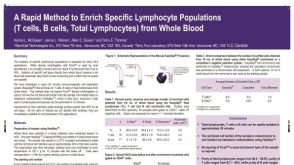 科学海报Cell Enrichment of Specific Lymphocyte Populations (T Cells, B Cells, Total Lymphocytes) from Whole Blood


 沪公网安备31010102008431号