C. Bouffi et al. (Jun 2023)
Nature biotechnology 41 824-831
In vivo development of immune tissue in human intestinal organoids transplanted into humanized mice.
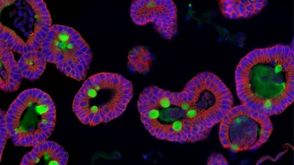
Human intestinal organoids (HIOs) derived from pluripotent stem cells provide a valuable model for investigating human intestinal organogenesis and physiology,but they lack the immune components required to fully recapitulate the complexity of human intestinal biology and diseases. To address this issue and to begin to decipher human intestinal-immune crosstalk during development,we generated HIOs containing immune cells by transplanting HIOs under the kidney capsule of mice with a humanized immune system. We found that human immune cells temporally migrate to the mucosa and form cellular aggregates that resemble human intestinal lymphoid follicles. Moreover,after microbial exposure,epithelial microfold cells are increased in number,leading to immune cell activation determined by the secretion of IgA antibodies in the HIO lumen. This in vivo HIO system with human immune cells provides a framework for future studies on infection- or allergen-driven intestinal diseases.
View Publication
J. Wang et al. (JAN 2018)
Gastroenterology 154 6 1737--1750
Ceragenin CSA13 Reduces Clostridium difficile Infection in Mice by Modulating the Intestinal Microbiome and Metabolites.
BACKGROUND & AIMS Clostridium difficile induces intestinal inflammation by releasing toxins A and B. The antimicrobial compound cationic steroid antimicrobial 13 (CSA13) has been developed for treating gastrointestinal infections. The CSA13-Eudragit formulation can be given orally and releases CSA13 in the terminal ileum and colon. We investigated whether this form of CSA13 reduces C difficile infection (CDI) in mice. METHODS C57BL/6J mice were infected with C difficile on day 0,followed by subcutaneous administration of pure CSA13 or oral administration of CSA13-Eudragit (10 mg/kg/d for 10 days). Some mice were given intraperitoneal vancomycin (50 mg/kg daily) on days 0-4 and relapse was measured after antibiotic withdrawal. The mice were monitored until day 20; colon and fecal samples were collected on day 3 for analysis. Blood samples were collected for flow cytometry analyses. Fecal pellets were collected each day from mice injected with CSA13 and analyzed by high-performance liquid chromatography or 16S sequencing; feces were also homogenized in phosphate-buffered saline and fed to mice with CDI via gavage. RESULTS CDI of mice caused 60{\%} mortality,significant bodyweight loss,and colonic damage 3 days after infection; these events were prevented by subcutaneous injection of CSA13 or oral administration CSA13-Eudragit. There was reduced relapse of CDI after administration of CSA13 was stopped. Levels of CSA13 in feces from mice given CSA13-Eudragit were significantly higher than those of mice given subcutaneous CSA13. Subcutaneous and oral CSA13 each significantly increased the abundance of Peptostreptococcaceae bacteria and reduced the abundance of C difficile in fecal samples of mice. When feces from mice with CDI and given CSA13 were fed to mice with CDI that had not received CSA13,the recipient mice had significantly increased rates of survival. CSA13 reduced fecal levels of inflammatory metabolites (endocannabinoids) and increased fecal levels of 4 protective metabolites (ie,citrulline,3-aminoisobutyric acid,retinol,and ursodeoxycholic acid) in mice with CDI. Oral administration of these CSA13-dependent protective metabolites reduced the severity of CDI. CONCLUSIONS In studies of mice,we found the CSA13-Eudragit formulation to be effective in eradicating CDI by modulating the intestinal microbiota and metabolites.
View Publication