D. Xie et al. (MAY 2017)
Experimental cell research
The effects of activin A on the migration of human breast cancer cells and neutrophils and their migratory interaction.
Activin A belongs to the superfamily of transforming growth factor beta (TGF$\beta$) and is a critical regulatory cytokine in breast cancer and inflammation. However,the role of activin A in migration of breast cancer cells and immune cells was not well characterized. Here,a microfluidic device was used to examine the effect of activin A on the migration of human breast cancer cell line MDA-MB-231 cells and human blood neutrophils as well as their migratory interaction. We found that activin A promoted the basal migration but impaired epidermal growth factor (EGF)-induced migration of breast cancer cells. By contrast,activin A reduced neutrophil chemotaxis and transendothelial migration to N-Formyl-Met-Leu-Phe (fMLP). Finally,activin A promoted neutrophil chemotaxis to the supernatant from breast cancer cell culture. Collectively,our study revealed the different roles of activin A in regulating the migration of breast cancer cells and neutrophils and their migratory interaction. These findings suggested the potential of activin A as a therapeutic target for inflammation and breast cancers.
View Publication
产品号#:
19666
100-0404
产品名:
EasySep™ Direct人中性粒细胞分选试剂盒
RoboSep™ 人中性粒细胞分选试剂盒
Abadier M et al. (DEC 2017)
Cell reports 21 13 3885--3899
Effector and Regulatory T Cells Roll at High Shear Stress by Inducible Tether and Sling Formation.
The adaptive immune response involves T cell differentiation and migration to sites of inflammation. T cell trafficking is initiated by rolling on inflamed endothelium. Tethers and slings,discovered in neutrophils,facilitate cell rolling at high shear stress. Here,we demonstrate that the ability to form tethers and slings during rolling is highly inducible in T helper 1 (Th1),Th17,and regulatory T (Treg) cells but less in Th2 cells. In vivo,endogenous Treg cells rolled stably in cremaster venules at physiological shear stress. Quantitative dynamic footprinting nanoscopy of Th1,Th17,and Treg cells uncovered the formation of multiple tethers per cell. Human Th1 cells also showed tethers and slings. RNA sequencing (RNA-seq) revealed the induction of cell migration and cytoskeletal genes in sling-forming cells. We conclude that differentiated CD4 T cells stabilize rolling by inducible tether and sling formation. These phenotypic changes approximate the adhesion phenotype of neutrophils and support CD4 T cell access to sites of inflammation.
View Publication
Nair S et al. (JAN 2007)
Cancer research 67 1 371--80
Vaccination against the forkhead family transcription factor Foxp3 enhances tumor immunity.
Depletion of CD4+CD25+ regulatory T cells (Treg) by treatment with alphaCD25 antibody synergizes with vaccination protocols to engender protective immunity in mice. The effectiveness of targeting CD25 to eliminate Treg is limited by the fact that CD25,the low-affinity interleukin-2 receptor,is up-regulated on conventional T cells. At present,foxp3 is the only product known to be exclusively expressed in Treg of mice. However,foxp3 is not expressed on the cell surface and hence cannot be targeted with antibodies. In this study,we tested the hypothesis that vaccination of mice against foxp3,a self-antigen expressed also in the thymus,is capable of stimulating foxp3-specific CTL that will cause the depletion of Treg and enhanced antitumor immunity. Vaccination of mice with foxp3 mRNA-transfected dendritic cells elicited a robust foxp3-specific CTL response and potentiated vaccine-induced protective immunity comparably with that of alphaCD25 antibody administration. In contrast to alphaCD25 antibody treatment,repeated foxp3 vaccination did not interfere with vaccine-induced protective immunity. Importantly,foxp3 vaccination led to the preferential depletion of foxp3-expressing Treg in the tumor but not in the periphery,whereas alphaCD25 antibody treatment led to depletion of Treg in both the tumor and the periphery. Targeting foxp3 by vaccination offers a specific and simpler protocol for the prolonged control of Treg that may be associated with reduced risk of autoimmunity,introducing an approach whereby specific depletion of cells is not limited to targeting products expressed on the cell surface.
View Publication
产品号#:
19751
19751RF
18554
18554RF
18564
18564RF
产品名:
Cammenga J et al. (JAN 2007)
Cancer research 67 2 537--45
Mutations in the RUNX1 gene are found at high frequencies in minimally differentiated acute myelogenous leukemia. In addition to null mutations,many of the mutations generate Runx1 DNA-binding (RDB) mutants. To determine if these mutants antagonize wild-type protein activity,cDNAs were transduced into murine bone marrow or human cord blood cells using retroviral vectors. Significantly,the RDB mutants did not act in a transdominant fashion in vivo to disrupt Runx1 activity in either T-cell or platelet development,which are highly sensitive to Runx1 dosage. However,RDB mutant expression impaired expansion and differentiation of the erythroid compartment in which Runx1 expression is normally down-regulated,showing that a RDB-independent function is incompatible with erythroid differentiation. Significantly,both bone marrow progenitors expressing RDB mutants or deficient for Runx1 showed increased replating efficiencies in vitro,accompanied by the accumulation of myeloblasts and dysplastic progenitors,but the effect was more pronounced in RDB cultures. Disruption of the interface that binds CBFbeta,an important cofactor of Runx1,did not impair RDB mutant replating activity,arguing against inactivation of Runx1 function by CBFbeta sequestration. We propose that RDB mutants antagonize Runx1 function in early progenitors by disrupting a critical balance between DNA-binding-independent and DNA-binding-dependent signaling.
View Publication
产品号#:
03434
03444
09500
09600
09650
18096
18096RF
84434
84444
产品名:
MethoCult™ GF M3434
MethoCult™ GF M3434
BIT 9500血清替代物
StemSpan™ SFEM
StemSpan™ SFEM
挂图
Human Immune Cytokines
Infographic of key cytokines for expansion, differentiation and characterization of major immune cell types
Miyoshi H et al. (JAN 1999)
Science (New York,N.Y.) 283 5402 682--6
Transduction of human CD34+ cells that mediate long-term engraftment of NOD/SCID mice by HIV vectors.
Efficient gene transfer into human hematopoietic stem cells (HSCs) is an important goal in the study of the hematopoietic system as well as for gene therapy of hematopoietic disorders. A lentiviral vector based on the human immunodeficiency virus (HIV) was able to transduce human CD34+ cells capable of stable,long-term reconstitution of nonobese diabetic/severe combined immunodeficient (NOD/SCID) mice. High-efficiency transduction occurred in the absence of cytokine stimulation and resulted in transgene expression in multiple lineages of human hematopoietic cells for up to 22 weeks after transplantation.
View Publication
产品号#:
09500
产品名:
BIT 9500血清替代物
Lee DJ et al. (NOV 2016)
Scientific reports 6 37790
MC5r and A2Ar Deficiencies During Experimental Autoimmune Uveitis Identifies Distinct T cell Polarization Programs and a Biphasic Regulatory Response.
Autoantigen-specific regulatory immunity emerges in the spleen of mice recovering from experimental autoimmune uveitis (EAU),a murine model for human autoimmune uveoretinitis. This regulatory immunity provides induced tolerance to ocular autoantigen,and requires melanocortin 5 receptor (MC5r) expression on antigen presenting cells with adenosine 2 A receptor (A2Ar) expression on T cells. During EAU it is not well understood what roles MC5r and A2Ar have on promoting regulatory immunity. Cytokine profile analysis during EAU revealed MC5r and A2Ar each mediate distinct T cell responses,and are responsible for a functional regulatory immune response in the spleen. A2Ar stimulation at EAU onset did not augment this regulatory response,nor bypass the MC5r requirement to induce regulatory immunity. The importance of this pathway in human autoimmune uveitis was assayed. PBMC from uveitis patients were assayed for MC5r expression on monocytes and A2Ar on T cells,and comparison between uveitis patients and healthy controls had no significant difference. The importance for MC5r and A2Ar expression in EAU to promote the induction of protective regulatory immunity,and the expression of MC5r and A2Ar on human immune cells,suggests that it may be possible to utilize the melanocortin-adenosinergic pathways to induce protective immunity in uveitic patients.
View Publication
产品号#:
85450
85460
86450
86460
产品名:
SepMate™-50 (IVD)
SepMate™-50 (IVD)
SepMate™-50 (RUO)
SepMate™-50 (RUO)
Pereira RC et al. ( 2016)
Frontiers in immunology 7 415
Human Articular Chondrocytes Regulate Immune Response by Affecting Directly T Cell Proliferation and Indirectly Inhibiting Monocyte Differentiation to Professional Antigen-Presenting Cells.
Autologous chondrocyte implantation is the current gold standard cell therapy for cartilage lesions. However,in some instances,the heavily compromised health of the patient can either impair or limit the recovery of the autologous chondrocytes and a satisfactory outcome of the implant. Allogeneic human articular chondrocytes (hAC) could be a good alternative,but the possible immunological incompatibility between recipient and hAC donor should be considered. Herein,we report that allogeneic hAC inhibited T lymphocyte response to antigen-dependent and -independent proliferative stimuli. This effect was maximal when T cells and hAC were in contact and it was not relieved by the addition of exogenous lymphocyte growth factor interleukin (IL)-2. More important,hAC impaired the differentiation of peripheral blood monocytes induced with granulocyte monocyte colony-stimulating factor and IL-4 (Mo) to professional antigen-presenting cells,such as dendritic cells (DC). Indeed,a marked inhibition of the onset of the CD1a expression and an ineffective downregulation of CD14 antigens was observed in Mo-hAC co-cultures. Furthermore,compared to immature or mature DC,Mo from Mo-hAC co-cultures did not trigger an efficacious allo-response. The prostaglandin (PG) E2 present in the Mo-hAC co-culture conditioned media is a putative candidate of the hAC-mediated inhibition of Mo maturation. Altogether,these findings indicate that allogeneic hAC inhibit,rather than trigger,immune response and strongly suggest that an efficient chondrocyte implantation could be possible also in an allogeneic setting.
View Publication
产品号#:
17951
17951RF
17952
17952RF
18099
18099RF
100-0695
100-0696
产品名:
EasySep™人T细胞分选试剂盒
RoboSep™ 人T细胞分选试剂盒
EasySep™人CD4+ T细胞分选试剂盒
RoboSep™ 人CD4+ T细胞分选试剂盒
EasySep™人T细胞分选试剂盒
EasySep™人CD4+ T细胞分离试剂盒
Hassanzadeh-Kiabi N et al. (NOV 2016)
Journal of immunology (Baltimore,Md. : 1950)
Autocrine Type I IFN Signaling in Dendritic Cells Stimulated with Fungal β-Glucans or Lipopolysaccharide Promotes CD8 T Cell Activation.
Type I IFNs are key mediators of immune defense against viruses and bacteria. Type I IFNs were also previously implicated in protection against fungal infection,but their roles in antifungal immunity have not been thoroughly investigated. A recent study demonstrated that bacterial and fungal β-glucans stimulate IFN-β production by dendritic cells (DCs) following detection by the Dectin-1 receptor,but the effects of β-glucan-induced type I IFNs have not been defined. We investigated whether type I IFNs regulate CD8 T cell activation by fungal β-glucan particle-stimulated DCs. We demonstrate that β-glucan-stimulated DCs induce CD8 T cell proliferation,activation marker (CD44 and CD69) expression,and production of IFN-γ,IL-2,and granzyme B. Moreover,we show that type I IFNs support robust CD8 T cell activation (proliferation and IFN-γ and granzyme B production) by β-glucan-stimulated DCs in vitro and in vivo due to autocrine effects on the DCs. Specifically,type I IFNs promote Ag presentation on MHC I molecules,CD86 and CD40 expression,and the production of IL-12 p70,IL-2,IL-6,and TNF-α by β-glucan-stimulated DCs. We also demonstrate a role for autocrine type I IFN signaling in bacterial LPS-induced DC maturation,although,in the context of LPS stimulation,this mechanism is not so critical for CD8 T cell activation (promotes IFN-γ production but not proliferation or granzyme B production). This study provides insight into the mechanisms underlying CD8 T cell activation during infection,which may be useful in the rational design of vaccines directed against pathogens and tumors.
View Publication
产品号#:
19858
19858RF
产品名:
EasySep™小鼠Naïve CD8+ T细胞分选试剂盒
RoboSep™ 小鼠Naïve CD8+ T细胞分选试剂盒
Rouhi A et al. (MAR 2006)
Journal of immunology (Baltimore,Md. : 1950) 176 5 2991--9
Evidence for epigenetic maintenance of Ly49a monoallelic gene expression.
Although structurally unrelated,the human killer cell Ig-like (KIR) genes and the rodent lectin-like Ly49 genes serve similar functional roles in NK cells. Moreover,both gene families display variegated,monoallelic expression patterns established at the transcriptional level. DNA methylation has been shown to play an important role in maintenance of expression patterns of KIR genes,which have CpG island promoters. The potential role of DNA methylation in expression of Ly49 genes,which have CpG-poor promoters,is unknown. In this study,we show that hypomethylation of the region encompassing the Pro-2 promoter of Ly49a and Ly49c in primary C57BL/6 NK cells correlates with expression of the gene. Using C57BL/6 x BALB/c F1 hybrid mice,we demonstrate that the expressed allele of Ly49a is hypomethylated while the nonexpressed allele is heavily methylated,indicating a role for epigenetics in maintaining monoallelic Ly49 gene expression. Furthermore,the Ly49a Pro-2 region is heavily methylated in fetal NK cells but variably methylated in nonlymphoid tissues. Finally,in apparent contrast to the KIR genes,we show that DNA methylation and the histone acetylation state of the Pro-2 region are strictly linked with Ly49a expression status.
View Publication
产品号#:
18554
18554RF
18564
18564RF
产品名:
Fu W et al. (DEC 2016)
Scientific reports 6 38162
Immune Activation Influences SAMHD1 Expression and Vpx-mediated SAMHD1 Degradation during Chronic HIV-1 Infection.
SAMHD1 restricts human immunodeficiency virus type 1 (HIV-1) replication in myeloid cells and CD4(+) T cells,while Vpx can mediate SAMHD1 degradation to promote HIV-1 replication. Although the restriction mechanisms of SAMHD1 have been well-described,SAMHD1 expression and Vpx-mediated SAMHD1 degradation during chronic HIV-1 infection were poorly understood. Flow cytometric analysis was used to directly visualize ex vivo,and after in vitro SIV-Vpx treatment,SAMHD1 expression in CD4(+) T cells and monocytes. Here we report activated CD4(+) T cells without SAMHD1 expression were severely reduced,and SAMHD1 in CD4(+) T cells became susceptible to SIV-Vpx mediated degradation during chronic HIV-1 infection,which was absent from uninfected donors. These alterations were irreversible,even after long-term fully suppressive antiretroviral treatment. Although SAMHD1 expression in CD4(+) T cells and monocytes was not found to correlate with plasma viral load,Vpx-mediated SAMHD1 degradation was associated with indicators of immune activation. In vitro assays further revealed that T-cell activation and an upregulated IFN-I pathway contributed to these altered SAMHD1 properties. These findings provide insight into how immune activation during HIV-1 infection leads to irreparable aberrations in restriction factors and in subsequent viral evasion from host antiviral defenses.
View Publication


 EasySep™小鼠TIL(CD45)正选试剂盒




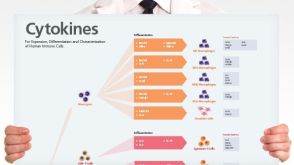 挂图Human Immune Cytokines Infographic of key cytokines for expansion, differentiation and characterization of major immune cell types
 沪公网安备31010102008431号