Carrera Silva EA et al. ( 2017)
Blood 130 17 1898--1902
CD207+CD1a+ cells circulate in pediatric patients with active Langerhans cell histiocytosis.
Langerhans cell histiocytosis (LCH) is a rare disease with an unknown etiology characterized by heterogeneous lesions containing CD207+CD1a+ cells that can arise in almost any tissue and cause significant morbidity and mortality. Precursors of pathological Langerhans cells have yet to be defined. Our aim was to identify circulating CD207+CD1a+ cells and their inducers in LCH. Expression of CD207 and CD1a in the blood myeloid compartment as well as thymic stromal lymphopoietin (TSLP) and transforming growth factor β (TGF-β) plasma levels were measured in 22 pediatric patients with active disease (AD) or nonactive disease (NAD). In patients with AD vs those with NAD,the myeloid compartment showed an increased CD11b (CD11bhigh plus CD11b+) fraction (39.7 ± 3.6 vs 18.6 ± 1.9),a higher percentage of circulating CD11bhighCD11c+CD207+ cells (44.5 ± 11.3 vs 3.2 ± 0.5),and the presence of CD11chighCD207+CD1a+ cells (25.0 ± 9.1 vs 2.3 ± 0.5). Blood CD207+CD1a+ cells were not observed in adult controls or umbilical cord. Increased TSLP and TGF-β levels were detected in patients with AD. Interestingly,plasma from patients with AD induces CD207 expression on CD14+ monocytes. We conclude that CD207+CD1a+ cells are circulating in patients with active LCH,and TSLP and TGF-β are potential drivers of Langerhans-like cells in vivo.
View Publication
产品号#:
17858
17858RF
100-0694
产品名:
EasySep™人CD14正选试剂盒II
RoboSep™ 人CD14正选试剂盒II
EasySep™人CD14正选试剂盒II
Lambrianides A et al. (JUN 2010)
Journal of immunology (Baltimore,Md. : 1950) 184 12 6622--8
Effects of polyclonal IgG derived from patients with different clinical types of the antiphospholipid syndrome on monocyte signaling pathways.
A major mechanism of hypercoagulability in the antiphospholipid syndrome (APS) is antiphospholipid Ab-mediated upregulation of tissue factor (TF) on monocytes via activation of TLRs,p38 MAPK,and NF-kappaB pathways. We examined whether monocyte signaling pathways are differentially activated by IgG from patients with vascular thrombosis (VT) alone compared with IgG from patients with pregnancy morbidity (PM) alone. We purified IgG from 49 subjects. A human monocyte cell line and ex vivo healthy monocytes were treated with 100 microg/ml IgG for 6 h,and cell extracts were examined by immunoblot using Abs to p38 MAPK and NF-kappaB. To further investigate intracellular signaling pathways induced by these IgGs,specific inhibitors of p38 MAPK,NF-kappaB,TLR4,and TLR2 were used to determine their effect on TF activity. Only IgG from patients with VT but no PM (VT+/PM-) caused phosphorylation of NF-kappaBand p38 MAPK and upregulation of TF activity in monocytes. These effects were not seen with IgG from patients with PM alone (VT-/PM+),anti-phospholipid Ab-positive patients without APS,or healthy controls. TF upregulation caused by the VT+/PM- samples was reduced by inhibitors of p38 MAPK,NF-kappaB,and TLR4. The effects of VT+/PM- IgG on signaling and TF upregulation were concentrated in the fraction that bound beta-2-glycoprotein I. Our findings demonstrate that IgGs from patients with diverse clinical manifestations of APS have differential effects upon phosphorylation of NF-kappaB and p38 MAPK and TF activity that may be mediated by differential activation of TLR4.
View Publication
Cytosolic sulfotransferase 1A1 regulates HIV-1 minus-strand DNA elongation in primary human monocyte-derived macrophages.
BACKGROUND: The cellular sulfonation pathway modulates key steps of virus replication. This pathway comprises two main families of sulfonate-conjugating enzymes: Golgi sulfotransferases,which sulfonate proteins,glycoproteins,glycolipids and proteoglycans; and cytosolic sulfotransferases (SULTs),which sulfonate various small molecules including hormones,neurotransmitters,and xenobiotics. Sulfonation controls the functions of numerous cellular factors such as those involved in cell-cell interactions,cell signaling,and small molecule detoxification. We previously showed that the cellular sulfonation pathway regulates HIV-1 gene expression and reactivation from latency. Here we show that a specific cellular sulfotransferase can regulate HIV-1 replication in primary human monocyte-derived macrophages (MDMs) by yet another mechanism,namely reverse transcription. METHODS: MDMs were derived from monocytes isolated from donor peripheral blood mononuclear cells (PBMCs) obtained from the San Diego Blood Bank. After one week in vitro cell culture under macrophage-polarizing conditions,MDMs were transfected with sulfotranserase-specific or control siRNAs and infected with HIV-1 or SIV constructs expressing a luciferase reporter. Infection levels were subsequently monitored by luminescence. Western blotting was used to assay siRNA knockdown and viral protein levels,and qPCR was used to measure viral RNA and DNA products. RESULTS: We demonstrate that the cytosolic sulfotransferase SULT1A1 is highly expressed in primary human MDMs,and through siRNA knockdown experiments,we show that this enzyme promotes infection of MDMs by single cycle VSV-G pseudotyped human HIV-1 and simian immunodeficiency virus vectors and by replication-competent HIV-1. Quantitative PCR analysis revealed that SULT1A1 affects HIV-1 replication in MDMs by modulating the kinetics of minus-strand DNA elongation during reverse transcription. CONCLUSIONS: These studies have identified SULT1A1 as a cellular regulator of HIV-1 reverse transcription in primary human MDMs. The normal substrates of this enzyme are small phenolic-like molecules,raising the possibility that one or more of these substrates may be involved. Targeting SULT1A1 and/or its substrate(s) may offer a novel host-directed strategy to improve HIV-1 therapeutics.
View Publication


 EasySep™小鼠TIL(CD45)正选试剂盒




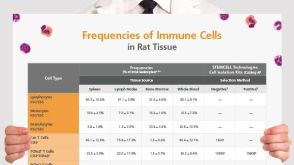 挂图Frequencies of Immune Cells in Rat Tissue Lists the estimated frequencies of more than 15 immune cell types in Sprague Dawley rats
 技术公告Simplify Your PBMC Isolations with the EasySep™ Direct Human PBMC Isolation Kit
 科学海报One-Step Enrichment of Leukocyte Subsets Directly in the Blood Collection Tube


 沪公网安备31010102008431号