Human Immune Cytokines
Infographic of key cytokines for expansion, differentiation and characterization of major immune cell types
Marzaioli V et al. ( 2017)
Blood 130 15 1734--1745
NOX5 and p22phox are 2 novel regulators of human monocytic differentiation into dendritic cells.
Dendritic cells (DCs) are a heterogeneous population of professional antigen-presenting cells and are key cells of the immune system,acquiring different phenotypes in accordance with their localization during the immune response. A subset of inflammatory DCs is derived from circulating monocytes (Mo) and has a key role in inflammation and infection. The pathways controlling Mo-DC differentiation are not fully understood. Our objective was to investigate the possible role of nicotinamide adenine dinucleotide phosphate reduced form oxidases (NOXs) in Mo-DC differentiation. In this study,we revealed that Mo-DC differentiation was inhibited by NOX inhibitors and reactive oxygen species scavengers. We show that the Mo-DC differentiation was dependent on p22phox,and not on gp91phox/NOX2,as shown by the reduced Mo-DC differentiation observed in chronic granulomatous disease patients lacking p22phox. Moreover,we revealed that NOX5 expression was strongly increased during Mo-DC differentiation,but not during Mo-macrophage differentiation. NOX5 was expressed in circulating myeloid DC,and at a lower level in plasmacytoid DC. Interestingly,NOX5 was localized at the outer membrane of the mitochondria and interacted with p22phox in Mo-DC. Selective inhibitors and small interfering RNAs for NOX5 indicated that NOX5 controlled Mo-DC differentiation by regulating the JAK/STAT/MAPK and NFκB pathways. These data demonstrate that the NOX5-p22phox complex drives Mo-DC differentiation,and thus could be critical for immunity and inflammation.
View Publication
产品号#:
19061
19061RF
19062
19062RF
19359
19359RF
100-0697
产品名:
EasySep™人髓样DC富集试剂盒
RoboSep™ 人髓样DC富集试剂盒
EasySep™人浆细胞样DC富集试剂盒
RoboSep™ 人浆细胞样DC富集试剂盒含滤芯吸头
EasySep™人单核细胞分选试剂盒
RoboSep™ 人单核细胞分选试剂盒
EasySep™人单核细胞分选试剂盒
Xu MM et al. (AUG 2017)
Immunity 47 2 363--373.e5
Dendritic Cells but Not Macrophages Sense Tumor Mitochondrial DNA for Cross-priming through Signal Regulatory Protein α Signaling.
Inhibition of cytosolic DNA sensing represents a strategy that tumor cells use for immune evasion,but the underlying mechanisms are unclear. Here we have shown that CD47-signal regulatory protein α (SIRPα) axis dictates the fate of ingested DNA in DCs for immune evasion. Although macrophages were more potent in uptaking tumor DNA,increase of DNA sensing by blocking the interaction of SIRPα with CD47 preferentially occurred in dendritic cells (DCs) but not in macrophages. Mechanistically,CD47 blockade enabled the activation of NADPH oxidase NOX2 in DCs,which in turn inhibited phagosomal acidification and reduced the degradation of tumor mitochondrial DNA (mtDNA) in DCs. mtDNA was recognized by cyclic-GMP-AMP synthase (cGAS) in the DC cytosol,contributing to type I interferon (IFN) production and antitumor adaptive immunity. Thus,our findings have demonstrated how tumor cells inhibit innate sensing in DCs and suggested that the CD47-SIRPα axis is critical for DC-driven antitumor immunity.
View Publication
产品号#:
18780
18780RF
18781
18781RF
19853
19853RF
70025
70025.1
70025.2
70025.3
产品名:
EasySep™小鼠CD11c正选试剂盒II
RoboSep™ 小鼠CD11c正选试剂盒II
EasySep™小鼠CD11c正选试剂盒II及脾脏解离液
RoboSep™ 小鼠CD11c正选试剂盒II及脾脏解离液
EasySep™小鼠CD8+ T细胞分选试剂盒
RoboSep™ 小鼠CD8+ T细胞分选试剂盒
冻存的人外周血单个核细胞
冻存的人外周血单个核细胞
冻存的人外周血单个核细胞
冻存的人外周血单个核细胞
Schulz O et al. (DEC 2009)
The Journal of experimental medicine 206 13 3101--14
Intestinal CD103+, but not CX3CR1+, antigen sampling cells migrate in lymph and serve classical dendritic cell functions.
Chemokine receptor CX3CR1(+) dendritic cells (DCs) have been suggested to sample intestinal antigens by extending transepithelial dendrites into the gut lumen. Other studies identified CD103(+) DCs in the mucosa,which,through their ability to synthesize retinoic acid (RA),appear to be capable of generating typical signatures of intestinal adaptive immune responses. We report that CD103 and CX3CR1 phenotypically and functionally characterize distinct subsets of lamina propria cells. In contrast to CD103(+) DC,CX3CR1(+) cells represent a nonmigratory gut-resident population with slow turnover rates and poor responses to FLT-3L and granulocyte/macrophage colony-stimulating factor. Direct visualization of cells in lymph vessels and flow cytometry of mouse intestinal lymph revealed that CD103(+) DCs,but not CX3CR1-expressing cells,migrate into the gut draining mesenteric lymph nodes (LNs) under steady-state and inflammatory conditions. Moreover,CX3CR1(+) cells displayed poor T cell stimulatory capacity in vitro and in vivo after direct injection of cells into intestinal lymphatics and appeared to be less efficient at generating RA compared with CD103(+) DC. These findings indicate that selectively CD103(+) DCs serve classical DC functions and initiate adaptive immune responses in local LNs,whereas CX3CR1(+) populations might modulate immune responses directly in the mucosa and serve as first line barrier against invading enteropathogens.
View Publication
产品号#:
01700
01705
01701
01702
产品名:
ALDEFLUOR™ 试剂盒
ALDEFLUOR™ DEAB试剂, 1.5 mM, 1 mL
ALDEFLUOR™检测缓冲液
Megjugorac NJ et al. (MAY 2010)
Blood 115 21 4185--90
IL-4 enhances IFN-lambda1 (IL-29) production by plasmacytoid DCs via monocyte secretion of IL-1Ra.
The type-III interferon (IFN) family is composed of 3 molecules in humans: IFN-lambda1 (interleukin-29 [IL-29]),IFN-lambda2 (IL-28A),and IFN-lambda3 (IL-28B),each of which signals through the same receptor complex. Plasmacytoid dendritic cells (pDCs) are major IFN-lambda producers among peripheral lymphocytes. Recently,it has been shown that IFN-lambda1 exerts a powerful inhibitory effect over the T-helper 2 (Th2) response by antagonizing the effect of IL-4 on CD4(+) T cells and inhibiting the production of Th2-associated cytokines. Here,we asked whether Th2 cytokines exert reciprocal control over IFN-lambda production. IL-4 treatment during stimulation of human peripheral lymphocytes significantly elevated IFN-lambda1 transcription and secretion. However,pDCs were not directly responsive to IL-4. Using depletion and reconstitution experiments,we showed that IL-4-responsive monocytes are an intermediary cell,responding to IL-4 by elevating their secretion of IL-1 receptor antagonist (IL-Ra); this IL-1Ra acts on pDCs to elevate their IFN-lambda1 output. Thus,our experiments revealed a novel mechanism for regulation of both IFN-lambda1 production and pDC function,and suggests an expanded immunomodulatory role for Th2-associated cytokines.
View Publication
产品号#:
18051
18051RF
18054
18054RF
18055
18055RF
18058
18058RF
19062
19062RF
19058
19058RF
18551
18551RF
18561
100-1525
产品名:
EasySep™人浆细胞样DC富集试剂盒
RoboSep™ 人浆细胞样DC富集试剂盒含滤芯吸头
EasySep™人单核细胞富集试剂盒(不去除CD16)
RoboSep™ 人单核细胞富集试剂盒(不去除CD16)含滤芯吸头
EasySep™人单核细胞富集试剂盒(不去除CD16)
G. B. Cross et al. ( 2019)
PloS one 14 5 e0216616
Impact of selective immune-cell depletion on growth of Mycobacterium tuberculosis (Mtb) in a whole-blood bactericidal activity (WBA) assay.
We investigated the contribution of host immune cells to bacterial killing in a whole-blood bactericidal activity (WBA) assay,an ex vivo model used to test efficacy of drugs against mycobacterium tuberculosis (Mtb). We performed WBA assays with immuno-magnetic depletion of specific cell types,in the presence or absence of rifampicin. Innate immune cells decreased Mtb growth in absence of drug,but appeared to diminish the cidal activity of rifampicin,possibly attributable to intracellular bacterial sequestration. Adaptive immune cells had no effect with or without drug. The WBA assay may have potential for testing adjunctive host-directed therapies acting on phagocytic cells.
View Publication
产品号#:
18000
产品名:
EasySep™磁极
Zeng J and Wang S (JAN 2014)
Stem cells translational medicine 3 1 69--80
Human dendritic cells derived from embryonic stem cells stably modified with CD1d efficiently stimulate antitumor invariant natural killer T cell response.
Invariant natural killer T (iNKT) cells are a unique lymphocyte subpopulation that mediates antitumor activities upon activation. A current strategy to harness iNKT cells for cancer treatment is endogenous iNKT cell activation using patient-derived dendritic cells (DCs). However,the limited number and functional defects of patient DCs are still the major challenges for this therapeutic approach. In this study,we investigated whether human embryonic stem cells (hESCs) with an ectopically expressed CD1d gene could be exploited to address this issue. Using a lentivector carrying an optimized expression cassette,we generated stably modified hESC lines that consistently overexpressed CD1d. These modified hESC lines were able to differentiate into DCs as efficiently as the parental line. Most importantly,more than 50% of such derived DCs were CD1d+. These CD1d-overexpressing DCs were more efficient in inducing iNKT cell response than those without modification,and their ability was comparable to that of DCs generated from monocytes of healthy donors. The iNKT cells expanded by the CD1d-overexpressing DCs were functional,as demonstrated by their ability to lyse iNKT cell-sensitive glioma cells. Therefore,hESCs stably modified with the CD1d gene may serve as a convenient,unlimited,and competent DC source for iNKT cell-based cancer immunotherapy.
View Publication
产品号#:
05850
05857
05870
05875
09600
09650
70024
70024.1
85850
85857
85870
85875
产品名:
StemSpan™ SFEM
StemSpan™ SFEM
冻存的人外周血Pan T细胞
冻存的人外周血Pan T细胞
mTeSR™1
mTeSR™1
Fedele G et al. (MAY 2011)
Journal of immunology (Baltimore,Md. : 1950) 186 9 5388--96
Attenuated Bordetella pertussis vaccine candidate BPZE1 promotes human dendritic cell CCL21-induced migration and drives a Th1/Th17 response.
New vaccines against pertussis are needed to evoke full protection and long-lasting immunological memory starting from the first administration in neonates--the major target of the life-threatening pertussis infection. A novel live attenuated Bordetella pertussis vaccine strain,BPZE1,has been developed by eliminating or detoxifying three important B. pertussis virulence factors: pertussis toxin,dermonecrotic toxin,and tracheal cytotoxin. We used a human preclinical ex vivo model based on monocyte-derived dendritic cells (MDDCs) to evaluate BPZE1 immunogenicity. We studied the effects of BPZE1 on MDDC functions,focusing on the impact of Bordetella-primed dendritic cells in the regulation of Th and suppressor T cells (Ts). BPZE1 is able to activate human MDDCs and to promote the production of a broad spectrum of proinflammatory and regulatory cytokines. Moreover,conversely to its parental wild-type counterpart BPSM,BPZE1-primed MDDCs very efficiently migrate in vitro in response to the lymphatic chemokine CCL21,due to the inactivation of pertussis toxin enzymatic activity. BPZE1-primed MDDCs drove a mixed Th1/Th17 polarization and also induced functional Ts. Experiments performed in a Transwell system showed that cell contact rather than the production of soluble factors was required for suppression activity. Overall,our findings support the potential of BPZE1 as a novel live attenuated pertussis vaccine,as BPZE1-challenged dendritic cells might migrate from the site of infection to the lymph nodes,prime Th cells,mount an adaptive immune response,and orchestrate Th1/Th17 and Ts responses.
View Publication


 EasySep™小鼠TIL(CD45)正选试剂盒




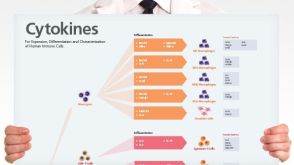 挂图Human Immune Cytokines Infographic of key cytokines for expansion, differentiation and characterization of major immune cell types


 沪公网安备31010102008431号