Simons MP et al. (MAR 2008)
Journal of leukocyte biology 83 3 621--9
TNF-related apoptosis-inducing ligand (TRAIL) is expressed throughout myeloid development, resulting in a broad distribution among neutrophil granules.
TRAIL induces apoptosis in a variety of tumor cells. Our laboratory found that human neutrophils contain an intracellular reservoir of prefabricated TRAIL that is released after stimulation with Mycobacterium bovis bacillus Calmette-Guérin. In this study,we examined the subcellular distribution of TRAIL in freshly isolated neutrophils. Neutrophil granules,secretory vesicles (SV),and plasma membrane vesicles were isolated by subcellular fractionation,followed by free-flow electrophoresis,and examined by ELISA and immunoblot. TRAIL was found in all membrane-bound fractions with the highest amounts in the fractions enriched in azurophilic granule (AG) and SV. Immunofluorescence confocal microscopy showed that TRAIL colocalized independently with myeloperoxidase (MPO),lactoferrin (LF),and albumin,respective markers of AG,specific granules,and SV. Furthermore,immunotransmission electron microscopy demonstrated that TRAIL colocalized intracellularly with MPO and albumin. We examined TRAIL expression in PLB-985 cells induced with dimethylformamide and in CD34-positive stem cells treated with G-CSF. Quantitative RT-PCR analysis showed that TRAIL was expressed in each stage of development,whereas MPO and LF were only expressed at distinct times during differentiation. Collectively,these findings suggest that TRAIL is expressed throughout neutrophil development,resulting in a broad distribution among different granule subtypes.
View Publication
产品号#:
09600
09650
09850
产品名:
StemSpan™ SFEM
StemSpan™ SFEM
Kim M-H et al. (MAR 2011)
Blood 117 12 3343--52
Neutrophil survival and c-kit(+)-progenitor proliferation in Staphylococcus aureus-infected skin wounds promote resolution.
Polymorphonuclear neutrophils (PMNs) are critical for the formation,maintenance,and resolution of bacterial abscesses. However,the mechanisms that regulate PMN survival and proliferation during the evolution of an abscess are not well defined. Using a mouse model of Staphylococcus aureus abscess formation within a cutaneous wound,combined with real-time imaging of genetically tagged PMNs,we observed that a high bacterial burden elicited a sustained mobilization of PMNs from the bone marrow to the infected wound,where their lifespan was markedly extended. A continuous rise in wound PMN number,which was not accounted for by trafficking from the bone marrow or by prolonged survival,was correlated with the homing of c-kit(+)-progenitor cells from the blood to the wound,where they proliferated and formed mature PMNs. Furthermore,by blocking their recruitment with an antibody to c-kit,which severely limited the proliferation of mature PMNs in the wound and shortened mouse survival,we confirmed that progenitor cells are not only important contributors to PMN expansion in the wound,but are also functionally important for immune protection. We conclude that the abscess environment provides a niche capable of regulating PMN survival and local proliferation of bone marrow-derived c-kit(+)-progenitor cells.
View Publication
E47 regulates hematopoietic stem cell proliferation and energetics but not myeloid lineage restriction.
The immune system is replenished by self-renewing hematopoietic stem cells (HSCs) that produce multipotent progenitors (MPPs) with little renewal capacity. E-proteins,the widely expressed basic helix-loop-helix transcription factors,contribute to HSC and MPP activity,but their specific functions remain undefined. Using quantitative in vivo and in vitro approaches,we show that E47 is dispensable for the short-term myeloid differentiation of HSCs but regulates their long-term capabilities. E47-deficient progenitors show competent myeloid production in short-term assays in vitro and in vivo. However,long-term myeloid and lymphoid differentiation is compromised because of a progressive loss of HSC self-renewal that is associated with diminished p21 expression and hyperproliferation. The activity of E47 is shown to be cell-intrinsic. Moreover,E47-deficient HSCs and MPPs have altered expression of genes associated with cellular energy metabolism,and the size of the MPP pool but not downstream lymphoid precursors in bone marrow or thymus is rescued in vivo by antioxidant. Together,these observations suggest a role for E47 in the tight control of HSC proliferation and energy metabolism,and demonstrate that E47 is not required for short-term myeloid differentiation.
View Publication
血液相关来源中人细胞类型的比例
List of the frequencies of over 35 cell types in normal human blood-related sources.
Tomihara K et al. (JUN 2010)
Journal of immunology (Baltimore,Md. : 1950) 184 11 6151--60
Antigen-specific immunity and cross-priming by epithelial ovarian carcinoma-induced CD11b(+)Gr-1(+) cells.
Both innate and adaptive immune systems are considered important for cancer prevention,immunosurveillance,and control of cancer progression. It is known that,although both systems initially eliminate emerging tumor cells efficiently,tumors eventually escape immune attack by a variety of mechanisms,including differentiation and recruitment of immunosuppressive CD11b(+)Gr-1(+) myeloid suppressor cells into the tumor microenvironment. However,we show that CD11b(+)Gr-1(+) cells found in ascites of epithelial ovarian cancer-bearing mice at advanced stages of disease are immunostimulatory rather than being immunosuppressive. These cells consist of a homogenous population of cells that morphologically resemble neutrophils. Moreover,like dendritic cells,immunostimulatory CD11b(+)Gr-1(+) cells can strongly cross-prime,augmenting the proliferation of functional CTLs via signaling through the expression of costimulatory molecule CD80. Adoptive transfer of these immunostimulatory CD11b(+)Gr-1(+) cells from ascites of ovarian cancer-bearing mice results in the significant regression of s.c. tumors even without being pulsed with exogenous tumor Ag prior to adoptive transfer. We now show for the first time that adaptive immune responses against cancer can be augmented by these cancer-induced granulocyte-like immunostimulatory myeloid (CD11b(+)Gr-1(+)) cells,thereby mediating highly effective antitumor immunity in an adoptive transfer model of immunity.
View Publication
产品号#:
18553
18553RF
18556
18556RF
21000
20119
20155
产品名:
RoboSep™- S
RoboSep™ 吸头组件抛光剂
RoboSep™分选管套装(9个塑料管)
MacNamara KC et al. (JAN 2011)
Journal of immunology (Baltimore,Md. : 1950) 186 2 1032--43
Infection-induced myelopoiesis during intracellular bacterial infection is critically dependent upon IFN-γ signaling.
Although microbial infections can alter steady-state hematopoiesis,the mechanisms that drive such changes are not well understood. We addressed a role for IFN-γ signaling in infection-induced bone marrow suppression and anemia in a murine model of human monocytic ehrlichiosis,an emerging tick-borne disease. Within the bone marrow of Ehrlichia muris-infected C57BL/6 mice,we observed a reduction in myeloid progenitor cells,as defined both phenotypically and functionally. Infected mice exhibited a concomitant increase in developing myeloid cells within the bone marrow,an increase in the frequency of circulating monocytes,and an increase in splenic myeloid cells. The infection-induced changes in progenitor cell phenotype were critically dependent on IFN-γ,but not IFN-α,signaling. In mice deficient in the IFN-γ signaling pathway,we observed an increase in myeloid progenitor cells and CDllb(lo)Gr1(lo) promyelocytic cells within the bone marrow,as well as reduced frequencies of mature granulocytes and monocytes. Furthermore,E. muris-infected IFN-γR-deficient mice did not exhibit anemia or an increase in circulating monocytes,and they succumbed to infection. Gene transcription studies revealed that IFN-γR-deficient CDllb(lo)Gr1(lo) promyelocytes from E. muris-infected mice exhibited significantly reduced expression of irf-1 and irf-8,both key transcription factors that regulate the differentiation of granulocytes and monocytes. Finally,using mixed bone marrow chimeric mice,we show that IFN-γ-dependent infection-induced myelopoiesis occurs via the direct effect of the cytokine on developing myeloid cells. We propose that,in addition to its many other known roles,IFN-γ acts to control infection by directly promoting the differentiation of myeloid cells that contribute to host defense.
View Publication
产品号#:
03434
03444
产品名:
MethoCult™ GF M3434
MethoCult™ GF M3434
Grzywacz B et al. (MAR 2011)
Blood 117 13 3548--58
Natural killer-cell differentiation by myeloid progenitors.
Because lymphoid progenitors can give rise to natural killer (NK) cells,NK ontogeny has been considered to be exclusively lymphoid. Here,we show that rare human CD34(+) hematopoietic progenitors develop into NK cells in vitro in the presence of cytokines (interleukin-7,interleukin-15,stem cell factor,and fms-like tyrosine kinase-3 ligand). Adding hydrocortisone and stromal cells greatly increases the frequency of progenitor cells that give rise to NK cells through the recruitment of myeloid precursors,including common myeloid progenitors and granulocytic-monocytic precursors to the NK-cell lineage. WNT signaling was involved in this effect. Cells at more advanced stages of myeloid differentiation (with increasing expression of CD13 and macrophage colony-stimulating factor receptor [M-CSFR]) could also differentiate into NK cells in the presence of cytokines,stroma,and hydrocortisone. NK cells derived from myeloid precursors (CD56(-)CD117(+)M-CSFR(+)) showed more expression of killer immunoglobulin-like receptors,a fraction of killer immunoglobulin-like receptor-positive-expressing cells that lacked NKG2A,a higher cytotoxicity compared with CD56(-)CD117(+)M-CSFR(-) precursor-derived NK cells and thus resemble the CD56(dim) subset of NK cells. Collectively,these studies show that NK cells can be derived from the myeloid lineage.
View Publication


 EasySep™小鼠TIL(CD45)正选试剂盒





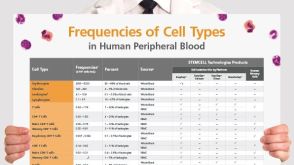 挂图血液相关来源中人细胞类型的比例 List of the frequencies of over 35 cell types in normal human blood-related sources.


 沪公网安备31010102008431号