Halim L et al. (JUL 2017)
Cell reports 20 3 757--770
An Atlas of Human Regulatory T Helper-like Cells Reveals Features of Th2-like Tregs that Support a Tumorigenic Environment.
Regulatory T cells (Tregs) play a pivotal role in maintaining immunological tolerance,but they can also play a detrimental role by preventing antitumor responses. Here,we characterized T helper (Th)-like Treg subsets to further delineate their biological function and tissue distribution,focusing on their possible contribution to disease states. RNA sequencing and functional assays revealed that Th2-like Tregs displayed higher viability and autocrine interleukin-2 (IL-2)-mediated activation than other subsets. Th2-like Tregs were preferentially found in tissues rather than circulation and exhibited the highest migratory capacity toward chemokines enriched at tumor sites. These cellular responses led us to hypothesize that this subset could play a role in maintaining a tumorigenic environment. Concurrently,Th2-like Tregs were enriched specifically in malignant tissues from patients with melanoma and colorectal cancer compared to healthy tissue. Overall,our results suggest that Th2-like Tregs may contribute to a tumorigenic environment due to their increased cell survival,higher migratory capacity,and selective T-effector suppressive ability.
View Publication
L. L. Lu et al. ( 2019)
Nature medicine 25 6 977--987
IFN-gamma-independent immune markers of Mycobacterium tuberculosis exposure.
Exposure to Mycobacterium tuberculosis (Mtb) results in heterogeneous clinical outcomes including primary progressive tuberculosis and latent Mtb infection (LTBI). Mtb infection is identified using the tuberculin skin test and interferon-gamma (IFN-gamma) release assay IGRA,and a positive result may prompt chemoprophylaxis to prevent progression to tuberculosis. In the present study,we report on a cohort of Ugandan individuals who were household contacts of patients with TB. These individuals were highly exposed to Mtb but tested negative disease by IFN-gamma release assay and tuberculin skin test,'resisting' development of classic LTBI. We show that 'resisters' possess IgM,class-switched IgG antibody responses and non-IFN-gamma T cell responses to the Mtb-specific proteins ESAT6 and CFP10,immunologic evidence of exposure to Mtb. Compared to subjects with classic LTBI,'resisters' display enhanced antibody avidity and distinct Mtb-specific IgG Fc profiles. These data reveal a distinctive adaptive immune profile among Mtb-exposed subjects,supporting an expanded definition of the host response to Mtb exposure,with implications for public health and the design of clinical trials.
View Publication
产品号#:
17858
17858RF
15025
15065
100-0694
19059
19059RF
产品名:
EasySep™人CD14正选试剂盒II
RoboSep™ 人CD14正选试剂盒II
RosetteSep™人NK细胞富集抗体混合物
RosetteSep™人NK细胞富集抗体混合物
EasySep™人CD14正选试剂盒II
EasySep™人单核细胞富集试剂盒
RoboSep™ 人单核细胞富集试剂盒含滤芯吸头
A. A. Titov et al. (jul 2019)
Journal of immunology (Baltimore,Md. : 1950) 203 2 338--348
Metformin Inhibits the Type 1 IFN Response in Human CD4+ T Cells.
In systemic lupus erythematosus,defective clearance of apoptotic debris and activation of innate cells result in a chronically activated type 1 IFN response,which can be measured in PBMCs of most patients. Metformin,a widely used prescription drug for Type 2 diabetes,has a therapeutic effect in several mouse models of lupus through mechanisms involving inhibition of oxidative phosphorylation and a decrease in CD4+ T cell activation. In this study,we report that in CD4+ T cells from human healthy controls and human systemic lupus erythematosus patients,metformin inhibits the transcription of IFN-stimulated genes (ISGs) after IFN-alpha treatment. Accordingly,metformin inhibited the phosphorylation of pSTAT1 (Y701) and its binding to IFN-stimulated response elements that control ISG expression. These effects were independent of AMPK activation or mTORC1 inhibition but were replicated using inhibitors of the electron transport chain respiratory complexes I,III,and IV. This indicates that mitochondrial respiration is required for ISG expression in CD4+ T cells and provides a novel mechanism by which metformin may exert a therapeutic effect in autoimmune diseases.
View Publication
Ichikawa S et al. (MAY 2011)
Journal of immunology (Baltimore,Md. : 1950) 186 10 5549--55
Hepatic stellate cells function as regulatory bystanders.
Regulatory T cells (Tregs) contribute significantly to the tolerogenic nature of the liver. The mechanisms,however,underlying liver-associated Treg induction are still elusive. We recently identified the vitamin A metabolite,retinoic acid (RA),as a key controller that promotes TGF-β-dependent Foxp3(+) Treg induction but inhibits TGF-β-driven Th17 differentiation. To investigate whether the RA producing hepatic stellate cells (HSC) are part of the liver tolerance mechanism,we investigated the ability of HSC to function as regulatory APC. Different from previous reports,we found that highly purified HSC did not express costimulatory molecules and only upregulated MHC class II after in vitro culture in the presence of exogenous IFN-γ. Consistent with an insufficient APC function,HSC failed to stimulate naive OT-II TCR transgenic CD4(+) T cells and only moderately stimulated α-galactosylceramide-primed invariant NKT cells. In contrast,HSC functioned as regulatory bystanders and promoted enhanced Foxp3 induction by OT-II TCR transgenic T cells primed by spleen dendritic cells,whereas they greatly inhibited the Th17 differentiation. Furthermore,the regulatory bystander capacity of the HSC was completely dependent on their ability to produce RA. Our data thus suggest that HSC can function as regulatory bystanders,and therefore,by promoting Tregs and suppressing Th17 differentiation,they might represent key players in the mechanism that drives liver-induced tolerance.
View Publication
产品号#:
01700
01705
01701
01702
19755
产品名:
ALDEFLUOR™ 试剂盒
ALDEFLUOR™ DEAB试剂, 1.5 mM, 1 mL
ALDEFLUOR™检测缓冲液
Mkhikian H et al. (JAN 2011)
Nature communications 2 334
Genetics and the environment converge to dysregulate N-glycosylation in multiple sclerosis.
How environmental factors combine with genetic risk at the molecular level to promote complex trait diseases such as multiple sclerosis (MS) is largely unknown. In mice,N-glycan branching by the Golgi enzymes Mgat1 and/or Mgat5 prevents T cell hyperactivity,cytotoxic T-lymphocyte antigen 4 (CTLA-4) endocytosis,spontaneous inflammatory demyelination and neurodegeneration,the latter pathologies characteristic of MS. Here we show that MS risk modulators converge to alter N-glycosylation and/or CTLA-4 surface retention conditional on metabolism and vitamin D(3),including genetic variants in interleukin-7 receptor-α (IL7RA*C),interleukin-2 receptor-α (IL2RA*T),MGAT1 (IV(A)V(T-T)) and CTLA-4 (Thr17Ala). Downregulation of Mgat1 by IL7RA*C and IL2RA*T is opposed by MGAT1 (IV(A)V(T-T)) and vitamin D(3),optimizing branching and mitigating MS risk when combined with enhanced CTLA-4 N-glycosylation by CTLA-4 Thr17. Our data suggest a molecular mechanism in MS whereby multiple environmental and genetic inputs lead to dysregulation of a final common pathway,namely N-glycosylation.
View Publication
产品号#:
15021
15061
产品名:
RosetteSep™人T细胞富集抗体混合物
RosetteSep™人T细胞富集抗体混合物
Martinez-Gonzalez I et al. (JUL 2016)
Immunity 45 1 198--208
Allergen-Experienced Group 2 Innate Lymphoid Cells Acquire Memory-like Properties and Enhance Allergic Lung Inflammation.
Group 2 innate lymphoid cells (ILC2s) in the lung are stimulated by inhaled allergens. ILC2s do not directly recognize allergens but they are stimulated by cytokines including interleukin (IL)-33 released by damaged epithelium. In response to allergens,lung ILC2s produce T helper 2 cell type cytokines inducing T cell-independent allergic lung inflammation. Here we examined the fate of lung ILC2s upon allergen challenges. ILC2s proliferated and secreted cytokines upon initial stimulation with allergen or IL-33,and this phase was followed by a contraction phase as cytokine production ceased. Some ILC2s persisted long after the resolution of the inflammation as allergen-experienced ILC2s and responded to unrelated allergens more potently than naive ILC2s,mediating severe allergic inflammation. The allergen-experienced ILC2s exhibited a gene expression profile similar to that of memory T cells. The memory-like properties of allergen-experienced ILC2s may explain why asthma patients are often sensitized to multiple allergens.
View Publication
产品号#:
19842
产品名:
EasySep™小鼠ILC2富集试剂盒
Hansen AS et al. (OCT 2016)
Scientific reports 6 35406
Non-random pairing of CD46 isoforms with skewing towards BC2 and C2 in activated and memory/effector T cells.
CD46 is a glycoprotein with important functions in innate and adaptive immune responses. Functionally different isoforms are generated by alternative splicing at exons 7-9 (BC and C isoforms) and exon 13 (CYT-1 and CYT-2 isoforms) giving rise to BC1,BC2,C1 and C2. We developed a novel real-time PCR assay that allows quantitative comparisons between these isoforms. Their relative frequency in CD4(+) T cells from 100 donors revealed a distribution with high interpersonally variability. Importantly,the distribution between the isoforms was not random and although splicing favoured inclusion of exon 8 (BC isoforms),exclusion of exon 8 (C isoforms) was significantly linked to exclusion of exon 13 (CYT-2 isoforms). Despite inter-individual differences,CD4(+) and CD8(+) T cells,B cells,NK cells and monocytes expressed similar isoform profiles intra-individually. However,memory/effector CD4(+) T cells had a significantly higher frequency of CYT-2 when compared with naïve CD4(+) T cells. Likewise,in vitro activation of naïve and total CD4(+) T cells increased the expression of CYT-2. This indicates that although splicing factors determine a certain expression profile in an individual,the profile can be modulated by external stimuli. This suggests a mechanism by which alterations in CD46 isoforms may temporarily regulate the immune response.
View Publication


 EasySep™小鼠TIL(CD45)正选试剂盒




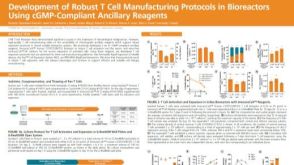 科学海报Development of Robust T Cell Manufacturing Protocols in Bioreactors Using cGMP-Compliant Ancillary Reagents


 沪公网安备31010102008431号