Mef2C is a lineage-restricted target of Scl/Tal1 and regulates megakaryopoiesis and B-cell homeostasis.
The basic helix-loop-helix transcription factor stem cell leukemia gene (Scl) is a master regulator for hematopoiesis essential for hematopoietic specification and proper differentiation of the erythroid and megakaryocyte lineages. However,the critical downstream targets of Scl remain undefined. Here,we identified a novel Scl target gene,transcription factor myocyte enhancer factor 2 C (Mef2C) from Scl(fl/fl) fetal liver progenitor cell lines. Analysis of Mef2C(-/-) embryos showed that Mef2C,in contrast to Scl,is not essential for specification into primitive or definitive hematopoietic lineages. However,adult VavCre(+)Mef2C(fl/fl) mice exhibited platelet defects similar to those observed in Scl-deficient mice. The platelet counts were reduced,whereas platelet size was increased and the platelet shape and granularity were altered. Furthermore,megakaryopoiesis was severely impaired in vitro. Chromatin immunoprecipitation microarray hybridization analysis revealed that Mef2C is directly regulated by Scl in megakaryocytic cells,but not in erythroid cells. In addition,an Scl-independent requirement for Mef2C in B-lymphoid homeostasis was observed in Mef2C-deficient mice,characterized as severe age-dependent reduction of specific B-cell progenitor populations reminiscent of premature aging. In summary,this work identifies Mef2C as an integral member of hematopoietic transcription factors with distinct upstream regulatory mechanisms and functional requirements in megakaryocyte and B-lymphoid lineages.
View Publication
产品号#:
03234
03434
03444
04960
04902
04900
04961
04901
04963
04962
04970
04971
产品名:
MethoCult™ M3234
MethoCult™ GF M3434
MethoCult™ GF M3434
MegaCult™-C胶原和无细胞因子培养基
胶原蛋白溶液
MegaCult™-C无细胞因子培养基
MegaCult™-C胶原和含细胞因子培养基
MegaCult™-C含细胞因子培养基
双室载玻片套件
MegaCult™-C CFU-Mk染色试剂盒
MegaCult™-C无细胞因子全套试剂盒
MegaCult™-C含细胞因子全套试剂盒
Giassi LJ et al. (AUG 2008)
Experimental biology and medicine (Maywood,N.J.) 233 8 997--1012
Expanded CD34+ human umbilical cord blood cells generate multiple lymphohematopoietic lineages in NOD-scid IL2rgamma(null) mice.
Umbilical cord blood (UCB) is increasingly being used for human hematopoietic stem cell (HSC) transplantation in children but often requires pooling multiple cords to obtain sufficient numbers for transplantation in adults. To overcome this limitation,we have used an ex vivo two-week culture system to expand the number of hematopoietic CD34(+) cells in cord blood. To assess the in vivo function of these expanded CD34(+) cells,cultured human UCB containing 1 x 10(6) CD34(+) cells were transplanted into conditioned NOD-scid IL2rgamma(null) mice. The expanded CD34(+) cells displayed short- and long-term repopulating cell activity. The cultured human cells differentiated into myeloid,B-lymphoid,and erythroid lineages,but not T lymphocytes. Administration of human recombinant TNFalpha to recipient mice immediately prior to transplantation promoted human thymocyte and T-cell development. These T cells proliferated vigorously in response to TCR cross-linking by anti-CD3 antibody. Engrafted TNFalpha-treated mice generated antibodies in response to T-dependent and T-independent immunization,which was enhanced when mice were co-treated with the B cell cytokine BLyS. Ex vivo expanded CD34(+) human UCB cells have the capacity to generate multiple hematopoietic lineages and a functional human immune system upon transplantation into TNFalpha-treated NOD-scid IL2rgamma(null) mice.
View Publication
产品号#:
09600
09650
09850
产品名:
StemSpan™ SFEM
StemSpan™ SFEM
Li H et al. (AUG 2010)
Blood 116 7 1060--9
Repression of Id2 expression by Gfi-1 is required for B-cell and myeloid development.
The development of mature blood cells from hematopoietic stem cells requires coordinated activities of transcriptional networks. Transcriptional repressor growth factor independence 1 (Gfi-1) is required for the development of B cells,T cells,neutrophils,and for the maintenance of hematopoietic stem cell function. However,the mechanisms by which Gfi-1 regulates hematopoiesis and how Gfi-1 integrates into transcriptional networks remain unclear. Here,we provide evidence that Id2 is a transcriptional target of Gfi-1,and repression of Id2 by Gfi-1 is required for B-cell and myeloid development. Gfi-1 binds to 3 conserved regions in the Id2 promoter and represses Id2 promoter activity in transient reporter assays. Increased Id2 expression was observed in multipotent progenitors,myeloid progenitors,T-cell progenitors,and B-cell progenitors in Gfi-1(-/-) mice. Knockdown of Id2 expression or heterozygosity at the Id2 locus partially rescues the B-cell and myeloid development but not the T-cell development in Gfi-1(-/-) mice. These studies demonstrate a role of Id2 in mediating Gfi-1 functions in B-cell and myeloid development and provide a direct link between Gfi-1 and the B-cell transcriptional network by its ability to repress Id2 expression.
View Publication
产品号#:
03234
产品名:
MethoCult™ M3234
Heavey B et al. (AUG 2003)
The EMBO journal 22 15 3887--97
Myeloid lineage switch of Pax5 mutant but not wild-type B cell progenitors by C/EBPalpha and GATA factors.
The developmental potential of hematopoietic progenitors is restricted early on to either the erythromyeloid or lymphoid lineages. The broad developmental potential of Pax5(-/-) pro-B cells is in apparent conflict with such a strict separation,although these progenitors realize the myeloid and erythroid potential with lower efficiency compared to the lymphoid cell fates. Here we demonstrate that ectopic expression of the transcription factors C/EBPalpha,GATA1,GATA2 and GATA3 strongly promoted in vitro macrophage differentiation and myeloid colony formation of Pax5(-/-) pro-B cells. GATA2 and GATA3 expression also resulted in efficient engraftment and myeloid development of Pax5(-/-) pro-B cells in vivo. The myeloid transdifferentiation of Pax5(-/-) pro-B cells was accompanied by the rapid activation of myeloid genes and concomitant repression of B-lymphoid genes by C/EBPalpha and GATA factors. These data identify the Pax5(-/-) pro-B cells as lymphoid progenitors with a latent myeloid potential that can be efficiently activated by myeloid transcription factors. The same regulators were unable to induce a myeloid lineage switch in Pax5(+/+) pro-B cells,indicating that Pax5 dominates over myeloid transcription factors in B-lymphocytes.
View Publication
产品号#:
03334
03434
03444
产品名:
MethoCult™ M3334
MethoCult™ GF M3434
MethoCult™ GF M3434
Peng C et al. (JAN 2010)
Blood 115 3 626--35
PTEN is a tumor suppressor in CML stem cells and BCR-ABL-induced leukemias in mice.
The tumor suppressor gene phosphatase and tensin homolog (PTEN) is inactivated in many human cancers. However,it is unknown whether PTEN functions as a tumor suppressor in human Philadelphia chromosome-positive leukemia that includes chronic myeloid leukemia (CML) and B-cell acute lymphoblastic leukemia (B-ALL) and is induced by the BCR-ABL oncogene. By using our mouse model of BCR-ABL-induced leukemias,we show that Pten is down-regulated by BCR-ABL in leukemia stem cells in CML and that PTEN deletion causes acceleration of CML development. In addition,overexpression of PTEN delays the development of CML and B-ALL and prolongs survival of leukemia mice. PTEN suppresses leukemia stem cells and induces cell-cycle arrest of leukemia cells. Moreover,PTEN suppresses B-ALL development through regulating its downstream gene Akt1. These results demonstrate a critical role of PTEN in BCR-ABL-induced leukemias and suggest a potential strategy for the treatment of Philadelphia chromosome-positive leukemia.
View Publication


 EasySep™小鼠TIL(CD45)正选试剂盒




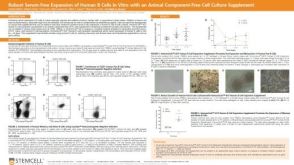 科学海报Robust Serum-Free Expansion of Human B Cells In Vitro with an Animal Component-Free Cell Culture Supplement





 沪公网安备31010102008431号