Kharas MG et al. (SEP 2008)
The Journal of clinical investigation 118 9 3038--50
Ablation of PI3K blocks BCR-ABL leukemogenesis in mice, and a dual PI3K/mTOR inhibitor prevents expansion of human BCR-ABL+ leukemia cells.
Some cases of pre-B cell acute lymphoblastic leukemia (pre-B-ALL) are caused by the Philadelphia (Ph) chromosome-encoded BCR-ABL oncogene,and these tend to have a poor prognosis. Inhibitors of the PI3K/AKT pathway reduce BCR-ABL-mediated transformation in vitro; however,the specific PI3K isoforms involved are poorly defined. Using a murine model of Ph+ pre-B-ALL,we found that deletion of both Pik3r1 and Pik3r2,genes encoding class IA PI3K regulatory isoforms,severely impaired transformation. BCR-ABL-dependent pre/pro-B cell lines could be established at low frequency from progenitors that lacked these genes,but the cells were smaller,proliferated more slowly,and failed to cause leukemia in vivo. These cell lines displayed nearly undetectable PI3K signaling function and were resistant to the PI3K inhibitor wortmannin. However,they maintained activation of mammalian target of rapamycin (mTOR) and were more sensitive to rapamycin. Treatment with rapamycin caused feedback activation of AKT in WT cell lines but not PI3K-deficient lines. A dual inhibitor of PI3K and mTOR,PI-103,was more effective than rapamycin at suppressing proliferation of mouse pre-B-ALL and human CD19+CD34+)Ph+ ALL leukemia cells treated with the ABL kinase inhibitor imatinib. Our findings provide mechanistic insights into PI3K dependency in oncogenic networks and provide a rationale for targeting class IA PI3K,alone or together with mTOR,in the treatment of Ph+ ALL.
View Publication
产品号#:
03630
产品名:
MethoCult™ M3630
Stern P et al. (SEP 2008)
Proceedings of the National Academy of Sciences of the United States of America 105 37 13895--900
A system for Cre-regulated RNA interference in vivo.
We report a system for Cre-regulated expression of RNA interference in vivo. Expression cassettes comprise selectable and FACS-sortable markers in tandem with additional marker genes and shRNAs in the antisense orientation. The cassettes are flanked by tandem LoxP sites arranged so that Cre expression inverts the marker-shRNA construct,allowing its regulated expression (and,at the same time,deletes the original selection/marker genes). The cassettes can be incorporated into retroviral or lentiviral vectors and delivered to cells in culture or used to generate transgenic mice. We describe cassettes incorporating various combinations of reporter genes,miRNA-based RNAi (including two shRNA constructs at once),and oncogenes and demonstrate the delivery of effective RNA interference in cells in culture,efficient transduction into hematopoietic stem cells with cell-type-specific knockdown in their progeny,and rapid generation of regulated shRNA knockdown in transgenic mice. These vector systems allow regulated combinatorial manipulation (both overexpression and loss of function) of gene expression in multiple systems in vitro and in vivo.
View Publication
产品号#:
09600
09650
产品名:
StemSpan™ SFEM
StemSpan™ SFEM
Singh KP et al. (JAN 2009)
Carcinogenesis 30 1 11--9
Treatment of mice with the Ah receptor agonist and human carcinogen dioxin results in altered numbers and function of hematopoietic stem cells.
The aryl hydrocarbon receptor (AhR) mediates the carcinogenicity of a family of environmental contaminants,the most potent being 2,3,7,8-tetrachlorodibenzo-p-dioxin (TCDD). Increased incidence of lymphoma and leukemia in humans is associated with TCDD exposure. Although AhR activation by TCDD has profound effects on the immune system,precise cellular and molecular mechanisms have yet to be determined. These studies tested the hypothesis that alteration of marrow populations following treatment of mice with TCDD is due to an effect on hematopoietic stem cells (HSCs). Treatment with TCDD resulted in an increased number and proliferation of bone marrow (BM) populations enriched for HSCs. There was a time-dependent decrease in B-lineage cells with a concomitant increase in myeloid populations. The decrease in the B-cell lineage colony-forming unit-preB progenitors along with a transient increase in myeloid progenitors were consistent with a skewing of lineage development from lymphoid to myeloid populations. However,HSCs from TCDD-treated mice exhibited diminished capacity to reconstitute and home to marrow of irradiated recipients. AhR messenger RNA was expressed in progenitor subsets but is downregulated during HSC proliferation. This result was consistent with the lack of response following the exposure of 5-fluorouracil-treated mice to TCDD. The direct exposure of cultured BM cells to TCDD inhibited the growth of immature hematopoietic progenitor cells,but not more mature lineage-restricted progenitors. Overall,these data are consistent with the hypothesis that TCDD,through AhR activation,alters the ability of HSCs to respond appropriately to signals within the marrow microenvironment.
View Publication
产品号#:
03231
产品名:
MethoCult™ M3231
Seo J-H et al. (SEP 2010)
Cancer research 70 18 7325--35
A specific need for CRKL in p210BCR-ABL-induced transformation of mouse hematopoietic progenitors.
CRKL (CRK-like) is an adapter protein predominantly phosphorylated in cells that express the tyrosine kinase p210(BCR-ABL),the fusion product of a (9;22) chromosomal translocation causative for chronic myeloid leukemia. It has been unclear,however,whether CRKL plays a functional role in p210(BCR-ABL) transformation. Here,we show that CRKL is required for p210(BCR-ABL) to support interleukin-3-independent growth of myeloid progenitor cells and long-term outgrowth of B-lymphoid cells from fetal liver-derived hematopoietic progenitor cells. Furthermore,a synthetic phosphotyrosyl peptide that binds to the CRKL SH2 domain with high affinity blocks association of endogenous CRKL with the p210(BCR-ABL) complex and reduces c-MYC levels in K562 human leukemic cells as well as in mouse hematopoietic cells transformed by p210(BCR-ABL) or the imatinib-resistant mutant T315I. These results indicate that the function of CRKL as an adapter protein is essential for p210(BCR-ABL)-induced transformation.
View Publication
产品号#:
03234
产品名:
MethoCult™ M3234
Agosti V et al. (MAR 2004)
The Journal of experimental medicine 199 6 867--78
Critical role for Kit-mediated Src kinase but not PI 3-kinase signaling in pro T and pro B cell development.
The Kit receptor functions in hematopoiesis,lymphocyte development,gastrointestinal tract motility,melanogenesis,and gametogenesis. To investigate the roles of different Kit signaling pathways in vivo,we have generated knock-in mice in which docking sites for PI 3-kinase (KitY719) or Src kinase (KitY567) have been mutated. Whereas steady-state hematopoiesis is normal in KitY719F/Y719F and KitY567F/Y567F mice,lymphopoiesis is affected differentially. The KitY567F mutation,but not the KitY719F mutation,blocks pro T cell and pro B cell development in an age-dependent manner. Thus,the Src family kinase,but not the PI 3-kinase docking site in Kit,mediates a critical signal for lymphocyte development. In agreement with these results,treatment of normal mice with the Kit tyrosine kinase inhibitor imatinib (Gleevec) leads to deficits in pro T and pro B cell development,similar to those seen in KitY567F/Y567F and KitW/W mice. The two mutations do not affect embryonic gametogenesis but the KitY719F mutation blocks spermatogenesis at the spermatogonial stages and in contrast the KitY567F mutation does not affect this process. Therefore,Kit-mediated PI 3-kinase signaling and Src kinase family signaling is highly specific for different cellular contexts in vivo.
View Publication
产品号#:
09600
09650
产品名:
StemSpan™ SFEM
StemSpan™ SFEM
Secchiero P et al. (MAY 2006)
Blood 107 10 4122--9
Functional integrity of the p53-mediated apoptotic pathway induced by the nongenotoxic agent nutlin-3 in B-cell chronic lymphocytic leukemia (B-CLL).
Deletions and/or mutations of p53 are relatively rare and late events in the natural history of B-cell chronic lymphocytic leukemia (B-CLL). However,it is unknown whether p53 signaling is functional in B-CLL and if targeted nongenotoxic activation of the p53 pathway by using nutlin-3,a small molecule inhibitor of the p53/MDM2 interaction,is sufficient to kill B-CLL cells. In vitro treatment with nutlin-3 induced a significant cytotoxicity on primary CD19(+) B-CLL cells,but not on normal CD19(+) B lymphocytes,peripheral-blood mononuclear cells,or bone marrow hematopoietic progenitors. Among 29 B-CLL samples examined,only one was resistant to nutlin-3-mediated cytotoxicity. The induction of p53 by nutlin-3 in B-CLL samples was accompanied by alterations of the mitochondrial potential and activation of the caspase-dependent apoptotic pathway. Among several genes related to the p53 pathway,nutlin-3 up-regulated the steady-state mRNA levels of PCNA,CDKN1A/p21,GDF15,TNFRSF10B/TRAIL-R2,TP53I3/PIG3,and GADD45. This profile of gene activation showed a partial overlapping with that induced by the genotoxic drug fludarabine. Moreover,nutlin-3 synergized with both fludarabine and chlorambucil in inducing B-CLL apoptosis. Our data strongly suggest that nutlin-3 should be further investigated for clinical applications in the treatment of B-CLL.
View Publication
产品号#:
04434
04444
产品名:
MethoCult™ H4434 Classic
MethoCult™ H4434 Classic
Ciurea SO et al. (AUG 2007)
Blood 110 3 986--93
Pivotal contributions of megakaryocytes to the biology of idiopathic myelofibrosis.
In order to investigate the biologic processes underlying and resulting from the megakaryocytic hyperplasia that characterizes idiopathic myelofibrosis (IMF),peripheral blood CD34+ cells isolated from patients with IMF,polycythemia vera (PV),and G-CSF-mobilized healthy volunteers were cultured in the presence of stem cell factor and thrombopoietin. IMF CD34+ cells generated 24-fold greater numbers of megakaryocytes (MKs) than normal CD34+ cells. IMF MKs were also shown to have a delayed pattern of apoptosis and to overexpress the antiapoptotic protein bcl-xL. MK hyperplasia in IMF is,therefore,likely a consequence of both the increased ability of IMF progenitor cells to generate MKs and a decreased rate of MK apoptosis. Media conditioned (CM) by CD61+ cells generated in vitro from CD34+ cells were then assayed for the levels of growth factors and proteases. Higher levels of transforming growth factor-beta (TGF-beta) and active matrix metalloproteinase-9 (MMP9) were observed in media conditioned with IMF CD61+ cells than normal or PV CD61+ cells. Both normal and IMF CD61+ cells produced similar levels of VEGF. MK-derived TGF-B and MMP-9,therefore,likely contribute to the development of many pathological epiphenomena associated with IMF.
View Publication


 EasySep™小鼠TIL(CD45)正选试剂盒




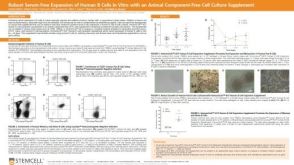 科学海报Robust Serum-Free Expansion of Human B Cells In Vitro with an Animal Component-Free Cell Culture Supplement




 沪公网安备31010102008431号