Bone Marrow Niches and HSC Fates
A detailed reference on signaling pathways in the bone marrow and how these influence HSC fate decisions; created in partnership with Nature Reviews Immunology and Nature Reviews Molecular Cell Biology
Perez SA et al. (MAY 2003)
Blood 101 9 3444--50
A novel myeloid-like NK cell progenitor in human umbilical cord blood.
Natural killer (NK) cell differentiation from pluripotent CD34(+) human hematopoietic stem cells or oligopotent lymphoid progenitors has already been reported. In the present study,long-term cultures of the CD56(-)/CD34(-) myeloid-like adherent cell fraction (ACF) from umbilical cord blood (UCB),characterized by the expression of CD14(+) as well as other myeloid markers,were set up with flt3 ligand (FL) and interleukin-15 (IL-15). The UCB/ACF gradually expressed the CD56 marker,which reached fairly high levels (approximately 90% of the cells were CD56(+)) by day 15. FL plus IL-15-driven ACF/CD56(+) cells progressively expressed a mature NK functional program lysing both NK- and lymphokine-activate killer (LAK)-sensitive tumor targets and producing high levels of interferon-gamma (IFN-gamma),granulocyte-macrophage colony-stimulating factor,tumor necrosis factor alpha,and IL-10 upon stimulation with IL-12 and IL-18. Similar results were obtained when highly purified CD14(+) cells from UCB were cultured with FL and IL-15. In contrast,UCB/CD34(+) cells cultured under the same conditions showed a delayed expression of CD56 and behaved functionally differently in that they exhibited NK but not LAK cytotoxicity and produced significantly fewer cytokines. Kinetic studies on the phenotype of UCB/ACF or UCB/CD14(+) cells cultured in the presence of FL and IL-15 showed a rapid decrease in CD14 expression after day 5,which reached levels of zero by day 20. Approximately 60% of the CD56(+) derived from the UCB/ACF or the UCB/CD14(+) cells coexpressed CD14 by day 5. Taken together,our data support the role of CD14(+) myeloid-like cells within UCB as a novel progenitor for lymphoid NK cells.
View Publication
产品号#:
05150
产品名:
MyeloCult™ H5100
Wood N et al. (MAR 2003)
The Journal of experimental medicine 197 6 703--9
Interleukin (IL)-13 has recently been shown to play important and unique roles in asthma,parasite immunity,and tumor recurrence. At least two distinct receptor components,IL-4 receptor (R)alpha and IL-13Ralpha1,mediate the diverse actions of IL-13. We have recently described an additional high affinity receptor for IL-13,IL-13Ralpha2,whose function in IL-13 signaling is unknown. To better appreciate the functional importance of IL-13Ralpha2,mice deficient in IL-13Ralpha2 were generated by gene targeting. Serum immunoglobulin E levels were increased in IL-13Ralpha2-/- mice despite the fact that serum IL-13 was absent and immune interferon gamma production increased compared with wild-type mice. IL-13Ralpha2-deficient mice display increased bone marrow macrophage progenitor frequency and decreased tissue macrophage nitric oxide and IL-12 production in response to lipopolysaccharide. These results are consistent with a phenotype of enhanced IL-13 responsiveness and demonstrate a role for endogenous IL-13 and IL-13Ralpha2 in regulating immune responses in wild-type mice.
View Publication
产品号#:
03434
03444
产品名:
MethoCult™ GF M3434
MethoCult™ GF M3434
Sommer G et al. (MAY 2003)
Proceedings of the National Academy of Sciences of the United States of America 100 11 6706--11
Gastrointestinal stromal tumors in a mouse model by targeted mutation of the Kit receptor tyrosine kinase.
Oncogenic Kit mutations are found in somatic gastrointestinal (GI) stromal tumors (GISTs) and mastocytosis. A mouse model for the study of constitutive activation of Kit in oncogenesis has been produced by a knock-in strategy introducing a Kit exon 11-activating mutation into the mouse genome based on a mutation found in a case of human familial GIST syndrome. Heterozygous mutant KitV558Delta/+ mice develop symptoms of disease and eventually die from pathology in the GI tract. Patchy hyperplasia of Kit-positive cells is evident within the myenteric plexus of the entire GI tract. Neoplastic lesions indistinguishable from human GISTs were observed in the cecum of the mutant mice with high penetrance. In addition,mast cell numbers in the dorsal skin were increased. Therefore KitV558Delta/+ mice reproduce human familial GISTs,and they may be used as a model for the study of the role and mechanisms of Kit in neoplasia. Importantly,these results demonstrate that constitutive Kit signaling is critical and sufficient for induction of GIST and hyperplasia of interstitial cells of Cajal.
View Publication
产品号#:
09600
09650
产品名:
StemSpan™ SFEM
StemSpan™ SFEM
Volpe DA and Warren MK (JUN 2003)
Toxicology in vitro : an international journal published in association with BIBRA 17 3 271--7
Myeloid clonogenic assays for comparison of the in vitro toxicity of alkylating agents.
A battery of clonal assays for myeloid progenitor cells (HPP-CFC,CFU-gemm,CFU-gm,CFU-g) was utilized to evaluate the myelotoxicity of a series of alkylating agents representing the spectrum of clinical times to nadir. Bone marrow aspirates from normal volunteers were incubated with mechlorethamine,busulfan,melphalan,carmustine or lomustine for 1 h and then cultured in methylcellulose with 30% serum and cytokines. There was a concentration-dependent inhibition of colony formation and often a differential toxicity to the myeloid progenitors with the alkylators tested. On a molar basis,mechlorethamine and melphalan were the most toxic of the alkylator drugs to the myeloid precursors. The most sensitive progenitor was CFU-gemm with the lowest inhibitory concentration IC(70) concentrations for mechlorethamine,melphalan,carmustine and lomustine. Generally,there was great similarity for drug effects between CFU-g and CFU-gm with overlapping inhibition curves. HPP-CFC proved to be the least sensitive of the progenitors to the toxic actions of the drugs. While there was no correlation between the time to clinical neutropenic nadir and the most sensitive progenitor in the clonal assays,the CFU-gm assay remains a suitable method for determining the myelotoxic potential of cytotoxic agents.
View Publication
产品号#:
04535
04545
产品名:
MethoCult™ H4535 Enriched,不含EPO
MethoCult™ H4535 Enriched,不含EPO
Fallon P et al. (JUL 2003)
British journal of haematology 122 1 99--108
Mobilized peripheral blood SSCloALDHbr cells have the phenotypic and functional properties of primitive haematopoietic cells and their number correlates with engraftment following autologous transplantation.
We have developed an approach for identifying primitive mobilized peripheral blood cells (PBSC) that express high levels of aldehyde dehydrogenase (ALDH). PBSC were stained with a fluorescent ALDH substrate,termed BODIPY trade mark -aminoacetaldehyde (BAAA),and then analysed using flow cytometry. A population of cells with a low side scatter (SSC) and a high level of BAAA staining,termed the SSCloALDHbr population,was readily discriminated and comprised a mean of 3 +/- 5% of leukapheresis samples. A mean of 73 +/- 11% of the SSCloALDHbr population expressed CD34 and 56 +/- 25% of all the mobilized CD34+ cells resided within the SSCloALDHbr population. The SSCloALDHbr population was largely depleted of cells with mature phenotypes and enriched for cells with immature phenotypes. Sorted SSCloALDHbr and SSCloALDHbr CD34+ PBSC were enriched for progenitors with the ability to (1) generate colony-forming units (CFU) and long-term culture (LTC)-derived CFU,(2) expand in primary and secondary LTC,and (3) generate multiple cell lineages. In 21 cancer patients who had undergone autologous PBSC transplantation,the number of infused SSCloALDHbr cells/kg highly correlated with the time to neutrophil and platelet engraftment (P textless 0.015 and P textless 0.003 respectively). In summary,peripheral blood SSCloALDHbr cells have the phenotypic and functional properties of primitive haematopoietic cells and their number correlates with engraftment following autologous transplantation.
View Publication
产品号#:
01700
01705
01701
01702
产品名:
ALDEFLUOR™ 试剂盒
ALDEFLUOR™ DEAB试剂, 1.5 mM, 1 mL
ALDEFLUOR™检测缓冲液
Wong JCY et al. (AUG 2003)
Human molecular genetics 12 16 2063--76
Targeted disruption of exons 1 to 6 of the Fanconi Anemia group A gene leads to growth retardation, strain-specific microphthalmia, meiotic defects and primordial germ cell hypoplasia.
Fanconi Anemia (FA) is an autosomal recessive disorder characterized by cellular hypersensitivity to DNA cross-linking agents. Recent studies suggest that FA proteins share a common pathway with BRCA proteins. To study the in vivo role of the FA group A gene (Fanca),gene-targeting techniques were used to generate Fanca(tm1Hsc) mice in which Fanca exons 1-6 were replaced by a beta-galactosidase reporter construct. Fanca(tm1.1Hsc) mice were generated by Cre-mediated removal of the neomycin cassette in Fanca(tm1Hsc) mice. Fanca(tm1.1Hsc) homozygotes display FA-like phenotypes including growth retardation,microphthalmia and craniofacial malformations that are not found in other Fanca mouse models,and the genetic background affects manifestation of certain phenotypes. Both male and female mice homozygous for Fanca mutation exhibit hypogonadism,and homozygous females demonstrate premature reproductive senescence and an increased incidence of ovarian cysts. We showed that fertility defects in Fanca(tm1.1Hsc) homozygotes might be related to a diminished population of primordial germ cells (PGCs) during migration into the gonadal ridges. We also found a high level of Fanca expression in pachytene spermatocytes. Fanca(tm1Hsc) homozygous males exhibited an elevated frequency of mispaired meiotic chromosomes and increased apoptosis in germ cells,implicating a role for Fanca in meiotic recombination. However,the localization of Rad51,Brca1,Fancd2 and Mlh1 appeared normal on Fanca(tm1Hsc) homozygous meiotic chromosomes. Taken together,our results suggest that the FA pathway plays a role in the maintenance of reproductive germ cells and in meiotic recombination.
View Publication
产品号#:
03434
03444
产品名:
MethoCult™ GF M3434
MethoCult™ GF M3434
Mortellaro A et al. (NOV 2006)
Blood 108 9 2979--88
Ex vivo gene therapy with lentiviral vectors rescues adenosine deaminase (ADA)-deficient mice and corrects their immune and metabolic defects.
Adenosine deaminase (ADA) deficiency is caused by a purine metabolic dysfunction,leading to severe combined immunodeficiency (SCID) and multiple organ damage. To investigate the efficacy of ex vivo gene therapy with self-inactivating lentiviral vectors (LVs) in correcting this complex phenotype,we used an ADA(-/-) mouse model characterized by early postnatal lethality. LV-mediated ADA gene transfer into bone marrow cells combined with low-dose irradiation rescued mice from lethality and restored their growth,as did transplantation of wild-type bone marrow. Mixed chimerism with multilineage engraftment of transduced cells was detected in the long term in animals that underwent transplantation. ADA activity was normalized in lymphocytes and partially corrected in red blood cells (RBCs),resulting in full metabolic detoxification and prevention of severe pulmonary insufficiency. Moreover,gene therapy restored normal lymphoid differentiation and immune functions,including antigen-specific antibody production. Similar degrees of detoxification and immune reconstitution were obtained in mice treated early after birth or after 1 month of enzyme-replacement therapy,mimicking 2 potential applications for ADA-SCID. Overall,this study demonstrates the efficacy of LV gene transfer in correcting both the immunological and metabolic phenotypes of ADA-SCID and supports the future clinical use of this approach.
View Publication
产品号#:
09600
09650
产品名:
StemSpan™ SFEM
StemSpan™ SFEM
Jiang J et al. (AUG 2006)
Blood 108 3 1077--83
cMYB is involved in the regulation of fetal hemoglobin production in adults.
A quantitative trait locus (QTL) controlling HbF levels has previously been mapped to chromosome 6q23 in an Asian-Indian kindred with beta thalassemia and heterocellular hereditary persistence of fetal hemoglobin (HPFH). Five protein-coding genes,ALDH8A1,HBS1L,cMYB,AHI1,and PDE7B reside in this 1.5-megabase (Mb) candidate interval of 6q23. To direct sequencing efforts we compared the expression profiles of these 5 genes between 12 individuals with elevated and 14 individuals with normal HbF levels during adult erythropoiesis by real-time quantitative reverse transcription-polymerase chain reaction (RT-PCR). Two genes,cMYB and HBS1L,demonstrated simultaneous transcriptional down-regulation in individuals with elevated HbF levels. Transfection of K562 cells encoding human cDNA of cMYB and HBS1L genes showed that,although overexpression of ectopic cMYB inhibited gamma-globin gene expression,overexpression of HBS1L had no effect. Low levels of cMYB were associated with low cell expansions,accelerated erythroid maturation,and higher number of macrophages in erythroid cell culture. These observations suggest that differences in the intrinsic levels of cMYB may account for some of the variation in adult HbF levels. The possible mechanism of cMYB influencing gamma- to beta-globin switching is discussed.
View Publication
产品号#:
09600
09650
产品名:
StemSpan™ SFEM
StemSpan™ SFEM
T. E. Ludwig et al. (aug 2006)
Nature methods 3 8 637--46
Feeder-independent culture of human embryonic stem cells.
Feeder-independent culture of human embryonic stem cells.
View Publication
Priestley GV et al. (JAN 2007)
Blood 109 1 109--11
Sustained alterations in biodistribution of stem/progenitor cells in Tie2Cre+ alpha4(f/f) mice are hematopoietic cell autonomous.
We have generated Tie2Cre+alpha4(f/f) mice with documented alpha4-integrin ablation in hematopoietic and endothelial cells. A prominent feature in this model is a sustained,significant increase in circulating progenitors at levels higher than the levels seen with Tie2Cre+VCAM-1(f/f) mice. To test whether phenotypic differences are due to contributions by ligands other than VCAM-1 in bone marrow,or to alpha4-deficient endothelial cells or pericytes,we carried out transplantation experiments using these mice as donors or as recipients. Changes in progenitor biodistribution after transplantation were seen only with alpha4-deficient donor cells,suggesting that these cells were necessary and sufficient to reproduce the phenotype with no discernible contribution by alpha4-deficient nonhematopoietic cells. Because several similarities are seen after transplantation between our results and those with CXCR4-/- donor cells,the data suggest that VLA4/VCAM-1 and CXCR4/CXCL12 pathways contribute to a nonredundant,ongoing signaling required for bone marrow retention of progenitor cells during homeostasis.
View Publication


 EasySep™小鼠TIL(CD45)正选试剂盒




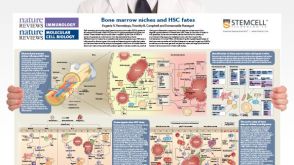 挂图Bone Marrow Niches and HSC Fates A detailed reference on signaling pathways in the bone marrow and how these influence HSC fate decisions; created in partnership with Nature Reviews Immunology and Nature Reviews Molecular Cell Biology

 沪公网安备31010102008431号