若您需要咨询产品或有任何技术问题,请通过官方电话 400 885 9050 或邮箱 info.cn@stemcell.com 与我们联系。

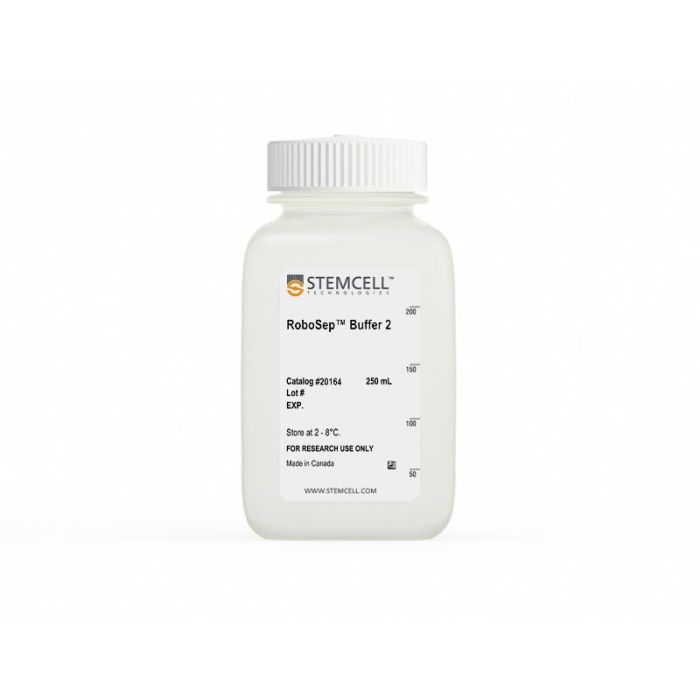
RoboSep™ 缓冲液 2

细胞分选缓冲液
只有 %1
¥934.00

产品号 #(选择产品)

产品号 #20164_C

细胞分选缓冲液

总览

RoboSep™Buffer 2推荐用于特定的EasySep™细胞分选流程。请注意,每套RoboSep™试剂盒中包含一到两瓶缓冲液。

包含
• RoboSep™ 缓冲液 2
• 杜氏PBS
• 牛血清白蛋白(0.5%)
• 含EDTA(2 mM)的PBS溶液
 
种属
人,小鼠,非人灵长类,其他物种,大鼠
 
品牌
RoboSep
 
研究领域
免疫
 

产品说明书及文档

请在《产品说明书》中查找相关支持信息和使用说明,或浏览下方更多实验方案。

Document Type
Product Name
Catalog #
Lot #
Language
Catalog #
20164
Lot #
All
Language
English
Document Type
Safety Data Sheet
Catalog #
20164
Lot #
All
Language
English

应用领域

本产品专为以下研究领域设计,适用于工作流程中的高亮阶段。探索这些工作流程,了解更多我们为各研究领域提供的其他配套产品。

相关材料与文献

技术资料 (4)

文献 (3)

Craniofacial chondrogenesis in organoids from human stem cell-derived neural crest cells iScience 2024 Mar

Abstract

SummaryKnowledge of cell signaling pathways that drive human neural crest differentiation into craniofacial chondrocytes is incomplete,yet essential for using stem cells to regenerate craniomaxillofacial structures. To accelerate translational progress,we developed a differentiation protocol that generated self-organizing craniofacial cartilage organoids from human embryonic stem cell-derived neural crest stem cells. Histological staining of cartilage organoids revealed tissue architecture and staining typical of elastic cartilage. Protein and post-translational modification (PTM) mass spectrometry and snRNA-seq data showed that chondrocyte organoids expressed robust levels of cartilage extracellular matrix (ECM) components: many collagens,aggrecan,perlecan,proteoglycans,and elastic fibers. We identified two populations of chondroprogenitor cells,mesenchyme cells and nascent chondrocytes,and the growth factors involved in paracrine signaling between them. We show that ECM components secreted by chondrocytes not only create a structurally resilient matrix that defines cartilage,but also play a pivotal autocrine cell signaling role in determining chondrocyte fate. Graphical abstract Highlights•Craniofacial cartilage organoids were grown from human neural crest stem cells•These organoids exhibited elastic cartilage architecture and characteristic markers•Paracrine signaling drove chondrogenesis in mesenchyme cells and nascent chondrocytes•ECM components cemented chondrocyte cell fate through autocrine signaling Natural sciences; Biological sciences; Biochemistry; Cell biology; Stem cells research; Specialized functions of cells
Protocol for generating human craniofacial cartilage organoids from stem-cell-derived neural crest cells STAR Protocols 2024 Dec

Abstract

SummaryHere,we present a protocol to generate craniofacial cartilage organoids from human stem cells via neural crest stem cells (NCSCs). We describe steps for inducing human embryonic stem cells (hESCs) or induced pluripotent stem cells (iPSCs) to form NCSCs using sequential treatments of small molecules and growth factors and isolating NCSCs by magnetic bead sorting. We then detail procedures for defining conditions where NCSCs migrate together and self-organize into craniofacial cartilage organoids. Recapitulating craniofacial chondrogenesis will facilitate craniofacial reconstruction and disease modeling.For complete details on the use and execution of this protocol,please refer to Foltz et al.1 Graphical abstract Highlights•Protocol for inducing hESCs or iPSCs to form neural crest stem cells (NCSCs)•Steps for differentiating NCSCs into craniofacial cartilage organoids•Instructions for preparing appropriate media and conditions for differentiation•Guidance for assessing changes in cell and organoid morphology during differentiation Publisher’s note: Undertaking any experimental protocol requires adherence to local institutional guidelines for laboratory safety and ethics. Here,we present a protocol to generate craniofacial cartilage organoids from human stem cells via neural crest stem cells (NCSCs). We describe steps for inducing human embryonic stem cells (hESCs) or induced pluripotent stem cells (iPSCs) to form NCSCs using sequential treatments of small molecules and growth factors and isolating NCSCs by magnetic bead sorting. We then detail procedures for defining conditions where NCSCs migrate together and self-organize into craniofacial cartilage organoids. Recapitulating craniofacial chondrogenesis will facilitate craniofacial reconstruction and disease modeling.
Consequences of the Novel ALS-Associated KIF5A Variant c.2993-6C > A for Exon 27 Splicing and Axonal Transport of SFPQ G. A. Rouleau et al. Neurology: Genetics 2026 Mar

Abstract

Background and Objectives: Recent studies have identified variants in the kinesin family member 5A (KIF5A) gene that predispose to amyotrophic lateral sclerosis (ALS). These ALS-linked KIF5A variants lead to the exclusion of exon 27,resulting in the production of a mutated protein with an altered C-terminal region (KIF5A ΔExon27). Through whole genome sequencing,we identified a novel KIF5A intronic variant,rs1057522322 (c.2993-6C > A; chr12:57582596C > A,GRCh38.p14),in a family segregating ALS. Our goal is to investigate the effect of this variant on exon 27 splicing and to assess its functional consequences on KIF5A-mediated cargo transport. Methods: Induced pluripotent stem cells (iPSCs) were generated from siblings with and without the c.2993-6C > A variant. RT-PCR was performed on RNA extracted from iPSC-derived neurons to assess exon 27 splicing. Functional studies were conducted on iPSC-derived motor neurons (MNs). Results: RT-PCR confirmed that the c.2993-6C > A variant induced exon 27 skipping in KIF5A. Immunofluorescent staining showed that KIF5A ΔExon27 abolished the axonal interaction with splicing factor proline- and glutamine-rich,a cargo specifically transported by KIF5A. Under stress conditions,MNs carrying the c.2993-6C > A variant exhibited TDP-43 proteinopathy. Discussion: KIF5A intronic variant c.2993-6C > A could be a risk factor for ALS. KIF5A ΔExon27 impairs KIF5A-mediated cargo transport and contributes to ALS pathogenesis in a TDP-43–dependent manner.

更多信息

更多信息
物种 人, 其它物种, 大鼠, 小鼠, 非人灵长类
Contains RoboSep™ Buffer 2 • Dulbecco's PBS • Bovine serum albumin (0.5%) • EDTA (2 mM) in PBS
质量保证:

产品仅供研究使用,不用于针对人或动物的诊断或治疗。 欲获悉更多关于STEMCELL的质控信息,请访问 STEMCELL.CN/COMPLIANCE.
Copyright © 2026 by STEMCELL Technologies. All rights reserved.

在线联系