H. N. Sanchez et al. ( 2020)
Nature communications 11 1 60
B cell-intrinsic epigenetic modulation of antibody responses by dietary fiber-derived short-chain fatty acids.
Short-chain fatty acids (SCFAs) butyrate and propionate are metabolites from dietary fiber's fermentation by gut microbiota that can affect differentiation or functions of T cells,macrophages and dendritic cells. We show here that at low doses these SCFAs directly impact B cell intrinsic functions to moderately enhance class-switch DNA recombination (CSR),while decreasing at higher doses over a broad physiological range,AID and Blimp1 expression,CSR,somatic hypermutation and plasma cell differentiation. In human and mouse B cells,butyrate and propionate decrease B cell Aicda and Prdm1 by upregulating select miRNAs that target Aicda and Prdm1 mRNA-3'UTRs through inhibition of histone deacetylation (HDAC) of those miRNA host genes. By acting as HDAC inhibitors,not as energy substrates or through GPR-engagement signaling in these B cell-intrinsic processes,these SCFAs impair intestinal and systemic T-dependent and T-independent antibody responses. Their epigenetic impact on B cells extends to inhibition of autoantibody production and autoimmunity in mouse lupus models.
View Publication
产品类型:
产品号#:
19254
19254RF
19854
19854RF
产品名:
EasySep™人Naïve B细胞富集试剂盒
RoboSep™ 人Naïve B细胞富集试剂盒含滤芯吸头
EasySep™小鼠B细胞分选试剂盒
RoboSep™ 小鼠B细胞分选试剂盒
Z. Yin et al. (feb 2020)
Clinical cancer research : an official journal of the American Association for Cancer Research
Discovery of Berberine that Targetedly Induces Autophagic Degradation of both BCR-ABL and BCR-ABL T315I through Recruiting LRSAM1 for Overcoming Imatinib Resistance.
PURPOSE Imatinib,the breakpoint cluster region protein (BCR)/Abelson murine leukemia viral oncogene homolog (ABL) inhibitor,is widely used to treat chronic myeloid leukemia (CML). However,imatinib resistance develops in many patients. Therefore,new drugs with improved therapeutic effects are urgently needed. Berberine (BBR) is a potent BCR-ABL inhibitor for imatinib-sensitive and -resistant CML. EXPERIMENTAL DESIGN Protein structure analysis and virtual screening were used to identify BBR targets in CML. Molecular docking analysis,surface plasmon resonance imaging,nuclear magnetic resonance assays,and thermoshift assays were performed to confirm the BBR target. The change in BCR-ABL protein expression after BBR treatment was assessed by Western blotting. The effects of BBR were assessed in vitro in cell lines,in vivo in mice,and in human CML bone marrow cells as a potential strategy to overcome imatinib resistance. RESULTS We discovered that BBR bound to the protein tyrosine kinase domain of BCR-ABL. BBR inhibited the activity of BCR-ABL and BCR-ABL with the T315I mutation,and it also degraded these proteins via the autophagic lysosome pathway by recruiting E3 ubiquitin-protein ligase LRSAM1. BBR inhibited the cell viability and colony formation of CML cells and prolonged survival in CML mouse models with imatinib sensitivity and resistance. CONCLUSIONS The results show that BBR directly binds to and degrades BCR-ABL and BCR-ABL T315I via the autophagic lysosome pathway by recruiting LRSAM1. The use of BBR is a new strategy to improve the treatment of patients with CML with imatinib sensitivity or resistance.
View Publication
产品类型:
产品号#:
17896
17896RF
产品名:
EasySep™人脐带血CD34正选试剂盒II
RoboSep™ 人脐带血CD34正选试剂盒II
C. J. Hanley et al. (nov 2020)
Molecular cancer research : MCR 18 11 1615--1622
Tumor-Resident Stromal Cells Promote Breast Cancer Invasion through Regulation of the Basal Phenotype.
Collective invasion can be led by breast cancer cells expressing basal epithelial markers,typified by keratin-14 (KRT14). We analyzed gene expression data from The Cancer Genome Atlas and demonstrated a significant correlation between a KRT14+ invasion signature and a stromal-mediated extracellular matrix (ECM) organization module. We then developed a novel coculture model of tumor organoids with autologous stromal cells. Coculture significantly increased KRT14 expression and invasion of organoids from both luminal and basal murine breast cancer models. However,stromal cell conditioned medium induced invasion but not KRT14 expression. Cancer cells released TGF$\beta$ and that signaling pathway was required for stromal cell-induced invasion and KRT14 expression. Mechanistically,TGF$\beta$ induced NOX4 expression in stromal cells and NOX4 inhibition reduced invasion and KRT14 expression. In summary,we developed a novel coculture model and revealed dynamic molecular interactions between stromal cells and cancer cells that regulate both basal gene expression and invasive behavior. IMPLICATIONS: Fibroblasts within mammary tumors can regulate the molecular phenotype and invasive behavior of breast cancer cells. VISUAL OVERVIEW: http://mcr.aacrjournals.org/content/molcanres/18/11/1615/F1.large.jpg.
View Publication
产品类型:
产品号#:
19860
19860RF
产品名:
EasySep™小鼠Streptavidin RapidSpheres™分选试剂盒
RoboSep™ 小鼠Streptavidin RapidSpheres™分选试剂盒
J. Iske et al. ( 2020)
Nature communications 11 1 4289
Senolytics prevent mt-DNA-induced inflammation and promote the survival of aged organs following transplantation.
Older organs represent an untapped potential to close the gap between demand and supply in organ transplantation but are associated with age-specific responses to injury and increased immunogenicity,thereby aggravating transplant outcomes. Here we show that cell-free mitochondrial DNA (cf-mt-DNA) released by senescent cells accumulates with aging and augments immunogenicity. Ischemia reperfusion injury induces a systemic increase of cf-mt-DNA that promotes dendritic cell-mediated,age-specific inflammatory responses. Comparable events are observed clinically,with the levels of cf-mt-DNA elevated in older deceased organ donors,and with the isolated cf-mt-DNA capable of activating human dendritic cells. In experimental models,treatment of old donor animals with senolytics clear senescent cells and diminish cf-mt-DNA release,thereby dampening age-specific immune responses and prolonging the survival of old cardiac allografts comparable to young donor organs. Collectively,we identify accumulating cf-mt-DNA as a key factor in inflamm-aging and present senolytics as a potential approach to improve transplant outcomes and availability.
View Publication
PD-L1 on dendritic cells attenuates T cell activation and regulates response to immune checkpoint blockade.
Immune checkpoint blockade therapies have shown clinical promise in a variety of cancers,but how tumor-infiltrating T cells are activated remains unclear. In this study,we explore the functions of PD-L1 on dendritic cells (DCs),which highly express PD-L1. We observe that PD-L1 on DC plays a critical role in limiting T cell responses. Type 1 conventional DCs are essential for PD-L1 blockade and they upregulate PD-L1 upon antigen uptake. Upregulation of PD-L1 on DC is mediated by type II interferon. While DCs are the major antigen presenting cells for cross-presenting tumor antigens to T cells,subsequent PD-L1 upregulation protects them from killing by cytotoxic T lymphocytes,yet dampens the antitumor responses. Blocking PD-L1 in established tumors promotes re-activation of tumor-infiltrating T cells for tumor control. Our study identifies a critical and dynamic role of PD-L1 on DC,which needs to be harnessed for better invigoration of antitumor immune responses.
View Publication
产品类型:
产品号#:
18780
19853
19853RF
18781
18781RF
18780RF
产品名:
EasySep™小鼠CD11c正选试剂盒II
EasySep™小鼠CD8+ T细胞分选试剂盒
RoboSep™ 小鼠CD8+ T细胞分选试剂盒
EasySep™小鼠CD11c正选试剂盒II及脾脏解离液
RoboSep™ 小鼠CD11c正选试剂盒II及脾脏解离液
RoboSep™ 小鼠CD11c正选试剂盒II
E. Vokali et al. (jan 2020)
Nature communications 11 1 538
Lymphatic endothelial cells prime na\ive CD8+ T cells into memory cells under steady-state conditions."
Lymphatic endothelial cells (LECs) chemoattract na{\{i}}ve T cells and promote their survival in the lymph nodes and can cross-present antigens to na{\"{i}}ve CD8+ T cells to drive their proliferation despite lacking key costimulatory molecules. However the functional consequence of LEC priming of CD8+ T cells is unknown. Here we show that while many proliferating LEC-educated T cells enter early apoptosis the remainders comprise a long-lived memory subset with transcriptional metabolic and phenotypic features of central memory and stem cell-like memory T cells. In vivo these memory cells preferentially home to lymph nodes and display rapid proliferation and effector differentiation following memory recall and can protect mice against a subsequent bacterial infection. These findings introduce a new immunomodulatory role for LECs in directly generating a memory-like subset of quiescent yet antigen-experienced CD8+ T cells that are long-lived and can rapidly differentiate into effector cells upon inflammatory antigenic challenge."""
View Publication


 EasySep™小鼠TIL(CD45)正选试剂盒






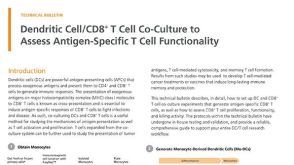 技术公告Dendritic Cell/CD8+ T Cell Co-Culture to Assess Antigen-Specific T Cell Functionality

 沪公网安备31010102008431号