McCully ML et al. ( 2015)
The Journal of Immunology 195 1 96--104
Skin Metabolites Define a New Paradigm in the Localization of Skin Tropic Memory T Cells
The localization of memory T cells to human skin is essential for long-term immune surveillance and the maintenance of barrier integrity. The expression of CCR8 during naive T cell activation is controlled by skin-specific factors derived from epidermal keratinocytes and not by resident dendritic cells. In this study,we show that the CCR8-inducing factors are heat stable and protease resistant and include the vitamin D3 metabolite 1α,25-dihydroxyvitamin D3 and PGE2. The effect of either metabolite alone on CCR8 expression was weak,whereas their combination resulted in robust CCR8 expression. Elevation of intracellular cAMP was essential because PGE2 could be substituted with the adenylyl cyclase agonist forskolin,and CCR8 expression was sensitive to protein kinase A inhibition. For effective induction,exposure of naive T cells to these epidermal factors needed to occur either prior to or during T cell activation even though CCR8 was only detected 4-5 d later in proliferating T cells. The importance of tissue environments in maintaining cellular immune surveillance networks within distinct healthy tissues provides a paradigm shift in adaptive immunity. Epidermal-derived vitamin D3 metabolites and PGs provide an essential cue for the localization of CCR8(+) immune surveillance T cells within healthy human skin.
View Publication
产品类型:
产品号#:
07801
07811
07851
07861
19848
19848RF
18060
18061
产品名:
Lymphoprep™
Lymphoprep™
EasySep™小鼠Pan-Naïve T细胞分选试剂盒
RoboSep™ 小鼠Pan-Naïve T细胞分选试剂盒
Lymphoprep™
Lymphoprep™
Kujawski M et al. (DEC 2010)
Cancer research 70 23 9599--610
Targeting STAT3 in adoptively transferred T cells promotes their in vivo expansion and antitumor effects.
Adoptive cell therapy with engineered T cells to improve natural immune response and antitumor functions has shown promise for treating cancer. However,the requirement for extensive ex vivo manipulation of T cells and the immunosuppressive effects of the tumor microenvironment limit this therapeutic modality. In the present study,we investigated the possibility to circumvent these limitations by engineering Stat3 -deficient CD8(+) T cells or by targeting Stat3 in the tumor microenvironment. We show that ablating Stat3in CD8(+) T cells prior to their transfer allows their efficient tumor infiltration and robust proliferation,resulting in increased tumor antigen-specific T-cell activity and tumor growth inhibition. For potential clinical translation,we combined adoptive T-cell therapy with a Food and Drug Administration-approved tyrosine kinase inhibitor,sunitinib,in renal cell carcinoma and melanoma tumor models. Sunitinib inhibited Stat3 in dendritic cells and T cells and reduced conversion of transferred FoxP3(-) T cells to tumor-associated regulatory T cells while increasing transferred CD8(+) T-cell infiltration and activation at the tumor site,leading to inhibition of primary tumor growth. These data show that adoptively transferred T cells can be expanded and activated in vivo either by engineering Stat3-silenced T cells or by targeting Stat3 systemically with small-molecule inhibitors.
View Publication
产品类型:
产品号#:
19753
19753RF
产品名:
R. Fromentin et al. (feb 2019)
Nature communications 10 1 814
PD-1 blockade potentiates HIV latency reversal ex vivo in CD4+ T cells from ART-suppressed individuals.
HIV persists in latently infected CD4+ T cells during antiretroviral therapy (ART). Immune checkpoint molecules,including PD-1,are preferentially expressed at the surface of persistently infected cells. However,whether PD-1 plays a functional role in HIV latency and reservoir persistence remains unknown. Using CD4+ T cells from HIV-infected individuals,we show that the engagement of PD-1 inhibits viral production at the transcriptional level and abrogates T-cell receptor (TCR)-induced HIV reactivation in latently infected cells. Conversely,PD-1 blockade with the monoclonal antibody pembrolizumab enhances HIV production in combination with the latency reversing agent bryostatin without increasing T cell activation. Our results suggest that the administration of immune checkpoint blockers to HIV-infected individuals on ART may facilitate latency disruption.
View Publication
产品类型:
产品号#:
17853
17853RF
17855
17855RF
19157
19157RF
19052
19052RF
100-0699
产品名:
EasySep™人CD8正选试剂盒 II
RoboSep™ 人CD8正选试剂盒 II
EasySep™人CD56正选试剂盒 II
RoboSep™ 人CD56正选试剂盒 II
EasySep™人记忆CD4+ T细胞富集试剂盒
RoboSep™ 人记忆CD4 T细胞富集试剂盒含滤芯吸头
EasySep™人CD4+ T细胞富集试剂盒
RoboSep™ 人CD4+ T细胞富集试剂盒含滤芯吸头
EasySep™人CD8阳性选择试剂盒II
(May 2024)
Nature Communications 15
Priming with LSD1 inhibitors promotes the persistence and antitumor effect of adoptively transferred T cells
The antitumor efficacy of adoptively transferred T cells is limited by their poor persistence,in part due to exhaustion,but the underlying mechanisms and potential interventions remain underexplored. Here,we show that targeting histone demethylase LSD1 by chemical inhibitors reshapes the epigenome of in vitro activated and expanded CD8+ T cells,and potentiates their antitumor efficacy. Upon T cell receptor activation and IL-2 signaling,a timely and transient inhibition of LSD1 suffices to improve the memory phenotype of mouse CD8+ T cells,associated with a better ability to produce multiple cytokines,resist exhaustion,and persist in both antigen-dependent and -independent manners after adoptive transfer. Consequently,OT1 cells primed with LSD1 inhibitors demonstrate an enhanced antitumor effect in OVA-expressing solid tumor models implanted in female mice,both as a standalone treatment and in combination with PD-1 blockade. Moreover,priming with LSD1 inhibitors promotes polyfunctionality of human CD8+ T cells,and increases the persistence and antitumor efficacy of human CD19-CAR T cells in both leukemia and solid tumor models. Thus,pharmacological inhibition of LSD1 could be exploited to improve adoptive T cell therapy. Phenotypic changes in exhausted T cells are linked to chromatin remodeling. Here the authors show that pharmacological inhibition of the H3K4me1/2 demethylase LSD1 promotes the persistence and enhances the therapeutic activity of adoptively transferred T cells for cancer therapy.
View Publication
产品类型:
产品号#:
19853
19853RF
产品名:
EasySep™小鼠CD8+ T细胞分选试剂盒
RoboSep™ 小鼠CD8+ T细胞分选试剂盒
J. Bae et al. (mar 2019)
Leukemia
Selective targeting of multiple myeloma by B cell maturation antigen (BCMA)-specific central memory CD8+ cytotoxic T lymphocytes: immunotherapeutic application in vaccination and adoptive immunotherapy.
To expand the breadth and extent of current multiple myeloma (MM)-specific immunotherapy,we have identified various antigens on CD138+ tumor cells from newly diagnosed MM patients (n = 616) and confirmed B-cell maturation antigen (BCMA) as a key myeloma-associated antigen. The aim of this study is to target the BCMA,which promotes MM cell growth and survival,by generating BCMA-specific memory CD8+ CTL that mediate effective and long-lasting immunity against MM. Here we report the identification of novel engineered peptides specific to BCMA,BCMA72-80 (YLMFLLRKI),and BCMA54-62 (YILWTCLGL),which display improved affinity/stability to HLA-A2 compared to their native peptides and induce highly functional BCMA-specific CTL with increased activation (CD38,CD69) and co-stimulatory (CD40L,OX40,GITR) molecule expression. Importantly,the heteroclitic BCMA72-80 specific CTL demonstrated poly-functional Th1-specific immune activities [IFN-gamma/IL-2/TNF-alpha production,proliferation,cytotoxicity] against MM,which were correlated with expansion of Tetramer+ and memory CD8+ CTL. Additionally,heteroclitic BCMA72-80 specific CTL treated with anti-OX40 (immune agonist) or anti-LAG-3 (checkpoint inhibitor) display increased immune function,mainly by central memory CTL. These results provide the framework for clinical application of heteroclitic BCMA72-80 peptide,alone and in combination with anti-LAG3 and/or anti-OX40 therapy,in vaccination and/or adoptive immunotherapeutic strategies to generate long-lasting anti-tumor immunity in patients with MM or other BCMA expressing tumors.
View Publication
产品类型:
产品号#:
21000
20119
20155
18000
产品名:
RoboSep™- S
RoboSep™ 吸头组件抛光剂
RoboSep™分选管套装(9个塑料管)
EasySep™磁极
Ols ML et al. (OCT 2016)
Immunity
Dendritic Cells Regulate Extrafollicular Autoreactive B Cells via T Cells Expressing Fas and Fas Ligand.
The extrafollicular (EF) plasmablast response to self-antigens that contain Toll-like receptor (TLR) ligands is prominent in murine lupus models and some bacterial infections,but the inhibitors and activators involved have not been fully delineated. Here,we used two conventional dendritic cell (cDC) depletion systems to investigate the role of cDCs on a classical TLR-dependent autoreactive EF response elicited in rheumatoid-factor B cells by DNA-containing immune complexes. Contrary to our hypothesis,cDC depletion amplified rather than dampened the EF response in Fas-intact but not Fas-deficient mice. Further,we demonstrated that cDC-dependent regulation requires Fas and Fas ligand (FasL) expression by T cells,but not Fas expression by B cells. Thus,cDCs activate FasL-expressing T cells that regulate Fas-expressing extrafollicular helper T (Tefh) cells. These studies reveal a regulatory role for cDCs in B cell plasmablast responses and provide a mechanistic explanation for the excess autoantibody production observed in Fas deficiency.
View Publication
产品类型:
产品号#:
19754
19754RF
产品名:
Fahey AJ et al. (JUN 2007)
Journal of leukocyte biology 81 6 1562--7
Reciprocal effects of IFN-beta and IL-12 on STAT4 activation and cytokine induction in T cells.
IL-12 is an immunoregulatory cytokine,which promotes Th1 cell differentiation and is a major inducer of IFN-gamma. IFN-beta,a Type I IFN used in the treatment of multiple sclerosis,has been shown to significantly increase the expression of the anti-inflammatory cytokine IL-10,a major suppressor of Th1 cytokines. The beneficial immunomodulatory effects of IFN-beta may in part be a result of its ability to suppress IL-12. However,IL-12 and IFN-beta signal via the STAT4 pathway. Our aim was to investigate the relationship between IL-12 and IFN-beta by observing the effect of prior exposure to IL-12 or IFN-beta on the ability of T cells to subsequently respond to the other cytokine. We report that IFN-beta increases IL-12-induced STAT4 phosphorylation and up-regulates IL-12 receptor beta1 and beta2 expression. However,despite this up-regulation,IFN-beta suppressed IL-12-induced IFN-gamma expression. Our results suggest that this may be a result of the parallel induction of IL-10 by IFN-beta.
View Publication
产品类型:
产品号#:
19053
19053RF
19052
19052RF
产品名:
EasySep™人CD8+ T细胞富集试剂盒
RoboSep™ 人CD8+ T细胞富集试剂盒含滤芯吸头
EasySep™人CD4+ T细胞富集试剂盒
RoboSep™ 人CD4+ T细胞富集试剂盒含滤芯吸头
Dorosko SM and Connor RI (OCT 2010)
Journal of virology 84 20 10533--42
Primary human mammary epithelial cells endocytose HIV-1 and facilitate viral infection of CD4+ T lymphocytes.
The contribution of mammary epithelial cells (MEC) to human immunodeficiency virus type 1 (HIV-1) in breast milk remains largely unknown. While breast milk contains CD4(+) cells throughout the breast-feeding period,it is not known whether MEC directly support HIV-1 infection or facilitate infection of CD4(+) cells in the breast compartment. This study evaluated primary human MEC for direct infection with HIV-1 and for indirect transfer of infection to CD4(+) target cells. Primary human MEC were isolated and assessed for expression of HIV-1 receptors. MEC were exposed to CCR5-,CXCR4- and dual-tropic strains of HIV-1 and evaluated for viral reverse transcription and integration and productive viral infection. MEC were also tested for the ability to transfer HIV to CD4(+) target cells and to activate resting CD4(+) T cells. Our results demonstrate that MEC express HIV-1 receptor proteins CD4,CCR5,CXCR4,and galactosyl ceramide (GalCer). While no evidence for direct infection of MEC was found,HIV-1 virions were observed in MEC endosomal compartments. Coculture of HIV-exposed MEC resulted in productive infection of activated CD4(+) T cells. In addition,MEC secretions increased HIV-1 replication and proliferation of infected target cells. Overall,our results indicate that MEC are capable of endosomal uptake of HIV-1 and can facilitate virus infection and replication in CD4(+) target cells. These findings suggest that MEC may serve as a viral reservoir for HIV-1 and may enhance infection of CD4(+) T lymphocytes in vivo.
View Publication
产品类型:
产品号#:
19052
19052RF
产品名:
EasySep™人CD4+ T细胞富集试剂盒
RoboSep™ 人CD4+ T细胞富集试剂盒含滤芯吸头
E. Menares et al. (sep 2019)
Nature communications 10 1 4401
Tissue-resident memory CD8+ T cells amplify anti-tumor immunity by triggering antigen spreading through dendritic cells.
Tissue-resident memory CD8+ T (Trm) cells mediate potent local innate and adaptive immune responses and play a central role against solid tumors. However,whether Trm cells cross-talk with dendritic cells (DCs) to support anti-tumor immunity remains unclear. Here we show that antigen-specific activation of skin Trm cells leads to maturation and migration to draining lymph nodes of cross-presenting dermal DCs. Tumor rejection mediated by Trm cells triggers the spread of cytotoxic CD8+ T cell responses against tumor-derived neo- and self-antigens via dermal DCs. These responses suppress the growth of intradermal tumors and disseminated melanoma lacking the Trm cell-targeted epitope. Moreover,analysis of RNA sequencing data from human melanoma tumors reveals that enrichment of a Trm cell gene signature associates with DC activation and improved survival. This work unveils the ability of Trm cells to amplify the breath of cytotoxic CD8+ T cell responses through DCs,thereby strengthening anti-tumor immunity.
View Publication
产品类型:
产品号#:
09605
09655
产品名:
StemSpan™ SFEM II
StemSpan™ SFEM II
(Mar 2025)
The Journal of Gene Medicine 27 4
Adoptive Transfer of T Cells as a Potential Therapeutic Approach in the Bleomycin‐Injured Mouse Lung
ABSTRACTBackgroundIdiopathic pulmonary fibrosis (IPF) is a lethal disease with an unknown etiology and complex pathophysiology that are not fully understood. The disease involves intricate cellular interplay,particularly among various immune cells. Currently,there is no treatment capable of reversing the fibrotic process or aiding lung regeneration. Hepatocyte growth factor (HGF) has demonstrated antifibrotic properties,whereas the adoptive transfer of modified T cells is a well‐established treatment for various malignancies. We aimed to understand the dynamics of T cells in the progression of lung fibrosis and to study the therapeutic benefit of adoptive T cell transfer in a bleomycin‐injured mouse lung (BLM) model.MethodsT cells were isolated from the spleen of naïve mice and transfected in vitro with mouse HGF plasmid and were administered intratracheally to the mice lungs 7 days post‐bleomycin injury to the lung. Lung tissue and bronchoalveolar lavage were collected and analyzed using flow cytometry,histology,qRT‐PCR,ELISA,and hydroxyproline assay.ResultsOur findings demonstrate the successful T cell therapy of bleomycin‐induced lung injury through the adoptive transfer of HGF‐transfected T cells in mice. This treatment resulted in decreased collagen deposition and a balancing of immune cell exhaustion and cytokine homeostasis compared with untreated controls. In vitro testing showed enhanced apoptosis in myofibroblasts induced by HGF‐overexpressing T cells.ConclusionsTaken together,our data highlight the great potential of adoptive T cell transfer as an emerging therapy to counteract lung fibrosis. This study explores the potential of T cells as a therapeutic strategy against idiopathic pulmonary fibrosis (IPF),a progressive lung disease for which there is currently no treatment to reverse fibrosis or restore normal lung function. To investigate an innovative approach using adoptive T cell transfer,T cells isolated from healthy mice were genetically modified to carry a plasmid containing hepatocyte growth factor (HGF). The modified cells were delivered directly into the airways of mice with bleomycin‐induced lung fibrosis. The results showed a significant reduction in fibrotic scarring,improved immune regulation,and increased apoptosis of pathogenic myofibroblasts. These results highlight the potential of HGF‐engineered T cells as a promising therapeutic approach to combat IPF.
View Publication
产品类型:
产品号#:
19851
19851RF
产品名:
EasySep™小鼠T细胞分选试剂盒
RoboSep™ 小鼠T细胞分选试剂盒
(Feb 2024)
Nature Communications 15
Regulatory T cells use heparanase to access IL-2 bound to extracellular matrix in inflamed tissue
Although FOXP3+ regulatory T cells (Treg) depend on IL-2 produced by other cells for their survival and function,the levels of IL-2 in inflamed tissue are low,making it unclear how Treg access this critical resource. Here,we show that Treg use heparanase (HPSE) to access IL-2 sequestered by heparan sulfate (HS) within the extracellular matrix (ECM) of inflamed central nervous system tissue. HPSE expression distinguishes human and murine Treg from conventional T cells and is regulated by the availability of IL-2. HPSE-/- Treg have impaired stability and function in vivo,including in the experimental autoimmune encephalomyelitis (EAE) mouse model of multiple sclerosis. Conversely,endowing monoclonal antibody-directed chimeric antigen receptor (mAbCAR) Treg with HPSE enhances their ability to access HS-sequestered IL-2 and their ability to suppress neuroinflammation in vivo. Together,these data identify a role for HPSE and the ECM in immune tolerance,providing new avenues for improving Treg-based therapy of autoimmunity. Regulatory T cell (Treg) maintenance and function require IL-2,yet this cytokine is only present in low levels in vivo. In this study,the authors demonstrate that that Treg use heparanase to access IL-2 bound to heparan sulfate proteoglycans in the extracellular matrix of inflamed brain tissue in mice.
View Publication


 EasySep™小鼠TIL(CD45)正选试剂盒




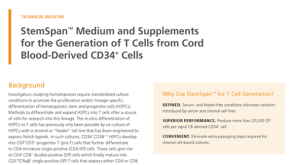 技术公告StemSpan™ Medium and Supplements for the Generation of T Cells from Cord Blood-Derived CD34+ Cells

 沪公网安备31010102008431号