Davies BR et al. ( 2007)
Molecular cancer therapeutics 6 8 2209--2219
AZD6244 (ARRY-142886), a potent inhibitor of mitogen-activated protein kinase/extracellular signal-regulated kinase kinase 1/2 kinases: mechanism of action in vivo, pharmacokinetic/pharmacodynamic relationship, and potential for combination in preclinical
Constitutive activation of the extracellular signal-regulated kinase 1/2 (ERK1/2) mitogen-activated protein kinase (MAPK) signaling pathway in human cancers is often associated with mutational activation of BRAF or RAS. MAPK/ERK kinase 1/2 kinases lie downstream of RAS and BRAF and are the only acknowledged activators of ERK1/2,making them attractive targets for therapeutic intervention. AZD6244 (ARRY-142886) is a potent,selective,and ATP-uncompetitive inhibitor of MAPK/ERK kinase 1/2. In vitro cell viability inhibition screening of a tumor cell line panel found that lines harboring BRAF or RAS mutations were more likely to be sensitive to AZD6244. The in vivo mechanisms by which AZD6244 inhibits tumor growth were investigated. Chronic dosing with 25 mg/kg AZD6244 bd resulted in suppression of growth of Colo-205,Calu-6,and SW-620 xenografts,whereas an acute dose resulted in significant inhibition of ERK1/2 phosphorylation. Increased cleaved caspase-3,a marker of apoptosis,was detected in Colo-205 and Calu-6 but not in SW-620 tumors where a significant decrease in cell proliferation was detected. Chronic dosing of AZD6244 induced a morphologic change in SW-620 tumors to a more differentiated phenotype. The potential of AZD6244 in combination with cytotoxic drugs was evaluated in mice bearing SW-620 xenografts. Treatment with tolerated doses of AZD6244 and either irinotecan or docetaxel resulted in significantly enhanced antitumor efficacy relative to that of either agent alone. These results indicate that AZD6244 has potential to inhibit proliferation and induce apoptosis and differentiation,but the response varies between different xenografts. Moreover,enhanced antitumor efficacy can be obtained by combining AZD6244 with the cytotoxic drugs irinotecan or docetaxel.
View Publication
Stingl J et al. (MAY 2001)
Breast cancer research and treatment 67 2 93--109
Characterization of bipotent mammary epithelial progenitor cells in normal adult human breast tissue.
The purpose of the present study was to characterize primitive epithelial progenitor populations present in adult normal human mammary tissue using a combination of flow cytometry and in vitro colony assay procedures. Three types of human breast epithelial cell (HBEC) progenitors were identified: luminal-restricted,myoepithelial-restricted and bipotent progenitors. The first type expressed epithelial cell adhesion molecule (EpCAM),alpha6 integrin and MUC1 and generated colonies composed exclusively of cells positive for the luminal-associated markers keratin 8/18,keratin 19,EpCAM and MUC1. Bipotent progenitors produced colonies containing a central core of cells expressing luminal markers surrounded by keratin 14+ myoepithelial-like cells. Single cell cultures confirmed the bipotentiality of these progenitors. Their high expression of alpha6 integrin and low expression of MUC1 suggests a basal position of these cells in the mammary epithelium in vivo. Serial passage in vitro of an enriched population of bipotent progenitors demonstrated that only myoepithelial-restricted progenitors could be readily generated under the culture conditions used. These results support a hierarchical branching model of HBEC progenitor differentiation from a primitive uncommitted cell to luminal- and myoepithelial-restricted progenitors.
View Publication
产品类型:
产品号#:
01700
01705
05601
05610
01420
01421
01702
产品名:
ALDEFLUOR™ 试剂盒
ALDEFLUOR™ DEAB试剂, 1.5 mM, 1 mL
EpiCult™-B 人培养基
EpiCult™-B 小鼠培养基
ALDEFLUOR™检测缓冲液
Bohannon C et al. ( 2016)
Nature communications 7 11826
Long-lived antigen-induced IgM plasma cells demonstrate somatic mutations and contribute to long-term protection.
Long-lived plasma cells are critical to humoral immunity as a lifelong source of protective antibodies. Antigen-activated B cells-with T-cell help-undergo affinity maturation within germinal centres and persist as long-lived IgG plasma cells in the bone marrow. Here we show that antigen-specific,induced IgM plasma cells also persist for a lifetime. Unlike long-lived IgG plasma cells,which develop in germinal centres and then home to the bone marrow,IgM plasma cells are primarily retained within the spleen and can develop even in the absence of germinal centres. Interestingly,their expressed IgV loci exhibit somatic mutations introduced by the activation-induced cytidine deaminase (AID). However,these IgM plasma cells are probably not antigen-selected,as replacement mutations are spread through the variable segment and not enriched within the CDRs. Finally,antibodies from long-lived IgM plasma cells provide protective host immunity against a lethal virus challenge.
View Publication
产品类型:
产品号#:
19854
19854RF
产品名:
EasySep™小鼠B细胞分选试剂盒
RoboSep™ 小鼠B细胞分选试剂盒
Son M-Y et al. (JAN 2017)
Stem cells and development 26 2 133--145
Biomarker Discovery by Modeling Behçet's Disease with Patient-Specific Human Induced Pluripotent Stem Cells.
Behçet's disease (BD) is a chronic inflammatory and multisystemic autoimmune disease of unknown etiology. Due to the lack of a specific test for BD,its diagnosis is very difficult and therapeutic options are limited. Induced pluripotent stem cell (iPSC) technology,which provides inaccessible disease-relevant cell types,opens a new era for disease treatment. In this study,we generated BD iPSCs from patient somatic cells and differentiated them into hematopoietic precursor cells (BD iPSC-HPCs) as BD model cells. Based on comparative transcriptome analysis using our BD model cells,we identified eight novel BD-specific genes,AGTR2,CA9,CD44,CXCL1,HTN3,IL-2,PTGER4,and TSLP,which were differentially expressed in BD patients compared with healthy controls or patients with other immune diseases. The use of CXCL1 as a BD biomarker was further validated at the protein level using both a BD iPSC-HPC-based assay system and BD patient serum samples. Furthermore,we show that our BD iPSC-HPC-based drug screening system is highly effective for testing CXCL1 BD biomarkers,as determined by monitoring the efficacy of existing anti-inflammatory drugs. Our results shed new light on the usefulness of patient-specific iPSC technology in the development of a benchmarking platform for disease-specific biomarkers,phenotype- or target-driven drug discovery,and patient-tailored therapies.
View Publication
产品类型:
产品号#:
05850
05857
05870
05875
85850
85857
85870
85875
产品名:
mTeSR™1
mTeSR™1
O'Brien CM et al. (DEC 2016)
Stem cells (Dayton,Ohio)
New Monoclonal Antibodies to Defined Cell Surface Proteins on Human Pluripotent Stem Cells.
The study and application of human pluripotent stem cells (hPSCs) will be enhanced by the availability of well-characterised monoclonal antibodies (mAbs) detecting cell-surface epitopes. Here we report generation of seven new mAbs that detect cell surface proteins present on live and fixed human ES cells (hESCs) and human iPS cells (hiPSCs),confirming our previous prediction that these proteins were present on the cell surface of hPSCs. The mAbs all show a high correlation with POU5F1 (OCT4) expression and other hPSC surface markers (TRA-160 and SSEA-4) in hPSC cultures and detect rare OCT4 positive cells in differentiated cell cultures. These mAbs are immunoreactive to cell surface protein epitopes on both primed and naive state hPSCs,providing useful research tools to investigate the cellular mechanisms underlying human pluripotency and states of cellular reprogramming. In addition,we report that subsets of the seven new mAbs are also immunoreactive to human bone marrow-derived mesenchymal stem cells (MSCs),normal human breast subsets and both normal and tumorigenic colorectal cell populations. The mAbs reported here should accelerate the investigation of the nature of pluripotency,and enable development of robust cell separation and tracing technologies to enrich or deplete for hPSCs and other human stem and somatic cell types. This article is protected by copyright. All rights reserved.
View Publication
产品类型:
产品号#:
05970
产品名:
P. A. Morawski et al. (JAN 2017)
Scientific reports 7 40838
Non-pathogenic tissue-resident CD8+ T cells uniquely accumulate in the brains of lupus-prone mice.
Severe lupus often includes psychiatric and neurological sequelae,although the cellular contributors to CNS disease remain poorly defined. Using intravascular staining to discriminate tissue-localized from blood-borne cells,we find substantial accumulation of CD8+ T cells relative to other lymphocytes in brain tissue,which correlates with lupus disease and limited neuropathology. This is in contrast to all other affected organs,where infiltrating CD4+ cells are predominant. Brain-infiltrating CD8+ T cells represent an activated subset of those found in the periphery,having a resident-memory phenotype (CD69+CD122-PD1+CD44+CD62L-) and expressing adhesion molecules (VLA-4+LFA-1+) complementary to activated brain endothelium. Remarkably,infiltrating CD8+ T cells do not cause tissue damage in lupus-prone mice,as genetic ablation of these cells via $\beta$2 m deficiency does not reverse neuropathology,but exacerbates disease both in the brain and globally despite decreased serum IgG levels. Thus,lupus-associated inflammation disrupts the blood-brain barrier in a discriminating way biased in favor of non-pathogenic CD8+ T cells relative to other infiltrating leukocytes,perhaps preventing further tissue damage in such a sensitive organ.
View Publication
产品类型:
产品号#:
21000
20119
20155
产品名:
RoboSep™- S
RoboSep™ 吸头组件抛光剂
RoboSep™分选管套装(9个塑料管)
Smalls-Mantey A et al. ( 2013)
PloS one 8 9 e74858
Comparative efficiency of HIV-1-infected T cell killing by NK cells, monocytes and neutrophils.
HIV-1 infected cells are eliminated in infected individuals by a variety of cellular mechanisms,the best characterized of which are cytotoxic T cell and NK cell-mediated killing. An additional antiviral mechanism is antibody-dependent cellular cytotoxicity. Here we use primary CD4(+) T cells infected with the BaL clone of HIV-1 as target cells and autologous NK cells,monocytes,and neutrophils as effector cells,to quantify the cytotoxicity mediated by the different effectors. This was carried out in the presence or absence of HIV-1-specific antiserum to assess antibody-dependent cellular cytotoxicity. We show that at the same effector to target ratio,NK cells and monocytes mediate similar levels of both antibody-dependent and antibody-independent killing of HIV-1-infected T cells. Neutrophils mediated significant antibody-dependent killing of targets,but were less effective than monocytes or NK cells. These data have implications for acquisition and control of HIV-1 in natural infection and in the context of vaccination.
View Publication
产品类型:
产品号#:
19257
19257RF
19055
19055RF
19059
19059RF
产品名:
EasySep™人NK细胞富集试剂盒
RoboSep™ 人NK细胞富集试剂盒含滤芯吸头
EasySep™人单核细胞富集试剂盒
RoboSep™ 人单核细胞富集试剂盒含滤芯吸头
Nä et al. (NOV 2013)
PLoS ONE 8 11 e78847
Continuous Hypoxic Culturing of Human Embryonic Stem Cells Enhances SSEA-3 and MYC Levels
Low oxygen tension (hypoxia) contributes critically to pluripotency of human embryonic stem cells (hESCs) by preventing spontaneous differentiation and supporting self-renewal. However,it is not well understood how hESCs respond to reduced oxygen availability and what are the molecular mechanisms maintaining pluripotency in these conditions. In this study we characterized the transcriptional and molecular responses of three hESC lines (H9,HS401 and HS360) on short (2 hours),intermediate (24 hours) and prolonged (7 days) exposure to low oxygen conditions (4% O2). In response to prolonged hypoxia the expression of pluripotency surface marker SSEA-3 was increased. Furthermore,the genome wide gene-expression analysis revealed that a substantial proportion (12%) of all hypoxia-regulated genes in hESCs,were directly linked to the mechanisms controlling pluripotency or differentiation. Moreover,transcription of MYC oncogene was induced in response to continuous hypoxia. At the protein level MYC was stabilized through phosphorylation already in response to a short hypoxic exposure. Total MYC protein levels remained elevated throughout all the time points studied. Further,MYC protein expression in hypoxia was affected by silencing HIF2α,but not HIF1α. Since MYC has a crucial role in regulating pluripotency we propose that induction of sustained MYC expression in hypoxia contributes to activation of transcriptional programs critical for hESC self-renewal and maintenance of enhanced pluripotent state.
View Publication
产品类型:
产品号#:
05850
05857
05870
05875
36254
85850
85857
85870
85875
产品名:
DMEM/F-12 with 15 mM HEPES
mTeSR™1
mTeSR™1
Marchand M et al. (JAN 2014)
Stem cells translational medicine 3 1 91--97
Concurrent generation of functional smooth muscle and endothelial cells via a vascular progenitor.
Smooth muscle cells (SMCs) and endothelial cells (ECs) are typically derived separately,with low efficiencies,from human pluripotent stem cells (hPSCs). The concurrent generation of these cell types might lead to potential applications in regenerative medicine to model,elucidate,and eventually treat vascular diseases. Here we report a robust two-step protocol that can be used to simultaneously generate large numbers of functional SMCs and ECs from a common proliferative vascular progenitor population via a two-dimensional culture system. We show here that coculturing hPSCs with OP9 cells in media supplemented with vascular endothelial growth factor,basic fibroblast growth factor,and bone morphogenetic protein 4 yields a higher percentage of CD31(+)CD34(+) cells on day 8 of differentiation. Upon exposure to endothelial differentiation media and SM differentiation media,these vascular progenitors were able to differentiate and mature into functional endothelial cells and smooth muscle cells,respectively. Furthermore,we were able to expand the intermediate population more than a billion fold to generate sufficient numbers of ECs and SMCs in parallel for potential therapeutic transplantations.
View Publication


 EasySep™小鼠TIL(CD45)正选试剂盒





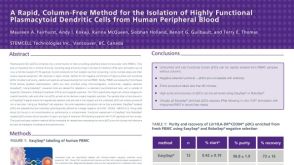 科学海报Rapid Cell Isolation of Highly Functional Plasmacytoid Dendritic Cells from Human Peripheral Blood
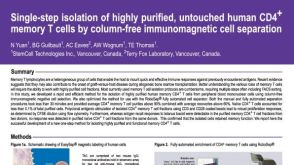 科学海报Cell Isolation of Human CD4+ Memory T Cells By Column-Free Immunomagnetic Cell Separation

 沪公网安备31010102008431号