DNA repair in human pluripotent stem cells is distinct from that in non-pluripotent human cells.
The potential for human disease treatment using human pluripotent stem cells,including embryonic stem cells and induced pluripotent stem cells (iPSCs),also carries the risk of added genomic instability. Genomic instability is most often linked to DNA repair deficiencies,which indicates that screening/characterization of possible repair deficiencies in pluripotent human stem cells should be a necessary step prior to their clinical and research use. In this study,a comparison of DNA repair pathways in pluripotent cells,as compared to those in non-pluripotent cells,demonstrated that DNA repair capacities of pluripotent cell lines were more heterogeneous than those of differentiated lines examined and were generally greater. Although pluripotent cells had high DNA repair capacities for nucleotide excision repair,we show that ultraviolet radiation at low fluxes induced an apoptotic response in these cells,while differentiated cells lacked response to this stimulus,and note that pluripotent cells had a similar apoptotic response to alkylating agent damage. This sensitivity of pluripotent cells to damage is notable since viable pluripotent cells exhibit less ultraviolet light-induced DNA damage than do differentiated cells that receive the same flux. In addition,the importance of screening pluripotent cells for DNA repair defects was highlighted by an iPSC line that demonstrated a normal spectral karyotype,but showed both microsatellite instability and reduced DNA repair capacities in three out of four DNA repair pathways examined. Together,these results demonstrate a need to evaluate DNA repair capacities in pluripotent cell lines,in order to characterize their genomic stability,prior to their pre-clinical and clinical use.
View Publication
产品类型:
产品号#:
05850
05857
05870
05875
85850
85857
85870
85875
产品名:
mTeSR™1
mTeSR™1
(Dec 2024)
Scientific Reports 14 4
miRNA changes associated with differentiation of human embryonic stem cells into human retinal ganglion cells
miRNA,short non-coding RNA,are rapidly emerging as important regulators in cell homeostasis,as well as potential players in cellular degeneration. The latter has led to interest in them as both biomarkers and as potential therapeutics. Retinal ganglion cells (RGC),whose axons connect the eye to the brain,are central nervous system cells of great interest,yet their study is largely restricted to animals due to the difficulty in obtaining healthy human RGC. Using a CRISPR/Cas9-based reporter embryonic stem cell line,human RGC were generated and their miRNA profile characterized using NanoString miRNA assays. We identified a variety of retinal specific miRNA upregulated in ESC-derived RGC,with half of the most abundant miRNA also detectable in purified rat RGC. Several miRNA were however identified to be unique to RGC from human. The findings show which miRNA are abundant in RGC and the limited congruence with animal derived RGC. These data could be used to understand miRNA’s role in RGC function,as well as potential biomarkers or therapies in retinal diseases involving RGC degeneration.
View Publication
产品类型:
产品号#:
85850
85857
产品名:
mTeSR™1
mTeSR™1
(Apr 2024)
Frontiers in Cell and Developmental Biology 12 2
Airway basal cells from human-induced pluripotent stem cells: a new frontier in cystic fibrosis research
Human-induced airway basal cells (hiBCs) derived from human-induced pluripotent stem cells (hiPSCs) offer a promising cell model for studying lung diseases,regenerative medicine,and developing new gene therapy methods. We analyzed existing differentiation protocols and proposed our own protocol for obtaining hiBCs,which involves step-by-step differentiation of hiPSCs into definitive endoderm,anterior foregut endoderm,NKX2.1+ lung progenitors,and cultivation on basal cell medium with subsequent cell sorting using the surface marker CD271 (NGFR). We derived hiBCs from two healthy cell lines and three cell lines with cystic fibrosis (CF). The obtained hiBCs,expressing basal cell markers (NGFR,KRT5,and TP63),could differentiate into lung organoids (LOs). We demonstrated that LOs derived from hiBCs can assess cystic fibrosis transmembrane conductance regulator (CFTR) channel function using the forskolin-induced swelling (FIS) assay. We also carried out non-viral (electroporation) and viral (recombinant adeno-associated virus (rAAV)) serotypes 6 and 9 and recombinant adenovirus (rAdV) serotype 5 transgene delivery to hiBCs and showed that rAAV serotype 6 is most effective against hiBCs,potentially applicable for gene therapy research.
View Publication
Assessment of functional competence of endothelial cells from human pluripotent stem cells in zebrafish embryos.
Human pluripotent stem cells (hPSCs) are proving to be a valuable source of endothelial cells (ECs),pericytes,and vascular smooth muscle cells (vSMCs). Although an increasing number of phenotypic markers are becoming available to determine the phenotypes of these cells in vitro,the ability to integrate and form functional vessels in the host organism,typically mouse,remains critical for the assessment of EC functional competence. However,current mouse models require relatively large numbers of cells that might be difficult to derive simultaneously from multiple hPSCs lines. Therefore,there is an urgent need for new functional assays that are robust and can be performed with small numbers of cells. Here we describe a novel zebrafish xenograft model to test functionality of hPSC-derived ECs. The assay can be performed in 10 days and requires only ˜100-400 human cells per embryo. Thus,the zebrafish xenograft model can be useful for the accurate and rapid assessment of functionality of hPSC-derived ECs in a lower vertebrate model that is widely viewed by regulatory authorities as a more acceptable alternative to adult mice.
View Publication
产品类型:
产品号#:
05850
05857
05870
05875
85850
85857
85870
85875
产品名:
mTeSR™1
mTeSR™1
Wang X et al. (FEB 2016)
Stem cells (Dayton,Ohio) 34 2 380--391
Immune modulatory mesenchymal stem cells derived from human embryonic stem cells through a trophoblast-like stage.
Mesenchymal stem/stromal cells (MSCs) have great clinical potential in modulating inflammation and promoting tissue repair. Human embryonic stem cells (hESCs) have recently emerged as a potentially superior cell source for MSCs. However,the generation methods reported so far vary greatly in quality and efficiency. Here,we describe a novel method to rapidly and efficiently produce MSCs from hESCs via a trophoblast-like intermediate stage in approximately 11-16 days. We term these cells T-MSCs" and show that T-MSCs express a phenotype and differentiation potential minimally required to define MSCs. T-MSCs exhibit potent immunomodulatory activity in vitro as they can remarkably inhibit proliferation of cocultured T and B lymphocytes. Unlike bone marrow MSCs�
View Publication
产品类型:
产品号#:
05850
05857
05870
05875
85850
85857
85870
85875
产品名:
mTeSR™1
mTeSR™1
Muthuswamy R et al. (JUL 2008)
Cancer research 68 14 5972--8
Ability of mature dendritic cells to interact with regulatory T cells is imprinted during maturation.
Preferential activation of regulatory T (Treg) cells limits autoimmune tissue damage during chronic immune responses but can also facilitate tumor growth. Here,we show that tissue-produced inflammatory mediators prime maturing dendritic cells (DC) for the differential ability of attracting anti-inflammatory Treg cells. Our data show that prostaglandin E(2) (PGE(2)),a factor overproduced in chronic inflammation and cancer,induces stable Treg-attracting properties in maturing DC,mediated by CCL22. The elevated production of CCL22 by PGE(2)-matured DC persists after the removal of PGE(2) and is further elevated after secondary stimulation of DC in a neutral environment. This PGE(2)-induced overproduction of CCL22 and the resulting attraction of FOXP3(+) Tregs are counteracted by IFN alpha,a mediator of acute inflammation,which also restores the ability of the PGE(2)-exposed DC to secrete the Th1-attracting chemokines: CXCL9,CXCL10,CXCL11,and CCL5. In accordance with these observations,different DCs clinically used as cancer vaccines show different Treg-recruiting abilities,with PGE(2)-matured DC,but not type 1-polarized DC,generated in the presence of type I and type II IFNs,showing high Treg-attracting activity. The current data,showing that the ability of mature DC to interact with Treg cells is predetermined at the stage of DC maturation,pave the way to preferentially target the regulatory versus proinflammatory T cells in autoimmunity and transplantation,as opposed to intracellular infections and cancer.
View Publication
产品类型:
产品号#:
19052
19052RF
产品名:
EasySep™人CD4+ T细胞富集试剂盒
RoboSep™ 人CD4+ T细胞富集试剂盒含滤芯吸头
S. Fan et al. ( 2019)
NPJ vaccines 4 14
Role of innate lymphoid cells and dendritic cells in intradermal immunization of the enterovirus antigen.
Enterovirus type 71 (EV71) and coxsackievirus A 16 (CA16) are the major pathogens of human hand,foot,and mouth disease (HFMD). In our previous study,intramuscular immunization with the inactivated EV71 vaccine elicited effective immunity,while immunization with the inactivated CA16 vaccine did not. In this report,we focused on innate immune responses elicited by inactivated EV71 and CA16 antigens administered intradermally or intramuscularly. The distributions of the EV71 and CA16 antigens administered intradermally or intramuscularly were not obviously different,but the antigens were detected for a shorter period of time when administered intradermally. The expression levels of NF-kappaB pathway signaling molecules,which were identified as being capable of activating DCs,ILCs,and T cells,were higher in the intradermal group than in the intramuscular group. Antibodies for the EV71 and CA16 antigens colocalized with ILCs and DCs in skin and muscle tissues under fluorescence microscopy. Interestingly,ILC colocalization decreased over time,while DC colocalization increased over time. ELISpot analysis showed that coordination between DCs and ILCs contributed to successful adaptive immunity against vaccine antigens in the skin. EV71 and/or CA16 antigen immunization via the intradermal route was more capable of significantly increasing neutralizing antibody titers and activating specific T cell responses than immunization via the intramuscular route. Furthermore,neonatal mice born to mothers immunized with the EV71 and CA16 antigens were 100{\%} protected against wild-type EV71 or CA16 viral challenge. Together,our results provide new insights into the development of vaccines for HFMD.
View Publication
产品类型:
产品号#:
19851
19851RF
产品名:
EasySep™小鼠T细胞分选试剂盒
RoboSep™ 小鼠T细胞分选试剂盒
Chen YS et al. (FEB 2012)
Stem cells translational medicine 1 2 83--95
Small molecule mesengenic induction of human induced pluripotent stem cells to generate mesenchymal stem/stromal cells.
The translational potential of mesenchymal stem/stromal cells (MSCs) is limited by their rarity in somatic organs,heterogeneity,and need for harvest by invasive procedures. Induced pluripotent stem cells (iPSCs) could be an advantageous source of MSCs,but attempts to derive MSCs from pluripotent cells have required cumbersome or untranslatable techniques,such as coculture,physical manipulation,sorting,or viral transduction. We devised a single-step method to direct mesengenic differentiation of human embryonic stem cells (ESCs) and iPSCs using a small molecule inhibitor. First,epithelial-like monolayer cells were generated by culturing ESCs/iPSCs in serum-free medium containing the transforming growth factor-β pathway inhibitor SB431542. After 10 days,iPSCs showed upregulation of mesodermal genes (MSX2,NCAM,HOXA2) and downregulation of pluripotency genes (OCT4,LEFTY1/2). Differentiation was then completed by transferring cells into conventional MSC medium. The resultant development of MSC-like morphology was associated with increased expression of genes,reflecting epithelial-to-mesenchymal transition. Both ESC- and iPSC-derived MSCs exhibited a typical MSC immunophenotype,expressed high levels of vimentin and N-cadherin,and lacked expression of pluripotency markers at the protein level. Robust osteogenic and chondrogenic differentiation was induced in vitro in ES-MSCs and iPS-MSCs,whereas adipogenic differentiation was limited,as reported for primitive fetal MSCs and ES-MSCs derived by other methods. We conclude that treatment with SB431542 in two-dimensional cultures followed by culture-induced epithelial-to-mesenchymal transition leads to rapid and uniform MSC conversion of human pluripotent cells without the need for embryoid body formation or feeder cell coculture,providing a robust,clinically applicable,and efficient system for generating MSCs from human iPSCs.
View Publication
产品类型:
产品号#:
05850
05857
05870
05875
85850
85857
85870
85875
产品名:
mTeSR™1
mTeSR™1
Kovats S et al. (NOV 2016)
Clinical and experimental immunology 186 2 214--226
West Nile virus-infected human dendritic cells fail to fully activate invariant natural killer T cells.
West Nile virus (WNV) infection is a mosquito-borne zoonosis with increasing prevalence in the United States. WNV infection begins in the skin,and the virus replicates initially in keratinocytes and dendritic cells (DCs). In the skin and cutaneous lymph nodes,infected DCs are likely to interact with invariant natural killer T cells (iNKTs). Bidirectional interactions between DCs and iNKTs amplify the innate immune response to viral infections,thus controlling viral load and regulating adaptive immunity. iNKTs are stimulated by CD1d-bound lipid antigens or activated indirectly by inflammatory cytokines. We exposed human monocyte-derived DCs to WNV Kunjin and determined their ability to activate isolated blood iNKTs. DCs became infected as judged by synthesis of viral mRNA and Envelope and NS-1 proteins,but did not undergo significant apoptosis. Infected DCs up-regulated the co-stimulatory molecules CD86 and CD40,but showed decreased expression of CD1d. WNV infection induced DC secretion of type I interferon (IFN),but no or minimal interleukin (IL)-12,IL-23,IL-18 or IL-10. Unexpectedly,we found that the WNV-infected DCs stimulated human iNKTs to up-regulate CD69 and produce low amounts of IL-10,but not proinflammatory cytokines such as IFN-γ or tumour necrosis factor (TNF)-α. Both CD1d and IFNAR blockade partially abrogated this iNKT response,suggesting involvement of a T cell receptor (TCR)-CD1d interaction and type I interferon receptor (IFNAR) signalling. Thus,WNV infection interferes with DC-iNKT interactions by preventing the production of proinflammatory cytokines. iNKTs may be a source of IL-10 observed in human flavivirus infections and initiate an anti-inflammatory innate response that limits adaptive immunity and immune pathology upon WNV infection.
View Publication
Generation of human muscle fibers and satellite-like cells from human pluripotent stem cells in vitro.
Progress toward finding a cure for muscle diseases has been slow because of the absence of relevant cellular models and the lack of a reliable source of muscle progenitors for biomedical investigation. Here we report an optimized serum-free differentiation protocol to efficiently produce striated,millimeter-long muscle fibers together with satellite-like cells from human pluripotent stem cells (hPSCs) in vitro. By mimicking key signaling events leading to muscle formation in the embryo,in particular the dual modulation of Wnt and bone morphogenetic protein (BMP) pathway signaling,this directed differentiation protocol avoids the requirement for genetic modifications or cell sorting. Robust myogenesis can be achieved in vitro within 1 month by personnel experienced in hPSC culture. The differentiating culture can be subcultured to produce large amounts of myogenic progenitors amenable to numerous downstream applications. Beyond the study of myogenesis,this differentiation method offers an attractive platform for the development of relevant in vitro models of muscle dystrophies and drug screening strategies,as well as providing a source of cells for tissue engineering and cell therapy approaches.
View Publication
产品类型:
产品号#:
05850
05857
05870
05875
85850
85857
85870
85875
产品名:
mTeSR™1
mTeSR™1
Bemark M et al. ( 2016)
Nature communications 7 12698
Limited clonal relatedness between gut IgA plasma cells and memory B cells after oral immunization.
Understanding how memory B cells are induced and relate to long-lived plasma cells is important for vaccine development. Immunity to oral vaccines has been considered short-lived because of a poor ability to develop IgA B-cell memory. Here we demonstrate that long-lived mucosal IgA memory is readily achieved by oral but not systemic immunization in mouse models with NP hapten conjugated with cholera toxin and transfer of B1-8(high)/GFP(+) NP-specific B cells. Unexpectedly,memory B cells are poorly related to long-lived plasma cells and less affinity-matured. They are α4β7-integrin(+)CD73(+)PD-L2(+)CD80(+) and at systemic sites mostly IgM(+),while 80% are IgA(+) in Peyer's patches. On reactivation,most memory B cells in Peyer's patches are GL7(-),but expand in germinal centres and acquire higher affinity and more mutations,demonstrating strong clonal selection. CCR9 expression is found only in Peyer's patches and appears critical for gut homing. Thus,gut mucosal memory possesses unique features not seen after systemic immunization.
View Publication


 EasySep™小鼠TIL(CD45)正选试剂盒





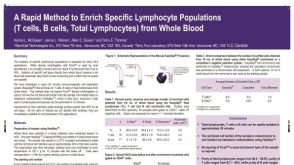 科学海报Cell Enrichment of Specific Lymphocyte Populations (T Cells, B Cells, Total Lymphocytes) from Whole Blood
 沪公网安备31010102008431号