Centrioles are frequently amplified in early B cell development but dispensable for humoral immunity
Centrioles define centrosome structure and function. Deregulation of centriole numbers can cause developmental defects and cancer. The p53 tumor suppressor limits the growth of cells lacking or harboring additional centrosomes and can be engaged by the “mitotic surveillance” or the “PIDDosome pathway”,respectively. Here,we show that early B cell progenitors frequently present extra centrioles,ensuing their high proliferative activity and related DNA damage. Extra centrioles are efficiently cleared during B cell maturation. In contrast,centriole loss upon Polo-like kinase 4 (Plk4) deletion causes apoptosis and arrests B cell development. This defect can be rescued by co-deletion of Usp28,a critical component of the mitotic surveillance pathway,that restores cell survival and maturation. Centriole-deficient mature B cells are proliferation competent and mount a humoral immune response. Our findings imply that progenitor B cells are intolerant to centriole loss but permissive to centriole amplification,a feature potentially facilitating their malignant transformation. Centrioles organize chromosome segregation,migration,and the immune synapse. Here,Schapfl et al. show that B cell progenitors tolerate centriole overamplification,but not loss,while mature B cells can mount a humoral immune response in their absence.
View Publication
产品类型:
产品号#:
19854
19854RF
产品名:
EasySep™小鼠B细胞分选试剂盒
RoboSep™ 小鼠B细胞分选试剂盒
Y. Takahashi et al. (Apr 2026)
Stem Cell Reports 21 5
Organoid phenotypic screening identified glycyrrhizin that confers protection against tumor necrosis factor-induced cell death
Human organoids are considered physiological models that reflect human physiology; however,their applications in drug screening studies are limited. To develop a fundamental treatment for recurrent Crohn’s disease (CD),in which tumor necrosis factor (TNF) is a key pathogenic factor,we conducted phenotypic drug screening to prevent TNF-induced cell death in human intestinal epithelial organoids. Glycyrrhizin,a natural product of licorice root,dose-dependently blocked TNF-induced cell death in organoids but not in TNF-sensitive L929 cells; L929 cells exhibited necroptosis,whereas organoid-derived cells preferentially showed apoptosis upon TNF treatment,determining the specificity of glycyrrhizin. Glycyrrhizin inhibited downstream caspase-8 signaling,which is essential for TNF-dependent apoptosis,and ameliorated intestinal inflammation in vivo. These results demonstrate that glycyrrhizin may be a novel therapeutic compound for CD and highlight the importance of using organoids for phenotypic drug screening. Graphical abstract Highlights•Human intestinal organoids are sensitive to TNF-induced cytotoxicity•We developed an assay system to screen for compounds that resist TNF in organoids•Glycyrrhizin inhibited TNF-induced apoptosis but not necroptosis in organoids•Glycyrrhizin ameliorated intestinal inflammation in a murine model in vivo Takahashi et al. developed a high-throughput phenotypic screening platform using human intestinal organoids,which exhibited higher sensitivity to TNF than conventional intestinal epithelial cell lines,and identified glycyrrhizin that protected TNF-induced cell death both in organoids and in vivo. Phenotypic screening using organoids,as demonstrated in this study,paves the way for drug development and chemical biology.
View Publication
产品类型:
产品号#:
5140
产品名:
(Apr 2024)
Cell Regeneration 13
Characterization of gene regulatory networks underlying key properties in human hematopoietic stem cell ontogeny
Human hematopoiesis starts at early yolk sac and undergoes site- and stage-specific changes over development. The intrinsic mechanism underlying property changes in hematopoiesis ontogeny remains poorly understood. Here,we analyzed single-cell transcriptome of human primary hematopoietic stem/progenitor cells (HSPCs) at different developmental stages,including yolk-sac (YS),AGM,fetal liver (FL),umbilical cord blood (UCB) and adult peripheral blood (PB) mobilized HSPCs. These stage-specific HSPCs display differential intrinsic properties,such as metabolism,self-renewal,differentiating potentialities etc. We then generated highly co-related gene regulatory network (GRNs) modules underlying the differential HSC key properties. Particularly,we identified GRNs and key regulators controlling lymphoid potentiality,self-renewal as well as aerobic respiration in human HSCs. Introducing selected regulators promotes key HSC functions in HSPCs derived from human pluripotent stem cells. Therefore,GRNs underlying key intrinsic properties of human HSCs provide a valuable guide to generate fully functional HSCs in vitro.Supplementary InformationThe online version contains supplementary material available at 10.1186/s13619-024-00192-z.
View Publication
产品类型:
产品号#:
85850
85857
产品名:
mTeSR™1
mTeSR™1
(Oct 2024)
NPJ Microgravity 10
Surface tension enables induced pluripotent stem cell culture in commercially available hardware during spaceflight
Low Earth Orbit (LEO) has emerged as a unique environment for evaluating altered stem cell properties in microgravity. LEO has become increasingly accessible for research and development due to progress in private spaceflight. Axiom Mission 2 (Ax-2) was launched as the second all-private astronaut mission to the International Space Station (ISS). Frozen human induced pluripotent stem cells (hiPSCs) expressing green fluorescent protein (GFP) under the SOX2 promoter,as well as fibroblasts differentiated from SOX2-GFP hiPSCs,were sent to the ISS. Astronauts then thawed and seeded both cell types into commercially available 96-well plates,which provided surface tension that reduced fluid movement out of individual wells and showed that hiPSCs or hiPSC-derived fibroblasts could survive either in suspension or attached to a Matrigel substrate. Furthermore,both cell types could be transfected with red fluorescent protein (RFP)-expressing plasmid. We demonstrate that hiPSCs and hiPSC-fibroblasts can be thawed in microgravity in off-the-shelf,commercially-available cell culture hardware,can associate into 3D spheroids or grow adherently in Matrigel,and can be transfected with DNA. This lays the groundwork for future biomanufacturing experiments in space.
View Publication
产品类型:
产品号#:
100-0276
100-1130
产品名:
mTeSR™ Plus
mTeSR™ Plus
(Feb 2024)
Nature Communications 15
Time-integrated BMP signaling determines fate in a stem cell model for early human development
How paracrine signals are interpreted to yield multiple cell fate decisions in a dynamic context during human development in vivo and in vitro remains poorly understood. Here we report an automated tracking method to follow signaling histories linked to cell fate in large numbers of human pluripotent stem cells (hPSCs). Using an unbiased statistical approach,we discover that measured BMP signaling history correlates strongly with fate in individual cells. We find that BMP response in hPSCs varies more strongly in the duration of signaling than the level. However,both the level and duration of signaling activity control cell fate choices only by changing the time integral. Therefore,signaling duration and level are interchangeable in this context. In a stem cell model for patterning of the human embryo,we show that signaling histories predict the fate pattern and that the integral model correctly predicts changes in cell fate domains when signaling is perturbed. Our data suggest that mechanistically,BMP signaling is integrated by SOX2. The interpretation of the key developmental signal BMP remains poorly understood. Here,the authors show that the total time-integrated signaling controls differentiation in a stem cell embryo model and provide a possible mechanism.
View Publication
产品类型:
产品号#:
85850
85857
产品名:
mTeSR™1
mTeSR™1
(Oct 2024)
Bioactive Materials 43
Hydrogel microsphere stem cell encapsulation enhances cardiomyocyte differentiation and functionality in scalable suspension system
A reliable suspension-based platform for scaling engineered cardiac tissue (ECT) production from human induced pluripotent stem cells (hiPSCs) is crucial for regenerative therapies. Here,we compared the production and functionality of ECTs formed using our scaffold-based,engineered tissue microsphere differentiation approach with those formed using the prevalent scaffold-free aggregate platform. We utilized a microfluidic system for the rapid (1 million cells/min),high density (30,40,60 million cells/ml) encapsulation of hiPSCs within PEG-fibrinogen hydrogel microspheres. HiPSC-laden microspheres and aggregates underwent suspension-based cardiac differentiation in chemically defined media. In comparison to aggregates,microspheres maintained consistent size and shape initially,over time,and within and between batches. Initial size and shape coefficients of variation for microspheres were eight and three times lower,respectively,compared to aggregates. On day 10,microsphere cardiomyocyte (CM) content was 27 % higher and the number of CMs per initial hiPSC was 250 % higher than in aggregates. Contraction and relaxation velocities of microspheres were four and nine times higher than those of aggregates,respectively. Microsphere contractile functionality also improved with culture time,whereas aggregate functionality remained unchanged. Additionally,microspheres displayed improved ?-adrenergic signaling responsiveness and uniform calcium transient propagation. Transcriptomic analysis revealed that while both microspheres and aggregates demonstrated similar gene regulation patterns associated with cardiomyocyte differentiation,heart development,cardiac muscle contraction,and sarcomere organization,the microspheres exhibited more pronounced transcriptional changes over time. Taken together,these results highlight the capability of the microsphere platform for scaling up biomanufacturing of ECTs in a suspension-based culture platform. Graphical abstractImage 1 Highlights•Comparison of scaffold-based and scaffold-free 3D hiPSC cardiac differentiation.•Microsphere provided tighter control of size and shape with higher reproducibility.•Microspheres showed higher cardiomyocyte (CM) content and more CMs/initial hiPSC.•Microsphere contracted faster than aggregate with higher cell structural maturity.•Microsphere platform exhibited more pronounced transcriptional changes over time.
View Publication
Aoukaty A and Tan R (APR 2005)
Journal of immunology (Baltimore,Md. : 1950) 174 8 4551--8
Role for glycogen synthase kinase-3 in NK cell cytotoxicity and X-linked lymphoproliferative disease.
NK cells from individuals with X-linked lymphoproliferative (XLP) disease exhibit functional defects when stimulated through the NK receptor,2B4 (CD244). These defects are likely a consequence of aberrant intracellular signaling initiated by mutations of the adaptor molecule SLAM-associated protein. In this report,we show that NK cells from individuals with XLP but not healthy individuals fail to phosphorylate and thereby inactivate glycogen synthase kinase-3 (GSK-3) following 2B4 stimulation. Lack of GSK-3 phosphorylation prevented the accumulation of the transcriptional coactivator beta-catenin in the cytoplasm and its subsequent translocation to the nucleus. Potential signaling pathways leading from 2B4 stimulation to GSK-3 phosphorylation were also investigated. Ligation of 2B4 resulted in the phosphorylation of the guanine nucleotide exchange factor,Vav-1,and subsequent activation of the GTP-binding protein Rac-1 (but not Ras) and the serine-threonine kinase Raf-1 in healthy but not XLP-derived NK cells. In addition,the activity of MEK-2 (but not MEK-1) was up-regulated,and Erk1/2 was phosphorylated in normal NK cells but not those from an individual with XLP suggesting that these proteins relay SLAM-associated protein-dependent signals from 2B4. Finally,inactivation of GSK-3 using a specific inhibitor of GSK-3beta increased the cytotoxicity and cytokine secretion of both healthy and XLP NK cells. These data indicate that the signaling of 2B4 in NK cells is mediated by GSK-3 and beta-catenin,possibly through a signal transduction pathway that involves Vav-1,Rac-1,Raf-1,MEK-2,and Erk1/2 and that this pathway is aberrant in individuals with XLP.
View Publication
产品类型:
产品号#:
15025
15065
产品名:
RosetteSep™人NK细胞富集抗体混合物
RosetteSep™人NK细胞富集抗体混合物
Li J et al. (MAR 2006)
Proceedings of the National Academy of Sciences of the United States of America 103 10 3557--62
Human antibodies for immunotherapy development generated via a human B cell hybridoma technology.
Current strategies for the production of therapeutic mAbs include the use of mammalian cell systems to recombinantly produce Abs derived from mice bearing human Ig transgenes,humanization of rodent Abs,or phage libraries. Generation of hybridomas secreting human mAbs has been previously reported; however,this approach has not been fully exploited for immunotherapy development. We previously reported the use of transient regulation of cellular DNA mismatch repair processes to enhance traits (e.g.,affinity and titers) of mAb-producing cell lines,including hybridomas. We reasoned that this process,named morphogenics,could be used to improve suboptimal hybridoma cells generated by means of ex vivo immunization and immortalization of antigen-specific human B cells for therapeutic Ab development. Here we present a platform process that combines hybridoma and morphogenics technologies for the generation of fully human mAbs specific for disease-associated human antigens. We were able to generate hybridoma lines secreting mAbs with high binding specificity and biological activity. One mAb with strong neutralizing activity against human granulocyte-macrophage colony-stimulating factor was identified that is now considered for preclinical development for autoimmune disease indications. Moreover,these hybridoma cells have proven suitable for genetic optimization using the morphogenics process and have shown potential for large-scale manufacturing.
View Publication
产品类型:
产品号#:
18052
18052RF
18054
18054RF
产品名:
Darce JR et al. (MAY 2007)
Journal of immunology (Baltimore,Md. : 1950) 178 9 5612--22
Divergent effects of BAFF on human memory B cell differentiation into Ig-secreting cells.
B cell-activating factor belonging to the TNF family (BAFF) plays a critical role in B cell maturation,yet its precise role in B cell differentiation into Ig-secreting cells (ISCs) remains unclear. In this study,we find that upon isolation human naive and memory B (MB) cells have prebound BAFF on their surface,whereas germinal center (GC) B cells lack detectable levels of prebound BAFF. We attribute their lack of prebound BAFF to cell activation,because we demonstrate that stimulation of naive and MB cells results in the loss of prebound BAFF. Furthermore,the absence of prebound BAFF on GC B cells is not related to a lack of BAFF-binding receptors or an inability to bind exogenous BAFF. Instead,our data suggest that accessibility to soluble BAFF is limited within GCs,perhaps to prevent skewing of the conventional B cell differentiation program. In support of this concept,whereas BAFF significantly enhances ISC differentiation in response to T cell-dependent activation,we report for the first time the ability of BAFF to considerably attenuate ISC differentiation of MB cells in response to CpG stimulation,a form of T cell-independent activation. Our data suggest that BAFF may be providing regulatory signals during specific T cell-independent events,which protect the balance between MB cells and ISCs outside GCs. Taken together,these data define a complex role for BAFF in humoral immune responses and show for the first time that BAFF can also play an inhibitory role in B cell differentiation.
View Publication
Synthesis and evaluation of synthetic retinoid derivatives as inducers of stem cell differentiation.
All-trans-retinoic acid (ATRA) and its associated analogues are important mediators of cell differentiation and function during the development of the nervous system. It is well known that ATRA can induce the differentiation of neural tissues from human pluripotent stem cells. However,it is not always appreciated that ATRA is highly susceptible to isomerisation when in solution,which can influence the effective concentration of ATRA and subsequently its biological activity. To address this source of variability,synthetic retinoid analogues have been designed and synthesised that retain stability during use and maintain biological function in comparison to ATRA. It is also shown that subtle modifications to the structure of the synthetic retinoid compound impacts significantly on biological activity,as when exposed to cultured human pluripotent stem cells,synthetic retinoid 4-(5,5,8,8-tetramethyl-5,6,7,8-tetrahydronaphthalen-2-ylethynyl)benzoic acid,4a (para-isomer),induces neural differentiation similarly to ATRA. In contrast,stem cells exposed to synthetic retinoid 3-(5,5,8,8-tetramethyl-5,6,7,8-tetrahydronaphthalen-2-ylethynyl)benzoic acid,4b (meta-isomer),produce very few neurons and large numbers of epithelial-like cells. This type of structure-activity-relationship information for such synthetic retinoid compounds will further the ability to design more targeted systems capable of mediating robust and reproducible tissue differentiation.
View Publication


 EasySep™小鼠TIL(CD45)正选试剂盒





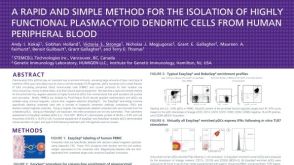 科学海报Rapid Cell Isolation of Highly Functional Plasmacytoid Dendritic Cells from Human Peripheral Blood

 沪公网安备31010102008431号