Trzonkowski P et al. (MAR 2009)
Cytometry. Part A : the journal of the International Society for Analytical Cytology 75 3 175--88
Ex vivo expansion of CD4(+)CD25(+) T regulatory cells for immunosuppressive therapy.
Immunosuppressants are powerful drugs,capable of triggering severe adverse effects. Hence,there is tremendous interest in replacing them with less-toxic agents. Adoptive therapy with CD25(+)CD4(+) T regulatory cells (Tregs) holds promise as an alternative to immunosuppressants. Tregs have been described as the most potent immunosuppressive cells in the human body. In a number of experimental models,they have been found to quench autoimmune diseases,maintain allogeneic transplants,and prevent allergic diseases. A major stumbling block in their clinical application is related to Treg phenotype and the very limited number of these cells in the periphery,not exceeding 1-5% of total CD4(+) T cells. Recent progress in multicolor flow cytometry and cell sorting as well as cellular immunology has found ways of overcoming these obstacles,and has opened the doors to the clinical application of Tregs. In the review,we describe Treg sorting and expansion techniques that have been developed in recent years. In the experience of our laboratory,as well as some published reports,Treg adoptive therapy is a promising tool in immunosuppressive therapy,and should be considered for clinical trials.
View Publication
产品类型:
产品号#:
19052
19052RF
产品名:
EasySep™人CD4+ T细胞富集试剂盒
RoboSep™ 人CD4+ T细胞富集试剂盒含滤芯吸头
Garg TK et al. (SEP 2012)
Haematologica 97 9 1348--56
Highly activated and expanded natural killer cells for multiple myeloma immunotherapy.
BACKGROUND Patients with gene expression profiling-defined high-risk myeloma in relapse have poor outcomes with current therapies. We tested whether natural killer cells expanded by co-culture with K562 cells transfected with 41BBL and membrane-bound interleukin-15 could kill myeloma cells with a high-risk gene expression profile in vitro and in a unique model which recapitulates human myeloma. DESIGN AND METHODS OPM2 and high-risk primary myeloma tumors were grown in human fetal bone implanted into non-obese diabetic severe combined immunodeficiency mice with a deficient interleukin-2 receptor gamma chain. These mice are devoid of endogenous natural killer and T-cell activity and were used to determine whether adoptively transferred expanded natural killer cells could inhibit myeloma growth and myeloma-associated bone destruction. RESULTS Natural killer cells from healthy donors and myeloma patients expanded a median of 804- and 351-fold,respectively,without significant T-cell expansion. Expanded natural killer cells killed both allogeneic and autologous primary myeloma cells avidly via a perforin-mediated mechanism in which the activating receptor NKG2D,natural cytotoxicity receptors,and DNAX-accessory molecule-1 played a central role. Adoptive transfer of expanded natural killer cells inhibited the growth of established OPM2 and high-risk primary myeloma tumors grown in the murine model. The transferred,expanded natural killer cells proliferated in vivo in an interleukin-2 dose-dependent fashion,persisted up to 4 weeks,were readily detectable in the human bone,inhibited myeloma growth and protected bone from myeloma-induced osteolysis. CONCLUSIONS These studies provide the rationale for testing expanded natural killer cells in humans.
View Publication
产品类型:
产品号#:
19055
19055RF
产品名:
EasySep™人NK细胞富集试剂盒
RoboSep™ 人NK细胞富集试剂盒含滤芯吸头
A. Lopresti et al. (jun 2019)
JCI insight 5
Sensitive and easy screening for circulating tumor cells by flow cytometry.
Circulating Tumor Cells (CTCs) represent an easy,repeatable and representative access to information regarding solid tumors. However,their detection remains difficult because of their paucity,their short half-life,and the lack of reliable surface biomarkers. Flow cytometry (FC) is a fast,sensitive and affordable technique,ideal for rare cells detection. Adapted to CTCs detection (i.e. extremely rare cells),most FC-based techniques require a time-consuming pre-enrichment step,followed by a 2-hours staining procedure,impeding on the efficiency of CTCs detection. We overcame these caveats and reduced the procedure to less than one hour,with minimal manipulation. First,cells were simultaneously fixed,permeabilized,then stained. Second,using low-speed FC acquisition conditions and two discriminators (cell size and pan-cytokeratin expression),we suppressed the pre-enrichment step. Applied to blood from donors with or without known malignant diseases,this protocol ensures a high recovery of the cells of interest independently of their epithelial-mesenchymal plasticity and can predict which samples are derived from cancer donors. This proof-of-concept study lays the bases of a sensitive tool to detect CTCs from a small amount of blood upstream of in-depth analyses.
View Publication
产品类型:
产品号#:
15122
15162
产品名:
RosetteSep™人CD45去除抗体混合物
RosetteSep™人CD45去除抗体混合物
(Dec 2024)
Bio-protocol 14 24
CRISPR/Cas9-Based Protocol for Precise Genome Editing in Induced Pluripotent Stem Cells
The advent of clustered regularly interspaced short palindromic repeats (CRISPR)/Cas9-based genome editing has marked a significant advancement in genetic engineering technology. However,the editing of induced pluripotent stem cells (iPSCs) with CRISPR presents notable challenges in ensuring cell survival and achieving high editing efficiency. These challenges become even more complex when considering the specific target site. P53 activation as a result of traditional CRISPR editing can lead to apoptosis,potentially worsening cell health or even resulting in cell death. Mitigating this apoptotic response can enhance cell survival post-CRISPR editing,which will ultimately increase editing efficiency. In our study,we observed that combining p53 inhibition with pro-survival small molecules yields a homologous recombination rate of over 90% when using CRISPR in human iPSCs. This protocol significantly streamlines the editing process and reduces the time and resources necessary for creating isogenic lines.
View Publication
产品类型:
产品号#:
100-0483
100-0484
100-0276
100-1130
产品名:
Hausser Scientificᵀᴹ 明线血球计数板
ReLeSR™
mTeSR™ Plus
mTeSR™ Plus
R. I. Klein Geltink et al. (aug 2020)
Nature metabolism 2 8 703--716
Metabolic conditioning of CD8+ effector T cells for adoptive cell therapy.
CD8+ effector T (TE) cell proliferation and cytokine production depends on enhanced glucose metabolism. However,circulating T cells continuously adapt to glucose fluctuations caused by diet and inter-organ metabolite exchange. Here we show that transient glucose restriction (TGR) in activated CD8+ TE cells metabolically primes effector functions and enhances tumour clearance in mice. Tumour-specific TGR CD8+ TE cells co-cultured with tumour spheroids in replete conditions display enhanced effector molecule expression,and adoptive transfer of these cells in a murine lymphoma model leads to greater numbers of immunologically functional circulating donor cells and complete tumour clearance. Mechanistically,TE cells treated with TGR undergo metabolic remodelling that,after glucose re-exposure,supports enhanced glucose uptake,increased carbon allocation to the pentose phosphate pathway (PPP) and a cellular redox shift towards a more reduced state-all indicators of a more anabolic programme to support their enhanced functionality. Thus,metabolic conditioning could be used to promote efficiency of T-cell products for adoptive cellular therapy.
View Publication
产品类型:
产品号#:
产品名:
Yanai A et al. ( 2016)
Methods in molecular biology (Clifton,N.J.) 1307 357--369
Efficient Production of Photoreceptor Precursor Cells from Human Embryonic Stem Cells.
Transplantation of photoreceptor precursor cells (PPCs) differentiated from human embryonic stem cells (hESCs) is a promising approach to treat common blinding diseases such as age-related macular degeneration and retinitis pigmentosa. However,existing PPC generation methods are inefficient. To enhance differentiation protocols for rapid and high-yield production of PPCs,we focused on optimizing the handling of the cells by including feeder-independent growth of hESCs,using size-controlled embryoid bodies (EBs),and addition of triiodothyronine (T3) and taurine to the differentiation medium,with subsequent removal of undifferentiated cells via negative cell-selection. Our novel protocol produces higher yields of PPCs than previously reported while reducing the time required for differentiation,which will help understand retinal diseases and facilitate large-scale preclinical trials.
View Publication
产品类型:
产品号#:
05860
05880
27845
27945
27840
27865
27940
27965
产品名:
Shigeharu G. YABE et al. (MAR 2016)
Journal of Diabetes n/a--n/a
Efficient Generation of Functional Pancreatic $$ Cells from Human iPS Cells.
BACKGROUND Many groups have generated insulin-secreting cells from hESCs/iPSCs in multiple differentiation stages by mimicking the developmental processes. However,these cells do not always secrete glucose responsive insulin,one of the most important characteristics of pancreatic $$ cells. We focused on the importance of endodermal differentiation from human iPSCs in order to obtain functional pancreatic $$ cells. METHODS We established a 6-stage protocol for the differentiation process from hiPSCs to pancreatic $$ cells using defined culture media without feeders or serum. We examined the effect of CHIR99021,the selective inhibitor of GSK-3$$,in the presence of Activin,FGF2,and BMP4 during definitive endodermal induction by immunostaining for SOX17 and FOXA2. We also compared the insulin secretion at the last stage between monolayer culture and spheroid culture conditions. Cultured cells were transplanted under the kidney capsules of STZ-induced diabetic NOD-SCID mice,and blood glucose levels were measured. Immunohistochemical analysis was performed 4 weeks and 12 weeks after transplantation. RESULTS Addition of CHIR99021 in the presence of Activin,FGF2,and BMP4 for 2 days improved the viability of the endodermal cells,keeping the high positive rate of SOX17. Spheroid formation after the endocrine progenitor stage showed more efficient insulin secretion than monolayer culture did. After cell transplantation,diabetic mice showed lowered blood glucose levels,and we detected islet-like structures in vivo. CONCLUSION We generated functional pancreatic $$ cells from human iPS cells. Induction of definitive endoderm and spheroid formation might be key steps for producing them.
View Publication
Ghosh Z et al. (JUL 2011)
Cancer research 71 14 5030--5039
Dissecting the oncogenic and tumorigenic potential of differentiated human induced pluripotent stem cells and human embryonic stem cells
Pluripotent stem cells,both human embryonic stem cells (hESC) and human-induced pluripotent stem cells (hiPSC),can give rise to multiple cell types and hence have tremendous potential for regenerative therapies. However,the tumorigenic potential of these cells remains a great concern,as reflected in the formation of teratomas by transplanted pluripotent cells. In clinical practice,most pluripotent cells will be differentiated into useful therapeutic cell types such as neuronal,cardiac,or endothelial cells prior to human transplantation,drastically reducing their tumorigenic potential. Our work investigated the extent to which these differentiated stem cell derivatives are truly devoid of oncogenic potential. In this study,we analyzed the gene expression patterns from three sets of hiPSC- and hESC-derivatives and the corresponding primary cells,and compared their transcriptomes with those of five different types of cancer. Our analysis revealed a significant gene expression overlap of the hiPSC- and hESC-derivatives with cancer,whereas the corresponding primary cells showed minimum overlap. Real-time quantitative PCR analysis of a set of cancer-related genes (selected on the basis of rigorous functional and pathway analyses) confirmed our results. Overall,our findings suggested that pluripotent stem cell derivatives may still bear oncogenic properties even after differentiation,and additional stringent functional assays to purify these cells should be done before they can be used for regenerative therapy.
View Publication
Scalable passaging of adherent human pluripotent stem cells
Current laboratory methods used to passage adherent human pluripotent stem cells (hPSCs) are labor intensive,result in reduced cell viability and are incompatible with larger scale production necessary for many clinical applications. To meet the current demand for hPSCs,we have developed a new non-enzymatic passaging method using sodium citrate. Sodium citrate,formulated as a hypertonic solution,gently and efficiently detaches adherent cultures of hPSCs as small multicellular aggregates with minimal manual intervention. These multicellular aggregates are easily and reproducibly recovered in calcium-containing medium,retain a high post-detachment cell viability of 97%±1% and readily attach to fresh substrates. Together,this significantly reduces the time required to expand hPSCs as high quality adherent cultures. Cells subcultured for 25 passages using this novel sodium citrate passaging solution exhibit characteristic hPSC morphology,high levels (textgreater80%) of pluripotency markers OCT4,SSEA-4,TRA-1-60 andTRA-1-81,a normal G-banded karyotype and the ability to differentiate into cells representing all three germ layers,both in vivo and in vitro.
View Publication


 EasySep™小鼠TIL(CD45)正选试剂盒





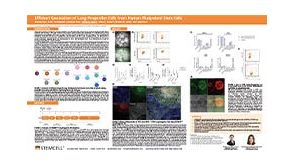 科学海报Efficient Generation of Lung Progenitor Cells From Human Pluripotent Stem Cells

 沪公网安备31010102008431号