Mobilization of hematopoietic stem and progenitor cells (HSPCs) from bone marrow into peripheral blood by the cytokine granulocyte colony-stimulating factor (G-CSF) has become the preferred source of HSPCs for stem cell transplants. However,G-CSF fails to mobilize sufficient numbers of stem cells in up to 10% of donors,precluding autologous transplantation in those donors or substantially delaying transplant recovery time. Consequently,new regimens are needed to increase the number of stem cells in peripheral blood upon mobilization. Using a forward genetic approach in mice,we mapped the gene encoding the epidermal growth factor receptor (Egfr) to a genetic region modifying G-CSF-mediated HSPC mobilization. Amounts of EGFR in HSPCs inversely correlated with the cells' ability to be mobilized by G-CSF,implying a negative role for EGFR signaling in mobilization. In combination with G-CSF treatment,genetic reduction of EGFR activity in HSPCs (in waved-2 mutant mice) or treatment with the EGFR inhibitor erlotinib increased mobilization. Increased mobilization due to suppression of EGFR activity correlated with reduced activity of cell division control protein-42 (Cdc42),and genetic Cdc42 deficiency in vivo also enhanced G-CSF-induced mobilization. Our findings reveal a previously unknown signaling pathway regulating stem cell mobilization and provide a new pharmacological approach for improving HSPC mobilization and thereby transplantation outcomes.
View Publication
产品类型:
产品号#:
03234
产品名:
MethoCult™ M3234
T. Yogo et al. (Jul 2025)
Nature Communications 16
Innovative identification technologies for hematopoietic stem cells (HSCs) have expanded the scope of stem cell biology. Clinically,the functional quality of HSCs critically influences the safety and therapeutic efficacy of stem cell therapies. However,most analytical techniques capture only a single snapshot,disregarding the temporal context. A comprehensive understanding of the temporal heterogeneity of HSCs necessitates live-cell,real-time and non-invasive analysis. Here,we developed a prediction system for HSC diversity by integrating single-HSC ex vivo expansion technology with quantitative phase imaging (QPI)-driven machine learning. By analyzing the cellular kinetics of individual HSCs,we discovered previously undetectable diversity that snapshot analysis cannot resolve. The QPI-driven algorithm quantitatively evaluates stemness at the single-cell level and leverages temporal information to significantly improve prediction accuracy. This platform advances the field from snapshot-based identification of HSCs to dynamic,time-resolved prediction of their functional quality based on past cellular kinetics. Subject terms: Haematopoietic stem cells,Stem-cell differentiation,Self-renewal,Imaging
View Publication
NK cell transfer overcomes resistance to PD-(L)1 therapy in aged mice
BackgroundCancer is the leading cause of death among older adults. Although the integration of immunotherapy has revolutionized the therapeutic landscape of cancer,the complex interactions between age and immunotherapy efficacy remain incompletely defined. Here,we aimed to elucidate the relationship between aging and immunotherapy resistance.MethodsFlow cytometry was performed to evaluate the infiltration of immune cells in the tumor microenvironment (TME). In vivo T cell proliferation,cytotoxicity and migration assays were performed to evaluate the antitumor capacity of tumor antigen-specific CD8+ T cells in mice. Real-time quantitative PCR (qPCR) was used to investigate the expression of IFN-γ-associated gene and natural killer (NK)-associated chemokine. Adoptive NK cell transfer was adopted to evaluate the effects of NK cells from young mice in overcoming the immunotherapy resistance of aged mice.ResultsWe found that elderly patients with advanced non-small cell lung cancer (aNSCLC) aged ≥ 75 years exhibited poorer progression-free survival (PFS),overall survival (OS) and a lower clinical response rate after immunotherapy. Mechanistically,we showed that the infiltration of NK cells was significantly reduced in aged mice compared to younger mice. Furthermore,the aged NK cells could also suppress the activation of tumor antigen-specific CD8+ T cells by inhibiting the recruitment and activation of CD103+ dendritic cells (DCs). Adoptive transfer of NK cells from young mice to aged mice promoted TME remodeling,and reversed immunotherapy resistance.ConclusionOur findings revealed the decreased sensitivity of elderly patients to immunotherapy,as well as in aged mice. This may be attributed to the reduction of NK cells in aged mice,which inhibits CD103+ DCs recruitment and its CD86 expression and ultimately leads to immunotherapy resistance.Supplementary InformationThe online version contains supplementary material available at 10.1186/s40164-024-00511-9.
View Publication
Hypoimmune gene edited human pluripotent stem cells (hPSCs) are a promising platform for developing reparative cellular therapies that evade immune rejection. Existing first-generation hypoimmune strategies have used CRISPR/Cas9 editing to modulate genes associated with adaptive (e.g.,T cell) immune responses,but have largely not addressed the innate immune cells (e.g.,monocytes,neutrophils) that mediate inflammation and rejection processes occurring early after graft transplantation. We identified the adhesion molecule ICAM-1 as a novel hypoimmune target that plays multiple critical roles in both adaptive and innate immune responses post-transplantation. In a series of studies,we found that ICAM-1 blocking or knock-out (KO) in hPSC-derived cardiovascular therapies imparted significantly diminished binding of multiple immune cell types. ICAM-1 KO resulted in diminished T cell proliferation responses in vitro and in longer in vivo retention/protection of KO grafts following immune cell encounter in NeoThy humanized mice. The ICAM-1 KO edit was also introduced into existing first-generation hypoimmune hPSCs and prevented immune cell binding,thereby enhancing the overall hypoimmune capacity of the cells. This novel hypoimmune editing strategy has the potential to improve the long-term efficacy and safety profiles of regenerative therapies for cardiovascular pathologies and a number of other diseases. Graphical Abstract ICAM-1 Knock-out in Transendothelial Migration and at the Immune Synapse. Abbreviations: PSC-EC - pluripotent stem cell-derived endothelial cells; KO – knock-out; dSMAC – distal supramolecular activation complex; pSMAC – peripheral supramolecular activation complex; cSMAC – central supramolecular activation complex.
View Publication
产品类型:
产品号#:
19666
18002
18000
100-0404
产品名:
EasySep™ Direct人中性粒细胞分选试剂盒
Easy50 EasySep™磁极
EasySep™磁极
RoboSep™ 人中性粒细胞分选试剂盒
(Mar 2025)
International Journal of Molecular Sciences 26 5
Effects of Vinorelbine on M2 Macrophages in Non-Small Cell Lung Cancer
Tumor-associated macrophages (TAMs) significantly influence tumor progression and patient responses to conventional chemotherapy. However,the interplay between anti-cancer drugs,immune responses in the tumor microenvironment,and their implications for cancer treatment remains poorly understood. This study investigates the effects of vinorelbine on M2 macrophages in lung cancer and its capacity to modulate TAMs toward an M1 phenotype. Peripheral blood mononuclear cells (PBMCs) were polarized into M2 macrophages,and subsequent phenotype alterations upon vinorelbine treatment were assessed. Additionally,we evaluated vinorelbine’s impact on gene and protein expression associated with cancer progression and cell invasion in non-small-cell lung cancer (NSCLC) cells indirectly co-cultured with M2 macrophages. Notably,vinorelbine,particularly at low concentrations,reprogrammed M2 macrophages to exhibit M1-like characteristics. While M2 macrophages enhanced cancer cell invasion,vinorelbine significantly mitigated this effect. M2 macrophages led to the overexpression of numerous genes linked to tumor growth,angiogenesis,invasion,and immune suppression in NSCLC cells,increasing the BCL2/BAX ratio and promoting cellular resistance to apoptosis. The anti-tumor efficacy of vinorelbine appears to be partly attributed to the reprogramming of M2 macrophages to the M1 phenotype,suggesting that low-dose vinorelbine may optimize therapeutic outcomes while minimizing toxicity in cancer patients.
View Publication
C. Hayot et al. (feb 2006)
Toxicology and applied pharmacology 211 1 30--40
Characterization of the activities of actin-affecting drugs on tumor cell migration.
Metastases kill 90{\%} of cancer patients. It is thus a major challenge in cancer therapy to inhibit the spreading of tumor cells from primary tumor sites to those particular organs where metastases are likely to occur. Whereas the actin cytoskeleton is a key component involved in cell migration,agents targeting actin dynamics have been relatively poorly investigated. Consequently,valuable in vitro pharmacological tools are needed to selectively identify this type of agent. In response to the absence of any standardized process,the present work aims to develop a multi-assay strategy for screening actin-affecting drugs with anti-migratory potentials. To validate our approach,we used two cancer cell lines (MCF7 and A549) and three actin-affecting drugs (cytochalasin D,latrunculin A,and jasplakinolide). We quantified the effects of these drugs on the kinetics of actin polymerization in tubes (by means of spectrofluorimetry) and on the dynamics of actin cytoskeletons within whole cells (by means of fluorescence microscopy). Using quantitative videomicroscopy,we investigated the actual effects of the drugs on cell motility. Finally,the combined drug effects on cell motility and cell growth were evaluated by means of a scratch-wound assay. While our results showed concordant drug-induced effects on actin polymerization occurring in vitro in test tubes and within whole cells,the whole cell assay appeared more sensitive than the tube assay. The inhibition of actin polymerization induced by cytochalasin D was paralleled by a decrease in cell motility for both cell types. In the case of jasplakinolide,which induces actin polymerization,while it significantly enhanced the locomotion of the A549 cells,it significantly inhibited that of the MCF-7 ones. All these effects were confirmed by means of the scratch-wound assay except of the jasplakinolide-induced effects on MCF-7 cell motility. These later seemed compensated by an additional effect occurring during wound recolonization (possibly acting on the cell growth features). In conclusion,the use of multi-assays with different levels of sophistication and biological relevance is recommended in the screening of new actin-affecting drugs with potentially anti-migratory effects.
View Publication
Hughes JN et al. (MAR 2014)
Differentiation; research in biological diversity 87 3-4 101--110
Regulation of pluripotent cell differentiation by a small molecule, staurosporine
Research in the embryo and in culture has resulted in a sophisticated understanding of many regulators of pluripotent cell differentiation. As a consequence,protocols for the differentiation of pluripotent cells generally rely on a combination of exogenous growth factors and endogenous signalling. Little consideration has been given to manipulating other pathways to achieve pluripotent cell differentiation. The integrity of cell:cell contacts has been shown to influence lineage choice during pluripotent cell differentiation,with disruption of cell:cell contacts promoting mesendoderm formation and maintenance of cell:cell contacts resulting in the preferential formation of neurectoderm. Staurosporine is a broad spectrum inhibitor of serine/threonine kinases which has several effects on cell function,including interruption of cell:cell contacts,decreasing focal contact size,inducing epithelial to mesenchyme transition (EMT) and promoting cell differentiation. The possibility that staurosporine could influence lineage choice from pluripotent cells in culture was investigated. The addition of staurosporine to differentiating mouse EPL resulted in preferential formation of mesendoderm and mesoderm populations,and inhibited the formation of neurectoderm. Addition of staurosporine to human ES cells similarly induced primitive streak marker gene expression. These data demonstrate the ability of staurosporine to influence lineage choice during pluripotent cell differentiation and to mimic the effect of disrupting cell:cell contacts. Staurosporine induced mesendoderm in the absence of known inducers of formation,such as serum and BMP4. Staurosporine induced the expression of mesendoderm markers,including markers that were not induced by BMP4,suggesting it acted as a broad spectrum inducer of molecular gastrulation. This approach has identified a small molecule regulator of lineage choice with potential applications in the commercial development of ES cell derivatives,specifically as a method for forming mesendoderm progenitors or as a culture adjunct to prevent the formation of ectoderm progenitors during pluripotent cell differentiation. ?? 2014.
View Publication
产品类型:
产品号#:
05850
05857
05870
05875
85850
85857
85870
85875
产品名:
mTeSR™1
mTeSR™1
Soncin F and Ward CM (FEB 2011)
Genes 2 1 229--259
The function of E-cadherin in stem cell pluripotency and self-renewal
Embryonic stem (ES) and induced-pluripotent stem (iPS) cells can be grown indefinitely under appropriate conditions whilst retaining the ability to differentiate to cells representative of the three primary germ layers. Such cells have the potential to revolutionize medicine by offering treatment options for a wide range of diseases and disorders as well as providing a model system for elucidating mechanisms involved in development and disease. In recent years,evidence for the function of E-cadherin in regulating pluripotent and self-renewal signaling pathways in ES and iPS cells has emerged. In this review,we discuss the function of E-cadherin and its interacting partners in the context of development and disease. We then describe relevant literature highlighting the function of E-cadherin in establishing and maintaining pluripotent and self-renewal properties of ES and iPS cells. In addition,we present experimental data demonstrating that exposure of human ES cells to the E-cadherin neutralizing antibody SHE78.7 allows culture of these cells in the absence of FGF2-supplemented medium.
View Publication
产品类型:
产品号#:
05850
05857
05870
05875
85850
85857
85870
85875
产品名:
mTeSR™1
mTeSR™1
Wu J et al. (JUL 2014)
PLoS ONE 9 7 e102486
Oxygen transport and stem cell aggregation in stirred-suspension bioreactor cultures
Stirred-suspension bioreactors are a promising modality for large-scale culture of 3D aggregates of pluripotent stem cells and their progeny. Yet,cells within these clusters experience limitations in the transfer of factors and particularly O2 which is characterized by low solubility in aqueous media. Cultured stem cells under different O2 levels may exhibit significantly different proliferation,viability and differentiation potential. Here,a transient diffusion-reaction model was built encompassing the size distribution and ultrastructural characteristics of embryonic stem cell (ESC) aggregates. The model was coupled to experimental data from bioreactor and static cultures for extracting the effective diffusivity and kinetics of consumption of O2 within mouse (mESC) and human ESC (hESC) clusters. Under agitation,mESC aggregates exhibited a higher maximum consumption rate than hESC aggregates. Moreover,the reaction-diffusion model was integrated with a population balance equation (PBE) for the temporal distribution of ESC clusters changing due to aggregation and cell proliferation. Hypoxia was found to be negligible for ESCs with a smaller radius than 100 µm but became appreciable for aggregates larger than 300 µm. The integrated model not only captured the O2 profile both in the bioreactor bulk and inside ESC aggregates but also led to the calculation of the duration that fractions of cells experience a certain range of O2 concentrations. The approach described in this study can be employed for gaining a deeper understanding of the effects of O2 on the physiology of stem cells organized in 3D structures. Such frameworks can be extended to encompass the spatial and temporal availability of nutrients and differentiation factors and facilitate the design and control of relevant bioprocesses for the production of stem cell therapeutics.
View Publication
产品类型:
产品号#:
05850
05857
05870
05875
85850
85857
85870
85875
产品名:
mTeSR™1
mTeSR™1
Li C-S et al. (MAR 2016)
Biomaterials 83 194--206
Fibromodulin reprogrammed cells: A novel cell source for bone regeneration.
Pluripotent or multipotent cell-based therapeutics are vital for skeletal reconstruction in non-healing critical-sized defects since the local endogenous progenitor cells are not often adequate to restore tissue continuity or function. However,currently available cell-based regenerative strategies are hindered by numerous obstacles including inadequate cell availability,painful and invasive cell-harvesting procedures,and tumorigenesis. Previously,we established a novel platform technology for inducing a quiescent stem cell-like stage using only a single extracellular proteoglycan,fibromodulin (FMOD),circumventing gene transduction. In this study,we further purified and significantly increased the reprogramming rate of the yield multipotent FMOD reprogrammed (FReP) cells. We also exposed the 'molecular blueprint' of FReP cell osteogenic differentiation by gene profiling. Radiographic analysis showed that implantation of FReP cells into a critical-sized SCID mouse calvarial defect,contributed to the robust osteogenic capability of FReP cells in a challenging clinically relevant traumatic scenario in vivo. The persistence,engraftment,and osteogenesis of transplanted FReP cells without tumorigenesis in vivo were confirmed by histological and immunohistochemical staining. Taken together,we have provided an extended potency,safety,and molecular profile of FReP cell-based bone regeneration. Therefore,FReP cells present a high potential for cellular and gene therapy products for bone regeneration.
View Publication


 EasySep™小鼠TIL(CD45)正选试剂盒





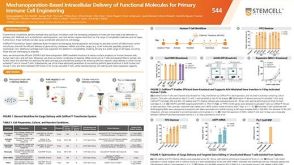 科学海报Mechanoporation-Based Intracellular Delivery of Functional Molecules for Primary Immune Cell Engineering

 沪公网安备31010102008431号