Xing Q et al. (AUG 2014)
Digestive and liver disease : official journal of the Italian Society of Gastroenterology and the Italian Association for the Study of the Liver 46 8 731--737
Hepatectomised patient sera promote hepatocyte differentiation of human-induced pluripotent stem cells.
Background: Human induced pluripotent stem cells,which can be differentiated into hepatocyte-like cells,could provide a source for liver regeneration and bio-artificial liver devices. However,the functionality of hepatocyte-like cells is significantly lower than that of primary hepatocytes. Aims: To investigate whether serum from patients undergoing hepatectomy might promote differentiation from human induced pluripotent stem cells to hepatocyte-like cells. Methods: Serum from patients undergoing hepatectomy (acquired pre-hepatectomy and 3. hours,1 day and 3 days post-hepatectomy) was used to replace foetal bovine serum when differentiating human induced pluripotent stem cells into hepatocyte-like cells. Properties of hepatocyte-like cells were assessed and compared with cells cultured in foetal bovine serum. Results: The differentiation efficiency and functionality of hepatocyte-like cells cultured in human serum 3. hours and 1 day post-hepatectomy were superior to those cultured in foetal bovine serum and human serum pre-hepatectomy. Human serum 3 days post-hepatectomy had an equal effect to that of human serum pre-hepatectomy. Some cytochrome P450 isozyme transcript levels of hepatocyte-like cells cultured in human serum were higher than those cultured in foetal bovine serum. Conclusion: Human serum,particularly that acquired relatively soon after hepatectomy,can enhance the differentiation efficiency and functionality of hepatocyte-like cells derived from human induced pluripotent stem cells. textcopyright 2014 Editrice Gastroenterologica Italiana S.r.l.
View Publication
产品类型:
产品号#:
05850
05857
05870
05875
07920
85850
85857
85870
85875
27845
27945
27840
27865
27940
27965
07922
产品名:
ACCUTASE™
mTeSR™1
mTeSR™1
ACCUTASE™
Ma R et al. (APR 2015)
Thyroid 25 4 455--461
Human embryonic stem cells form functional thyroid follicles.
OBJECTIVE: The molecular events that lead to human thyroid cell speciation remain incompletely characterized. It has been shown that overexpression of the regulatory transcription factors Pax8 and Nkx2-1 (ttf-1) directs murine embryonic stem (mES) cells to differentiate into thyroid follicular cells by initiating a transcriptional regulatory network. Such cells subsequently organized into three-dimensional follicular structures in the presence of extracellular matrix. In the current study,human embryonic stem (hES) cells were studied with the aim of recapitulating this scenario and producing functional human thyroid cell lines. METHODS: Reporter gene tagged pEZ-lentiviral vectors were used to express human PAX8-eGFP and NKX2-1-mCherry in the H9 hES cell line followed by differentiation into thyroid cells directed by Activin A and thyrotropin (TSH). RESULTS: Both transcription factors were expressed efficiently in hES cells expressing either PAX8,NKX2-1,or in combination in the hES cells,which had low endogenous expression of these transcription factors. Further differentiation of the double transfected cells showed the expression of thyroid-specific genes,including thyroglobulin (TG),thyroid peroxidase (TPO),the sodium/iodide symporter (NIS),and the TSH receptor (TSHR) as assessed by reverse transcription polymerase chain reaction and immunostaining. Most notably,the Activin/TSH-induced differentiation approach resulted in thyroid follicle formation and abundant TG protein expression within the follicular lumens. On stimulation with TSH,these hES-derived follicles were also capable of dose-dependent cAMP generation and radioiodine uptake,indicating functional thyroid epithelial cells. CONCLUSION: The induced expression of PAX8 and NKX2-1 in hES cells was followed by differentiation into thyroid epithelial cells and their commitment to form functional three-dimensional neo-follicular structures. The data provide proof of principal that hES cells can be committed to thyroid cell speciation under appropriate conditions.
View Publication
产品类型:
产品号#:
05850
05857
05870
05875
85850
85857
85870
85875
产品名:
mTeSR™1
mTeSR™1
Naujok O et al. ( 2015)
1341 67--85
Gene transfer into pluripotent stem cells via lentiviral transduction
Recombinant lentiviral vectors are powerful tools to stably manipulate human pluripotent stem cells. They can be used to deliver ectopic genes,shRNAs,miRNAs,or any possible genetic DNA sequence into diving and nondividing cells. Here we describe a general protocol for the production of self-inactivating lentiviral vector particles and their purification to high titers by either ultracentrifugation or ultrafiltration. Next we provide a basic procedure to transduce human pluripotent stem cells and propagate clonal cell lines.
View Publication
Non-integrating episomal plasmid-based reprogramming of human amniotic fluid stem cells into induced pluripotent stem cells in chemically defined conditions.
Amniotic fluid stem cells (AFSC) represent an attractive potential cell source for fetal and pediatric cell-based therapies. However,upgrading them to pluripotency confers refractoriness toward senescence,higher proliferation rate and unlimited differentiation potential. AFSC were observed to rapidly and efficiently reacquire pluripotency which together with their easy recovery makes them an attractive cell source for reprogramming. The reprogramming process as well as the resulting iPSC epigenome could potentially benefit from the unspecialized nature of AFSC. iPSC derived from AFSC also have potential in disease modeling,such as Down syndrome or $\$-thalassemia. Previous experiments involving AFSC reprogramming have largely relied on integrative vector transgene delivery and undefined serum-containing,feeder-dependent culture. Here,we describe non-integrative oriP/EBNA-1 episomal plasmid-based reprogramming of AFSC into iPSC and culture in fully chemically defined xeno-free conditions represented by vitronectin coating and E8 medium,a system that we found uniquely suited for this purpose. The derived AF-iPSC lines uniformly expressed a set of pluripotency markers Oct3/4,Nanog,Sox2,SSEA-1,SSEA-4,TRA-1-60,TRA-1-81 in a pattern typical for human primed PSC. Additionally,the cells formed teratomas,and were deemed pluripotent by PluriTest,a global expression microarray-based in-silico pluripotency assay. However,we found that the PluriTest scores were borderline,indicating a unique pluripotent signature in the defined condition. In the light of potential future clinical translation of iPSC technology,non-integrating reprogramming and chemically defined culture are more acceptable.
View Publication
产品类型:
产品号#:
05850
05857
05870
05875
05940
07180
07183
07190
27147
07191
07930
07931
07940
07955
07956
07959
07954
85850
85857
85870
85875
100-1061
07952
100-0763
产品名:
Vitronectin XF™
CellAdhere™ 稀释缓冲液
CryoStor® CS10
CryoStor® CS10
CryoStor® CS10
CryoStor® CS10
CryoStor® CS10
mTeSR™1
mTeSR™1
CryoStor® CS10
CryoStor® CS10
Vitronectin XF™
Shimada H et al. (JAN 2012)
Biochemical and Biophysical Research Communications 417 2 659--664
Accelerated generation of human induced pluripotent stem cells with retroviral transduction and chemical inhibitors under physiological hypoxia
Induced pluripotent stem (iPS) cells are generated from somatic cells by the forced expression of a defined set of pluripotency-associated transcription factors. Human iPS cells can be propagated indefinitely,while maintaining the capacity to differentiate into all cell types in the body except for extra-embryonic tissues. This technology not only represents a new way to use individual-specific stem cells for regenerative medicine but also constitutes a novel method to obtain large amounts of disease-specific cells for biomedical research. Despite their great potential,the long reprogramming process (up to 1. month) remains one of the most significant challenges facing standard virus-mediated methodology. In this study,we report the accelerated generation of human iPS cells from adipose-derived stem (ADS) cells,using a new combination of chemical inhibitors under a setting of physiological hypoxia in conjunction with retroviral transduction of Oct4,Sox2,Klf4,and L-Myc. Under optimized conditions,we observed human embryonic stem (ES)-like cells as early as 6. days after the initial retroviral transduction. This was followed by the emergence of fully reprogrammed cells bearing Tra-1-81-positive and DsRed transgene-silencing properties on day 10. The resulting cell lines resembled human ES cells in many respects including proliferation rate,morphology,pluripotency-associated markers,global gene expression patterns,genome-wide DNA methylation states,and the ability to differentiate into all three of the germ layers,both in vitro and in vivo. Our method,when combined with chemical inhibitors under conditions of physiological hypoxia,offers a powerful tool for rapidly generating bona fide human iPS cells and facilitates the application of iPS cell technology to biomedical research. textcopyright 2011 Elsevier Inc.
View Publication
产品类型:
产品号#:
05850
05857
05870
05875
85850
85857
85870
85875
产品名:
mTeSR™1
mTeSR™1
Yew CW and Tan YJ ( 2016)
1426 225--33
Generation of mouse monoclonal antibodies specific to Chikungunya virus using ClonaCell-HY hybridoma cloning kit
Monoclonal antibodies offer high specificity and this makes it an important tool for molecular biology,biochemistry and medicine. Typically,monoclonal antibodies are generated by fusing mouse spleen cells that have been immunized with the desired antigen with myeloma cells to create immortalized hybridomas. Here,we describe the generation of monoclonal antibodies that are specific to Chikungunya virus using ClonaCell-HY system.
View Publication
BAFF/BLyS can potentiate B-cell selection with the B-cell coreceptor complex.
The tumor necrosis factor (TNF)-like ligand BAFF/BLyS (B-cell activating factor of the TNF family/B-lymphocyte stimulator) is a potent B-cell survival factor,yet its functional relationship with other B-cell surface molecules such as CD19 and CD40 is poorly understood. We found that follicular dendritic cells (FDCs) in human lymph nodes expressed BAFF abundantly. BAFF up-regulated a B cell-specific transcription factor Pax5/BSAP (Pax5/B cell-specific activator protein) activity and its target CD19,a major component of the B-cell coreceptor complex,and synergistically enhanced CD19 phosphorylation by B-cell antigen receptor (BCR). BAFF further enhanced B-cell proliferation,immunoglobulin G (IgG) production,and reactivity to CD154 by BCR/CD19 coligation and interleukin-15 (IL-15). Our results suggest that BAFF may play an important role in FDC-B-cell interactions through the B-cell coreceptor complex and a possibly sequential link between the T cell-independent and -dependent B-cell responses in the germinal centers.
View Publication
产品类型:
产品号#:
03800
03801
03802
03803
03804
03805
03806
产品名:
ClonaCell™-HY杂交瘤试剂盒
ClonaCell™-HY培养基A
ClonaCell™-HY 培养基 B
ClonaCell™-HY 培养基 C
ClonaCell™-HY 培养基 D
ClonaCell™-HY 培养基 E
ClonaCell™-HY PEG
Fan Y et al. (NOV 2013)
Tissue Engineering Part A 20 3-4 131128071850006
Facile engineering of xeno-free microcarriers for the scalable cultivation of human pluripotent stem cells in stirred suspension.
A prerequisite for the realization of human pluripotent stem cell (hPSC) therapies is the development of bioprocesses for generating clinically relevant quantities of undifferentiated hPSCs and their derivatives under xeno-free conditions. Microcarrier stirred-suspension bioreactors are an appealing modality for the scalable expansion and directed differentiation of hPSCs. Comparative analyses of commercially available microcarriers clearly show the need for developing synthetic substrates supporting the adhesion and growth of hPSCs in three-dimensional cultures under agitation-induced shear. Moreover,the low seeding efficiencies during microcarrier loading with hPSC clusters poses a significant process bottleneck. To that end,a novel protocol was developed increasing hPSC seeding efficiency from 30% to over 80% and substantially shortening the duration of microcarrier loading. Importantly,this method was combined with the engineering of polystyrene microcarriers by surface conjugation of a vitronectin-derived peptide,which was previously shown to support the growth of human embryonic stem cells. Cells proliferated on peptide-conjugated beads in static culture but widespread detachment was observed after exposure to stirring. This prompted additional treatment of the microcarriers with a synthetic polymer commonly used to enhance cell adhesion. hPSCs were successfully cultivated on these microcarriers in stirred suspension vessels for multiple consecutive passages with attachment efficiencies close to 40%. Cultured cells exhibited on average a 24-fold increase in concentration per 6-day passage,over 85% viability,and maintained a normal karyotype and the expression of pluripotency markers such as Nanog,Oct4,and SSEA4. When subjected to spontaneous differentiation in embryoid body cultures or directed differentiation to the three embryonic germ layers,the cells adopted respective fates displaying relevant markers. Lastly,engineered microcarriers were successfully utilized for the expansion and differentiation of hPSCs to mesoderm progeny in stirred suspension vessels. Hence,we demonstrate a strategy for the facile engineering of xeno-free microcarriers for stirred-suspension cultivation of hPSCs. Our findings support the use of microcarrier bioreactors for the scalable,xeno-free propagation and differentiation of human stem cells intended for therapies.
View Publication


 EasySep™小鼠TIL(CD45)正选试剂盒





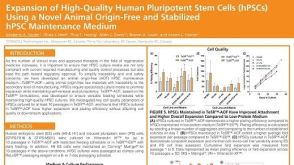 科学海报Expansion of High-Quality Human Pluripotent Stem Cells (hPSCs) Using a Novel Animal Origin-Free and Stabilized hPSC Maintenance Medium

 沪公网安备31010102008431号