Sato K et al. (JAN 2006)
The Journal of experimental medicine 203 1 239--50
TRAIL-expressing T cells induce apoptosis of vascular smooth muscle cells in the atherosclerotic plaque.
Acute coronary syndromes (ACS) are precipitated by a rupture of the atherosclerotic plaque,often at the site of T cell and macrophage infiltration. Here,we show that plaque-infiltrating CD4 T cells effectively kill vascular smooth muscle cells (VSMC). VSMCs sensitive to T cell-mediated killing express the death receptor DR5 (TNF-related apoptosis-inducing ligand [TRAIL] receptor 2),and anti-TRAIL and anti-DR5 antibodies block T cell-mediated apoptosis. CD4 T cells that express TRAIL upon stimulation are expanded in patients with ACS and more effectively induce VSMC apoptosis. Adoptive transfer of plaque-derived CD4 T cells into immunodeficient mice that are engrafted with human atherosclerotic plaque results in apoptosis of VSMCs,which was prevented by coadministration of anti-TRAIL antibody. These data identify that the death pathway is triggered by TRAIL-producing CD4 T cells as a direct mechanism of VSMC apoptosis,a process which may lead to plaque destabilization.
View Publication
D. G. W. Alanine et al. (jun 2019)
Cell 178 1 216--228
Human Antibodies that Slow Erythrocyte Invasion Potentiate Malaria-Neutralizing Antibodies.
The Plasmodium falciparum reticulocyte-binding protein homolog 5 (PfRH5) is the leading target for next-generation vaccines against the disease-causing blood-stage of malaria. However,little is known about how human antibodies confer functional immunity against this antigen. We isolated a panel of human monoclonal antibodies (mAbs) against PfRH5 from peripheral blood B cells from vaccinees in the first clinical trial of a PfRH5-based vaccine. We identified a subset of mAbs with neutralizing activity that bind to three distinct sites and another subset of mAbs that are non-functional,or even antagonistic to neutralizing antibodies. We also identify the epitope of a novel group of non-neutralizing antibodies that significantly reduce the speed of red blood cell invasion by the merozoite,thereby potentiating the effect of all neutralizing PfRH5 antibodies as well as synergizing with antibodies targeting other malaria invasion proteins. Our results provide a roadmap for structure-guided vaccine development to maximize antibody efficacy against blood-stage malaria.
View Publication
产品类型:
产品号#:
19054
19054RF
产品名:
EasySep™人B细胞富集试剂盒
RoboSep™ 人B细胞富集试剂盒含滤芯吸头
S. Balu et al. ( 2011)
The Journal of Immunology 186 3113-3119
A novel human IgA monoclonal antibody protects against tuberculosis
Abs have been shown to be protective in passive immunotherapy of tuberculous infection using mouse experimental models. In this study,we report on the properties of a novel human IgA1,constructed using a single-chain variable fragment clone (2E9),selected from an Ab phage library. The purified Ab monomer revealed high binding affinities for the mycobacterial ?-crystallin Ag and for the human Fc?RI (CD89) IgA receptor. Intranasal inoculations with 2E9IgA1 and recombinant mouse IFN-? significantly inhibited pulmonary H37Rv infection in mice transgenic for human CD89 but not in CD89-negative littermate controls,suggesting that binding to CD89 was necessary for the IgA-imparted passive protection. 2E9IgA1 added to human whole-blood or monocyte cultures inhibited luciferase-tagged H37Rv infection although not for all tested blood donors. Inhibition by 2E9IgA1 was synergistic with human rIFN-? in cultures of purified human monocytes but not in whole-blood cultures. The demonstration of the mandatory role of Fc?RI (CD89) for human IgA-mediated protection is important for understanding of the mechanisms involved and also for translation of this approach toward development of passive immunotherapy of tuberculosis.
View Publication
产品类型:
产品号#:
07801
19058
产品名:
EasySep™人单核细胞富集试剂盒(不去除CD16)
R. J. Komban et al. ( 2019)
Nature communications 10 1 2423
Activated Peyer's patch B cells sample antigen directly from M cells in the subepithelial dome.
The germinal center (GC) reaction in Peyer's patches (PP) requires continuous access to antigens,but how this is achieved is not known. Here we show that activated antigen-specific CCR6+CCR1+GL7- B cells make close contact with M cells in the subepithelial dome (SED). Using in situ photoactivation analysis of antigen-specific SED B cells,we find migration of cells towards the GC. Following antigen injection into ligated intestinal loops containing PPs,40{\%} of antigen-specific SED B cells bind antigen within 2 h,whereas unspecifc cells do not,indicating B cell-receptor involvment. Antigen-loading is not observed in M cell-deficient mice,but is unperturbed in mice depleted of classical dendritic cells (DC). Thus,we report a M cell-B cell antigen-specific transporting pathway in PP that is independent of DC. We propose that this antigen transporting pathway has a critical role in gut IgA responses,and should be taken into account when developing mucosal vaccines.
View Publication
D. Park et al. (may 2019)
Scientific reports 9 1 7094
Differences in the molecular signatures of mucosal-associated invariant T cells and conventional T cells.
Mucosal-associated invariant T (MAIT) cells exhibit different characteristics from those of TCRalpha7.2- conventional T cells. They play important roles in various inflammatory diseases,including rheumatoid arthritis and inflammatory bowel disease. MAIT cells express a single T cell receptor alpha chain,TCRalpha7.2 segment associated with Jalpha33 and CDR3 with fixed length,which recognizes bacteria-derived vitamin B metabolites. However,the characteristics of MAIT cells and TCRalpha7.2+ CD161- T cells have never been compared. Here,we performed RNA sequencing to compare the properties of MAIT cells,TCRalpha7.2- conventional T cells and TCRalpha7.2+ CD161- T cells. Genome-wide transcriptomes of MAIT cells,TCRalpha7.2- conventional T cells,and TCRalpha7.2+ CD161- T cells were compared and analyzed using causal network analysis. This is the first report comparing the transcriptomes of MAIT cells,TCRalpha7.2- conventional T cells and TCRalpha7.2+ CD161- T cells. We also identified the predominant signaling pathways of MAIT cells,which differed from those of TCRalpha7.2- conventional T cells and TCRalpha7.2+ CD161- T cells,through a gene set enrichment test and upstream regulator analysis and identified the genes responsible for the characteristic MAIT cell phenotypes. Our study advances the complete understanding of MAIT biology.
View Publication
产品类型:
产品号#:
15021
15061
产品名:
RosetteSep™人T细胞富集抗体混合物
RosetteSep™人T细胞富集抗体混合物
Glatigny S et al. (MAY 2016)
Journal of Immunology 196 9 3542--6
Cutting Edge: Integrin α4 Is Required for Regulatory B Cell Control of Experimental Autoimmune Encephalomyelitis.
The neutralization of integrin α4 (Itga4) is currently used as treatment in multiple sclerosis. Although most studies have focused on its function on lymphocyte migration to the CNS,we have uncovered the importance of Itga4 for the generation of regulatory B cells in peripheral immune organs and their control of pathogenic T cell response and CNS pathology. Our study underscores the importance of looking at the dual role of B cells in CNS autoimmunity and provides important perspectives regarding the efficacy and side effects associated with Itga4 neutralization and other B cell-targeting therapies.
View Publication
产品类型:
产品号#:
19854
19854RF
产品名:
EasySep™小鼠B细胞分选试剂盒
RoboSep™ 小鼠B细胞分选试剂盒
North JR et al. (MAY 2016)
Journal of biotechnology 226 24--34
A novel approach for emerging and antibiotic resistant infections: Innate defense regulators as an agnostic therapy.
Innate Defense Regulators (IDRs) are short synthetic peptides that target the host innate immune system via an intracellular adaptor protein which functions at key signaling nodes. In this work,further details of the mechanism of action of IDRs have been discovered. The studies reported here show that the lead clinical IDR,SGX94,has broad-spectrum activity against Gram-negative and Gram-positive bacterial infections caused by intracellular or extracellular bacteria and also complements the actions of standard of care antibiotics. Based on in vivo and primary cell culture studies,this activity is shown to result from the primary action of SGX94 on tissue-resident cells and subsequent secondary signaling to activate myeloid-derived cells,resulting in enhanced bacterial clearance and increased survival. Data from non-clinical and clinical studies also show that SGX94 treatment modulates pro-inflammatory and anti-inflammatory cytokine levels,thereby mitigating the deleterious inflammatory consequences of innate immune activation. Since they act through host pathways to provide both broad-spectrum anti-infective capability as well as control of inflammation,IDRs are unlikely to be impacted by resistance mechanisms and offer potential clinical advantages in the fight against emerging and antibiotic resistant bacterial infections.
View Publication


 EasySep™小鼠TIL(CD45)正选试剂盒






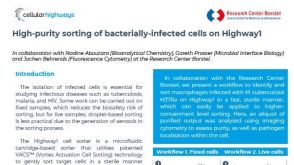 产品手册Highway1™: High-Purity Sorting of Bacterially-Infected Cells


 沪公网安备31010102008431号