Progenitor cell dose determines the pace and completeness of engraftment in a xenograft model for cord blood transplantation.
Two critical concerns in clinical cord blood transplantation are the initial time to engraftment and the subsequent restoration of immune function. These studies measured the impact of progenitor cell dose on both the pace and strength of hematopoietic reconstitution by transplanting nonobese diabetic/severe combined immunodeficiency/interleukin-2 receptor-gamma-null (NSγ) mice with lineage-depleted aldehyde dehydrogenase-bright CD34(+) human cord blood progenitors. The progress of each transplant was monitored over an extended time course by repeatedly analyzing the peripheral blood for human hematopoietic cells. In vivo human hematopoietic development was complete. After long-term transplantation assays (≥ 19 weeks),human T-cell development was documented within multiple tissues in 16 of 32 NSγ mice. Human T-cell differentiation was active within NSγ thymuses,as documented by the presence of CD4(+) CD8(+) T-cell progenitors as well as T-cell receptor excision circles. It is important to note that although myeloid and B-cell engraftment was detected as early as 4 weeks after transplantation,human T-cell development was exclusively late onset. High progenitor cell doses were associated with a robust human hematopoietic chimerism that accelerated both initial time to engraftment and subsequent T-cell development. At lower progenitor cell doses,the chimerism was weak and the human hematopoietic lineage development was frequently incomplete.
View Publication
Yasui K et al. (JAN 2003)
Stem cells (Dayton,Ohio) 21 2 143--51
Differences between peripheral blood and cord blood in the kinetics of lineage-restricted hematopoietic cells: implications for delayed platelet recovery following cord blood transplantation.
Cord blood (CB) cells are a useful source of hematopoietic cells for transplantation. The hematopoietic activities of CB cells are different from those of bone marrow and peripheral blood (PB) cells. Platelet recovery is significantly slower after transplantation with CB cells than with cells from other sources. However,the cellular mechanisms underlying these differences have not been elucidated. We compared the surface marker expression profiles of PB and CB hematopoietic cells. We focused on two surface markers of hematopoietic cell immaturity,i.e.,CD34 and AC133. In addition to differences in surface marker expression,the PB and CB cells showed nonidentical differentiation pathways from AC133(+)CD34(+) (immature) hematopoietic cells to terminally differentiated cells. The majority of the AC133(+)CD34(+) PB cells initially lost AC133 expression and eventually became AC133(-)CD34(-) cells. In contrast,the AC133(+)CD34(+) CB cells did not go through the intermediate AC133(-)CD34(+) stage and lost both markers simultaneously. Meanwhile,the vast majority of megakaryocyte progenitors were of the AC133(-)CD34(+) phenotype. We conclude that the delayed recovery of platelets after CB transplantation is due to both subpopulation distribution and the process of differentiation from AC133(+)CD34(+) cells.
View Publication


 EasySep™小鼠TIL(CD45)正选试剂盒




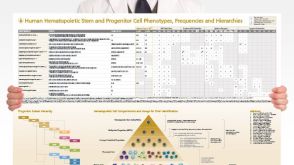 挂图Human Hematopoietic Stem and Progenitor Cell Phenotyping Overview of subset surface markers, frequencies and assays for analysis
 沪公网安备31010102008431号