C.-W. J. Lio et al. (apr 2019)
Science immunology 4 34
TET enzymes augment activation-induced deaminase (AID) expression via 5-hydroxymethylcytosine modifications at the Aicda superenhancer.
TET enzymes are dioxygenases that promote DNA demethylation by oxidizing the methyl group of 5-methylcytosine to 5-hydroxymethylcytosine (5hmC). Here,we report a close correspondence between 5hmC-marked regions,chromatin accessibility and enhancer activity in B cells,and a strong enrichment for consensus binding motifs for basic region-leucine zipper (bZIP) transcription factors at TET-responsive genomic regions. Functionally,Tet2 and Tet3 regulate class switch recombination (CSR) in murine B cells by enhancing expression of Aicda,which encodes the activation-induced cytidine deaminase (AID) enzyme essential for CSR. TET enzymes deposit 5hmC,facilitate DNA demethylation,and maintain chromatin accessibility at two TET-responsive enhancer elements,TetE1 and TetE2,located within a superenhancer in the Aicda locus. Our data identify the bZIP transcription factor,ATF-like (BATF) as a key transcription factor involved in TET-dependent Aicda expression. 5hmC is not deposited at TetE1 in activated Batf-deficient B cells,indicating that BATF facilitates TET recruitment to this Aicda enhancer. Our study emphasizes the importance of TET enzymes for bolstering AID expression and highlights 5hmC as an epigenetic mark that captures enhancer dynamics during cell activation.
View Publication
产品类型:
产品号#:
19854
19854RF
产品名:
EasySep™小鼠B细胞分选试剂盒
RoboSep™ 小鼠B细胞分选试剂盒
Y. Ode et al. (apr 2019)
Scientific reports 9 1 6252
Cold-inducible RNA-binding Protein Induces Neutrophil Extracellular Traps in the Lungs during Sepsis.
Extracellular cold-inducible RNA-binding protein (CIRP) exaggerates inflammation and tissue injury in sepsis. Neutrophil extracellular traps (NETs) are released by activated neutrophils during sepsis. NETs contribute to pathogen clearance,but excessive NET formation (NETosis) causes inflammation and tissue damage. Peptidylarginine deiminase 4 (PAD4) is associated with NETosis by increasing histone citrullination and chromatin decondensation. We hypothesized that CIRP induces NETosis in the lungs during sepsis via upregulating PAD4 expression. Sepsis was induced in C57BL/6 wild-type (WT) and CIRP-/- mice by cecal ligation and puncture (CLP). After 20 h of CLP induction,NETs in the lungs of WT and CIRP-/- mice were quantified by flow cytometry by staining the single cell suspensions with MPO and CitH3 Abs. PAD4 expression in the lungs of WT and CIRP-/- mice after sepsis was assessed by Western blotting. In vitro effects of recombinant mouse (rm) CIRP for NETosis and PAD4 expression in the bone marrow-derived neutrophils (BMDN) were assessed by flow cytometry and Western blotting,respectively. After 20 h of CLP,NETosis in the lungs was significantly decreased in CIRP-/- mice compared to WT mice,which also correlated with the decreased PAD4 expression. Intratracheal administration of rmCIRP into WT mice significantly increased NETosis and PAD4 expression in the lungs compared to vehicle-injected mice. In vitro culture of BMDN with rmCIRP significantly increased NETosis and PAD4 expression compared to PBS-treated control. Fluorescence microscopy revealed typical web-like structures consistent with NETs in rmCIRP-treated BMDN. Thus,CIRP serves as a novel inducer of NETosis via PAD4 during sepsis.
View Publication
Human CD68 promoter GFP transgenic mice allow analysis of monocyte to macrophage differentiation in vivo.
The recruitment of monocytes and their differentiation into macrophages at sites of inflammation are key events in determining the outcome of the inflammatory response and initiating the return to tissue homeostasis. To study monocyte trafficking and macrophage differentiation in vivo,we have generated a novel transgenic reporter mouse expressing a green fluorescent protein (GFP) under the control of the human CD68 promoter. CD68-GFP mice express high levels of GFP in both monocyte and embryo-derived tissue resident macrophages in adult animals. The human CD68 promoter drives GFP expression in all CD115(+) monocytes of adult blood,spleen,and bone marrow; we took advantage of this to directly compare the trafficking of bone marrow-derived CD68-GFP monocytes to that of CX3CR1(GFP) monocytes in vivo using a sterile zymosan peritonitis model. Unlike CX3CR1(GFP) monocytes,which downregulate GFP expression on differentiation into macrophages in this model,CD68-GFP monocytes retain high-level GFP expression for 72 hours after differentiation into macrophages,allowing continued cell tracking during resolution of inflammation. In summary,this novel CD68-GFP transgenic reporter mouse line represents a powerful resource for analyzing monocyte mobilization and monocyte trafficking as well as studying the fate of recruited monocytes in models of acute and chronic inflammation.
View Publication
产品类型:
产品号#:
18102
19761
19761RF
产品名:
EasyPlate™ EasySep™磁极
Gracias DT et al. (FEB 2016)
Journal of Immunology 196 3 1186--98
Phosphatidylinositol 3-Kinase p110δ Isoform Regulates CD8+ T Cell Responses during Acute Viral and Intracellular Bacterial Infections.
The p110δ isoform of PI3K is known to play an important role in immunity,yet its contribution to CTL responses has not been fully elucidated. Using murine p110δ-deficient CD8(+) T cells,we demonstrated a critical role for the p110δ subunit in the generation of optimal primary and memory CD8(+) T cell responses. This was demonstrated in both acute viral and intracellular bacterial infections in mice. We show that p110δ signaling is required for CD8(+) T cell activation,proliferation and effector cytokine production. We provide evidence that the effects of p110δ signaling are mediated via Akt activation and through the regulation of TCR-activated oxidative phosphorylation and aerobic glycolysis. In light of recent clinical trials that employ drugs targeting p110δ in certain cancers and other diseases,our study suggests caution in using these drugs in patients,as they could potentially increase susceptibility to infectious diseases. These studies therefore reveal a novel and direct role for p110δ signaling in in vivo CD8(+) T cell immunity to microbial pathogens.
View Publication
产品类型:
产品号#:
19858
19858RF
产品名:
EasySep™小鼠Naïve CD8+ T细胞分选试剂盒
RoboSep™ 小鼠Naïve CD8+ T细胞分选试剂盒
Valsecchi R et al. (APR 2016)
Blood 127 16 1987--97
HIF-1α regulates the interaction of chronic lymphocytic leukemia cells with the tumor microenvironment.
Hypoxia-inducible transcription factors (HIFs) regulate a wide array of adaptive responses to hypoxia and are often activated in solid tumors and hematologic malignancies due to intratumoral hypoxia and emerging new layers of regulation. We found that in chronic lymphocytic leukemia (CLL),HIF-1α is a novel regulator of the interaction of CLL cells with protective leukemia microenvironments and,in turn,is regulated by this interaction in a positive feedback loop that promotes leukemia survival and propagation. Through unbiased microarray analysis,we found that in CLL cells,HIF-1α regulates the expression of important chemokine receptors and cell adhesion molecules that control the interaction of leukemic cells with bone marrow and spleen microenvironments. Inactivation of HIF-1α impairs chemotaxis and cell adhesion to stroma,reduces bone marrow and spleen colonization in xenograft and allograft CLL mouse models,and prolongs survival in mice. Of interest,we found that in CLL cells,HIF-1α is transcriptionally regulated after coculture with stromal cells. Furthermore,HIF-1α messenger RNA levels vary significantly within CLL patients and correlate with the expression of HIF-1α target genes,including CXCR4,thus further emphasizing the relevance of HIF-1α expression to CLL pathogenesis.
View Publication
产品类型:
产品号#:
19554
19554RF
产品名:
EasySep™人Pan-B细胞富集试剂盒
RoboSep™ 人Pan-B细胞富集试剂盒
Deets KA et al. (MAR 2016)
Journal of Immunology 196 6 2450--5
Cutting Edge: Enhanced Clonal Burst Size Corrects an Otherwise Defective Memory Response by CD8+ Recent Thymic Emigrants.
The youngest peripheral T cells (recent thymic emigrants [RTEs]) are functionally distinct from naive T cells that have completed postthymic maturation. We assessed the RTE memory response and found that RTEs produced less granzyme B than their mature counterparts during infection but proliferated more and,therefore,generated equivalent target killing in vivo. Postinfection,RTE numbers contracted less dramatically than those of mature T cells,but RTEs were delayed in their transition to central memory,displaying impaired expression of CD62L,IL-2,Eomesodermin,and CXCR4,which resulted in impaired bone marrow localization. RTE-derived and mature memory cells expanded equivalently during rechallenge,indicating that the robust proliferative capacity of RTEs was maintained independently of central memory phenotype. Thus,the diminished effector function and delayed central memory differentiation of RTE-derived memory cells are counterbalanced by their increased proliferative capacity,driving the efficacy of the RTE response to that of mature T cells.
View Publication
产品类型:
产品号#:
19853
19853RF
产品名:
EasySep™小鼠CD8+ T细胞分选试剂盒
RoboSep™ 小鼠CD8+ T细胞分选试剂盒
Gleeson LE et al. (MAR 2016)
Journal of Immunology 196 6 2444--9
Cutting Edge: Mycobacterium tuberculosis Induces Aerobic Glycolysis in Human Alveolar Macrophages That Is Required for Control of Intracellular Bacillary Replication.
Recent advances in immunometabolism link metabolic changes in stimulated macrophages to production of IL-1β,a crucial cytokine in the innate immune response to Mycobacterium tuberculosis. To investigate this pathway in the host response to M. tuberculosis,we performed metabolic and functional studies on human alveolar macrophages,human monocyte-derived macrophages,and murine bone marrow-derived macrophages following infection with the bacillus in vitro. M. tuberculosis infection induced a shift from oxidative phosphorylation to aerobic glycolysis in macrophages. Inhibition of this shift resulted in decreased levels of proinflammatory IL-1β and decreased transcription of PTGS2,increased levels of anti-inflammatory IL-10,and increased intracellular bacillary survival. Blockade or absence of IL-1R negated the impact of aerobic glycolysis on intracellular bacillary survival,demonstrating that infection-induced glycolysis limits M. tuberculosis survival in macrophages through induction of IL-1β. Drugs that manipulate host metabolism may be exploited as adjuvants for future therapeutic and vaccination strategies.
View Publication
产品类型:
产品号#:
19359
19359RF
100-0697
产品名:
EasySep™人单核细胞分选试剂盒
RoboSep™ 人单核细胞分选试剂盒
EasySep™人单核细胞分选试剂盒
Thompson EA et al. (APR 2016)
Journal of Immunology 196 7 3054--63
Shortened Intervals during Heterologous Boosting Preserve Memory CD8 T Cell Function but Compromise Longevity.
Developing vaccine strategies to generate high numbers of Ag-specific CD8 T cells may be necessary for protection against recalcitrant pathogens. Heterologous prime-boost-boost immunization has been shown to result in large quantities of functional memory CD8 T cells with protective capacities and long-term stability. Completing the serial immunization steps for heterologous prime-boost-boost can be lengthy,leaving the host vulnerable for an extensive period of time during the vaccination process. We show in this study that shortening the intervals between boosting events to 2 wk results in high numbers of functional and protective Ag-specific CD8 T cells. This protection is comparable to that achieved with long-term boosting intervals. Short-boosted Ag-specific CD8 T cells display a canonical memory T cell signature associated with long-lived memory and have identical proliferative potential to long-boosted T cells Both populations robustly respond to antigenic re-exposure. Despite this,short-boosted Ag-specific CD8 T cells continue to contract gradually over time,which correlates to metabolic differences between short- and long-boosted CD8 T cells at early memory time points. Our studies indicate that shortening the interval between boosts can yield abundant,functional Ag-specific CD8 T cells that are poised for immediate protection; however,this is at the expense of forming stable long-term memory.
View Publication
产品类型:
产品号#:
17951
17951RF
17952
17952RF
19254
19254RF
19853
19853RF
100-0695
100-0696
产品名:
EasySep™人T细胞分选试剂盒
RoboSep™ 人T细胞分选试剂盒
EasySep™人CD4+ T细胞分选试剂盒
RoboSep™ 人CD4+ T细胞分选试剂盒
EasySep™人Naïve B细胞富集试剂盒
RoboSep™ 人Naïve B细胞富集试剂盒含滤芯吸头
EasySep™小鼠CD8+ T细胞分选试剂盒
RoboSep™ 小鼠CD8+ T细胞分选试剂盒
EasySep™人T细胞分选试剂盒
EasySep™人CD4+ T细胞分离试剂盒
Khazen R et al. (MAR 2016)
Nature Communications 7 10823
Melanoma cell lysosome secretory burst neutralizes the CTL-mediated cytotoxicity at the lytic synapse.
Human melanoma cells express various tumour antigens that are recognized by CD8(+) cytotoxic T lymphocytes (CTLs) and elicit tumour-specific responses in vivo. However,natural and therapeutically enhanced CTL responses in melanoma patients are of limited efficacy. The mechanisms underlying CTL effector phase failure when facing melanomas are still largely elusive. Here we show that,on conjugation with CTL,human melanoma cells undergo an active late endosome/lysosome trafficking,which is intensified at the lytic synapse and is paralleled by cathepsin-mediated perforin degradation and deficient granzyme B penetration. Abortion of SNAP-23-dependent lysosomal trafficking,pH perturbation or impairment of lysosomal proteolytic activity restores susceptibility to CTL attack. Inside the arsenal of melanoma cell strategies to escape immune surveillance,we identify a self-defence mechanism based on exacerbated lysosome secretion and perforin degradation at the lytic synapse. Interfering with this synaptic self-defence mechanism might be useful in potentiating CTL-mediated therapies in melanoma patients.
View Publication
产品类型:
产品号#:
17953
17953RF
100-0710
产品名:
EasySep™人CD8+ T细胞分选试剂盒
RoboSep™ 人CD8+ T细胞分选试剂盒
EasySep™人CD8+ T细胞分选试剂盒
Flach A-C et al. (MAR 2016)
Proceedings of the National Academy of Sciences of the United States of America 113 12 3323--8
Autoantibody-boosted T-cell reactivation in the target organ triggers manifestation of autoimmune CNS disease.
Multiple sclerosis (MS) is caused by T cells that are reactive for brain antigens. In experimental autoimmune encephalomyelitis,the animal model for MS,myelin-reactive T cells initiate the autoimmune process when entering the nervous tissue and become reactivated upon local encounter of their cognate CNS antigen. Thereby,the strength of the T-cellular reactivation process within the CNS tissue is crucial for the manifestation and the severity of the clinical disease. Recently,B cells were found to participate in the pathogenesis of CNS autoimmunity,with several diverse underlying mechanisms being under discussion. We here report that B cells play an important role in promoting the initiation process of CNS autoimmunity. Myelin-specific antibodies produced by autoreactive B cells after activation in the periphery diffused into the CNS together with the first invading pathogenic T cells. The antibodies accumulated in resident antigen-presenting phagocytes and significantly enhanced the activation of the incoming effector T cells. The ensuing strong blood-brain barrier disruption and immune cell recruitment resulted in rapid manifestation of clinical disease. Therefore,myelin oligodendrocyte glycoprotein (MOG)-specific autoantibodies can initiate disease bouts by cooperating with the autoreactive T cells in helping them to recognize their autoantigen and become efficiently reactivated within the immune-deprived nervous tissue.
View Publication


 EasySep™小鼠TIL(CD45)正选试剂盒






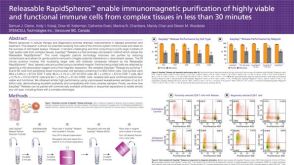 科学海报Releasable RapidSpheres Enable Immunomagnetic Purification of Highly Viable and Functional Immune Cells from Complex Tissues in Less Than 30 Minutes
 沪公网安备31010102008431号