ABC transporter activities of murine hematopoietic stem cells vary according to their developmental and activation status.
Primitive hematopoietic cells from several species are known to efflux both Hoechst 33342 and Rhodamine-123. We now show that murine hematopoietic stem cells (HSCs) defined by long-term multilineage repopulation assays efflux both dyes variably according to their developmental or activation status. In day 14.5 murine fetal liver,very few HSCs efflux Hoechst 33342 efficiently,and they are thus not detected as side population" (SP) cells. HSCs in mouse fetal liver also fail to efflux Rhodamine-123. Both of these features are retained by most of the HSCs present until 4 weeks after birth but are reversed by 8 weeks of age or after a new HSC population is regenerated in adult mice that receive transplants with murine fetal liver cells. Activation of adult HSCs in vivo following 5-fluorouracil treatment�
View Publication
产品类型:
产品号#:
18756
18756RF
产品名:
EasySep™小鼠SCA1正选试剂盒
RoboSep™ 小鼠SCA1正选试剂盒含滤芯吸头
Imren S et al. (OCT 2004)
The Journal of clinical investigation 114 7 953--62
High-level beta-globin expression and preferred intragenic integration after lentiviral transduction of human cord blood stem cells.
Transplantation of genetically corrected autologous hematopoietic stem cells is an attractive approach for the cure of sickle-cell disease and beta-thalassemia. Here,we infected human cord blood cells with a self-inactivating lentiviral vector encoding an anti-sickling betaA-T87Q-globin transgene and analyzed the transduced progeny produced over a 6-month period after transplantation of the infected cells directly into sublethally irradiated NOD/LtSz-scid/scid mice. Approximately half of the human erythroid and myeloid progenitors regenerated in the mice containing the transgene,and erythroid cells derived in vitro from these in vivo-regenerated cells produced high levels of betaA-T87Q-globin protein. Linker-mediated PCR analysis identified multiple transgene-positive clones in all mice analyzed with 2.1 +/- 0.1 integrated proviral copies per cell. Genomic sequencing of vector-containing fragments showed that 86% of the proviral inserts had occurred within genes,including several genes implicated in human leukemia. These findings indicate effective transduction of very primitive human cord blood cells with a candidate therapeutic lentiviral vector resulting in the long-term and robust,erythroid-specific production of therapeutically relevant levels of beta-globin protein. However,the frequency of proviral integration within genes that regulate hematopoiesis points to a need for additional safety modifications.
View Publication
产品类型:
产品号#:
18056
18056RF
产品名:
Storck S et al. (FEB 2005)
Molecular and cellular biology 25 4 1437--45
Normal immune system development in mice lacking the Deltex-1 RING finger domain.
The Notch signaling pathway controls several cell fate decisions during lymphocyte development,from T-cell lineage commitment to the peripheral differentiation of B and T lymphocytes. Deltex-1 is a RING finger ubiquitin ligase which is conserved from Drosophila to humans and has been proposed to be a regulator of Notch signaling. Its pattern of lymphoid expression as well as gain-of-function experiments suggest that Deltex-1 regulates both B-cell lineage and splenic marginal-zone B-cell commitment. Deltex-1 was also found to be highly expressed in germinal-center B cells. To investigate the physiological function of Deltex-1,we generated a mouse strain lacking the Deltex-1 RING finger domain,which is essential for its ubiquitin ligase activity. Deltex-1(Delta/Delta) mice were viable and fertile. A detailed histological analysis did not reveal any defects in major organs. T- and B-cell development was normal,as were humoral responses against T-dependent and T-independent antigens. These data indicate that the Deltex-1 ubiquitin ligase activity is dispensable for mouse development and immune function. Possible compensatory mechanisms,in particular those from a fourth Deltex gene identified during the course of this study,are also discussed.
View Publication
产品类型:
产品号#:
18751
18751RF
产品名:
Newman SL et al. (FEB 2006)
Journal of immunology (Baltimore,Md. : 1950) 176 3 1806--13
Human macrophages do not require phagosome acidification to mediate fungistatic/fungicidal activity against Histoplasma capsulatum.
Histoplasma capsulatum (Hc) is a facultative intracellular fungus that modulates the intraphagosomal environment to survive within macrophages (Mphi). In the present study,we sought to quantify the intraphagosomal pH under conditions in which Hc yeasts replicated or were killed. Human Mphi that had ingested both viable and heat-killed or fixed yeasts maintained an intraphagosomal pH of approximately 6.4-6.5 over a period of several hours. These results were obtained using a fluorescent ratio technique and by electron microscopy using the 3-(2,4-dinitroanilo)-3'-amino-N-methyldipropylamine reagent. Mphi that had ingested Saccharomyces cerevisae,a nonpathogenic yeast that is rapidly killed and degraded by Mphi,also maintained an intraphagosomal pH of approximately 6.5 over a period of several hours. Stimulation of human Mphi fungicidal activity by coculture with chloroquine or by adherence to type 1 collagen matrices was not reversed by bafilomycin,an inhibitor of the vacuolar ATPase. Human Mphi cultured in the presence of bafilomycin also completely degraded heat-killed Hc yeasts,whereas mouse peritoneal Mphi digestion of yeasts was completely reversed in the presence of bafilomycin. However,bafilomycin did not inhibit mouse Mphi fungistatic activity induced by IFN-gamma. Thus,human Mphi do not require phagosomal acidification to kill and degrade Hc yeasts,whereas mouse Mphi do require acidification for fungicidal but not fungistatic activity.
View Publication
产品类型:
产品号#:
18058
18058RF
产品名:
Maes C et al. (MAY 2006)
The Journal of clinical investigation 116 5 1230--42
Placental growth factor mediates mesenchymal cell development, cartilage turnover, and bone remodeling during fracture repair.
Current therapies for delayed- or nonunion bone fractures are still largely ineffective. Previous studies indicated that the VEGF homolog placental growth factor (PlGF) has a more significant role in disease than in health. Therefore we investigated the role of PlGF in a model of semi-stabilized bone fracture healing. Fracture repair in mice lacking PlGF was impaired and characterized by a massive accumulation of cartilage in the callus,reminiscent of delayed- or nonunion fractures. PlGF was required for the early recruitment of inflammatory cells and the vascularization of the fracture wound. Interestingly,however,PlGF also played a role in the subsequent stages of the repair process. Indeed in vivo and in vitro findings indicated that PlGF induced the proliferation and osteogenic differentiation of mesenchymal progenitors and stimulated cartilage turnover by particular MMPs. Later in the process,PlGF was required for the remodeling of the newly formed bone by stimulating osteoclast differentiation. As PlGF expression was increased throughout the process of bone repair and all the important cell types involved expressed its receptor VEGFR-1,the present data suggest that PlGF is required for mediating and coordinating the key aspects of fracture repair. Therefore PlGF may potentially offer therapeutic advantages for fracture repair.
View Publication
产品类型:
产品号#:
03534
03334
03434
03444
18753
18753RF
产品名:
MethoCult™ GF M3534
MethoCult™ M3334
MethoCult™ GF M3434
MethoCult™ GF M3434
Wunderlich M et al. (SEP 2006)
Blood 108 5 1690--7
Human CD34+ cells expressing the inv(16) fusion protein exhibit a myelomonocytic phenotype with greatly enhanced proliferative ability.
The t(16:16) and inv(16) are associated with FAB M4Eo myeloid leukemias and result in fusion of the CBFB gene to the MYH11 gene (encoding smooth muscle myosin heavy chain [SMMHC]). Knockout of CBFbeta causes embryonic lethality due to lack of definitive hematopoiesis. Although knock-in of CBFB-MYH11 is not sufficient to cause disease,expression increases the incidence of leukemia when combined with cooperating events. Although mouse models are valuable tools in the study of leukemogenesis,little is known about the contribution of CBFbeta-SMMHC to human hematopoietic stem and progenitor cell self-renewal. We introduced the CBFbeta-MYH11 cDNA into human CD34+ cells via retroviral transduction. Transduced cells displayed an initial repression of progenitor activity but eventually dominated the culture,resulting in the proliferation of clonal populations for up to 7 months. Long-term cultures displayed a myelomonocytic morphology while retaining multilineage progenitor activity and engraftment in NOD/SCID-B2M-/- mice. Progenitor cells from long-term cultures showed altered expression of genes defining inv(16) identified in microarray studies of human patient samples. This system will be useful in examining the effects of CBFbeta-SMMHC on gene expression in the human preleukemic cell,in characterizing the effect of this oncogene on human stem cell biology,and in defining its contribution to the development of leukemia.
View Publication
产品类型:
产品号#:
04100
18056
18056RF
产品名:
MethoCult™ H4100
Inoue S et al. (AUG 2006)
Cancer research 66 15 7741--7
Inhibitory effects of B cells on antitumor immunity.
B-cell functions in antitumor immunity are not well understood. In this study,we evaluated the role of B cells in the development of antitumor immunity using Friend murine leukemia virus gag-expressing mouse EL-4 (EL-4 gag),D5 mouse melanoma,or MCA304 mouse sarcoma cells. To screen tumors for susceptibility to B-cell-deficient immune environments,spleen cells from naive C57BL/6 [wild-type (WT)] and B-cell knockout (BKO) mice were cultured with irradiated tumor cells in vitro. When cells were stimulated with EL-4 gag or D5 (but not MCA304 tumors),IFN-gamma production from CD8 T cells and natural killer cells was markedly decreased in WT compared with BKO cultures. IFN-gamma production was correlated with CD40 ligand expression on the tumor and inversely with interleukin-10 (IL-10) production by B cells. Sorted WT B cells produced more IL-10 than CD40 knockout (CD40KO) B cells when cocultured with EL-4 gag or D5 (but not MCA304). IFN-gamma production by BKO cells was reduced by the addition of sorted naive WT B cells (partially by CD40KO B cells) or recombinant mouse IL-10. In vivo tumor progression mirrored in vitro studies in that WT mice were unable to control tumor growth whereas EL-4 gag and D5 tumors (but not MCA304) were eliminated in BKO mice. Robust in vivo antitumor CTLs developed only in BKO tumor-challenged mice. Our studies provide the first mechanistic basis for the concept that B-cell depletion could therapeutically enhance antitumor immune responses to certain tumors by decreasing IL-10 production from B cells.
View Publication
产品类型:
产品号#:
18754
18754RF
产品名:
Obar JJ et al. (SEP 2006)
Journal of virology 80 17 8303--15
In herpesvirus infections,the virus persists for life but is contained through T-cell-mediated immune surveillance. How this immune surveillance operates is poorly understood. Recent studies of other persistent infections have indicated that virus persistence is associated with functional deficits in the CD8(+) T-cell response. To test whether this is the case in a herpesvirus infection,we used a mutant murine gammaherpesvirus that is defective in its ability to persist in the host. By comparing the immune response to this virus with a revertant virus that can persist,we were able to dissect the changes in the antiviral CD8(+) T-cell response that are induced by virus persistence. Surprisingly,persistently infected mice controlled a secondary challenge infection more rapidly than nonpersistently infected mice,indicating enhanced rather than diminished effector functions. Consistent with this,virus-specific CD8 T cells from these mice exhibited faster upregulation of the cytotoxic mediator granzyme B. Another unexpected finding was that CD8(+) T cells from neither infection responded efficiently to homeostatic cytokines. The unresponsiveness of the memory cells from the nonpersistently infected mice appears to be linked to the prolonged replication of virus within the lungs. Other changes seen in different chronic infection models were also observed,such as changes in Bcl-2 levels,interleukin-2 production,and the immunodominance hierarchy. These data show persistence of gammaherpesvirus type 68 alters the properties of CD8(+) T cells and illustrates that immune surveillance does not require CD8 T cells with the same attributes as classical" memory CD8(+) T cells."
View Publication
产品类型:
产品号#:
18753
18753RF
产品名:
Hu J et al. (DEC 2006)
Journal of immunology (Baltimore,Md. : 1950) 177 11 8037--45
An HLA-A2.1-transgenic rabbit model to study immunity to papillomavirus infection.
We have established several HLA-A2.1-transgenic rabbit lines to provide a host to study CD8(+) T cell responses during virus infections. HLA-A2.1 protein expression was detected on cell surfaces within various organ tissues. Continuous cultured cells from these transgenic rabbits were capable of presenting both endogenous and exogenous HLA-A2.1-restricted epitopes to an HLA-A2.1-restricted epitope-specific CTL clone. A DNA vaccine containing an HLA-A2.1-restricted human papillomavirus type 16 E7 epitope (amino acid residues 82-90) stimulated epitope-specific CTLs in both PBLs and spleen cells of transgenic rabbits. In addition,vaccinated transgenic rabbits were protected against infection with a mutant cottontail rabbit papillomavirus DNA containing an embedded human papillomavirus type 16 E7/82-90 epitope. Complete protection was achieved using a multivalent epitope DNA vaccine based on epitope selection from cottontail rabbit papillomavirus E1 using MHC class I epitope prediction software. HLA-A2.1-transgenic rabbits will be an important preclinical animal model system to study virus-host interactions and to assess specific targets for immunotherapy.
View Publication
产品类型:
产品号#:
18557
18557RF
产品名:
Lengi AJ et al. (DEC 2006)
Journal of molecular endocrinology 37 3 421--32
17beta-estradiol downregulates interferon regulatory factor-1 in murine splenocytes.
Interferon regulatory factor-1 (IRF-1) is an important transcription factor that mediates interferon-gamma (IFN-gamma)-induced cell-signaling events. In this study,we examined whether 17beta-estradiol alters IRF-1 in splenic lymphocytes,in view of the immunomodulatory effects of this natural female sex hormone including its ability to alter IFN-gamma levels. We find that IRF-1 expression is markedly downregulated in splenocytes or purified T-cells from estrogen-treated mice at all time points studied when compared with their placebo counterparts. This decrease in IRF-1 in splenocytes from estrogen-treated mice is neither due to upregulation of IRF-1-interfering proteins (nucleophosmin or signal transducer and activator of transcription (STAT)-5) nor due to alternatively spliced IRF-1 mRNA. Given that IFN-gamma is a potent inducer of IRF-1,direct addition of recombinant IFN-gamma to splenocytes from either wild-type or IFN-gamma-knockout mice,or the addition of recombinant IFN-gamma to purified T-cells,was expected to stimulate IRF-1 expression. However,robust expression of IRF-1 in cells from estrogen-treated mice was not seen,unlike what was observed in cells from placebo-treated mice. Diminished IFN-gamma induction of IRF-1 in cells from estrogen-treated mice was noticed despite comparable phosphorylated STAT-1 activation. These studies are the first to show that estrogen regulates IFN-gamma-inducible IRF-1 in lymphoid cells,a finding that may have implications to IFN-gamma-regulated immune and vascular diseases.
View Publication
Gibbs BF et al. (MAR 2008)
Clinical and experimental allergy : journal of the British Society for Allergy and Clinical Immunology 38 3 480--5
A rapid two-step procedure for the purification of human peripheral blood basophils to near homogeneity.
BACKGROUND: Basophils are increasingly utilized as indicators of allergic inflammation and as primary allergic effector cells to study signalling pathways. However,until the present,their enrichment has been time consuming,costly and limited to relatively few specialized laboratories. OBJECTIVE: We have therefore devised a reproducible and rapid method for the purification of human basophils from small quantities of peripheral blood within 1.5 h,which does not require the use of specialized equipment such as elutriators. METHODS: Human basophils were obtained from healthy volunteers undergoing venipuncture. Heparinized or K3-ethylenediaminetetraacetic acid blood samples were first subjected to centrifugation in Hetasep,directly followed by negative selection using immunomagnetic beads. Basophil morphology and purity were assessed by May-Grünwald staining of cytospins. IgE-mediated histamine release was analysed spectrofluorometrically and IL-4 and IL-13 production by quantitative RT-PCR. CD203c and CD63 surface expression was measured using flow cytometry before and after activation with anti-IgE. RESULTS: Using this protocol,basophils were enriched close to homogeneity in most cases with a mean purity of 99.34+/-0.88% (range 97-100%,n=18) and a mean recovery of 75.6 (range 39-100%,n=8). Basophil viability following purification was 99.6+/-0.89% using Trypan blue exclusion. The purification procedure gave rise to basophils with normal functional responses to anti-IgE regarding histamine release as well as IL-4 and IL-13 mRNA expression. Moreover,constitutive cell-surface CD203c/CD63 expressions were not elevated before anti-IgE stimulation. CONCLUSION: The rapidity,simplicity and reproducibility of this method will facilitate the employment of basophils in high-output ex vivo studies.
View Publication


 EasySep™小鼠TIL(CD45)正选试剂盒





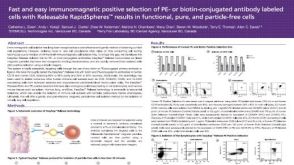 科学海报Fast and Easy Immunomagnetic Positive Selection of PE- or Biotin-Conjugated Antibody Labeled Cells with Releasable RapidSpheres™ Results in Functional, Pure and Particle-Free Cells
 沪公网安备31010102008431号