Domaica CI et al. (AUG 2009)
EMBO reports 10 8 908--15
Tumour-experienced T cells promote NK cell activity through trogocytosis of NKG2D and NKp46 ligands.
Natural killer (NK) cells trigger cytotoxicity and interferon (IFN)-gamma secretion on engagement of the natural-killer group (NKG)2D receptor or members of the natural cytotoxicity receptor (NCR) family,such as NKp46,by ligands expressed on tumour cells. However,it remains unknown whether T cells can regulate NK cell-mediated anti-tumour responses. Here,we investigated the early events occurring during T cell-tumour cell interactions,and their impact on NK cell functions. We observed that on co-culture with some melanomas,activated CD4(+) T cells promoted degranulation,and NKG2D- and NKp46-dependent IFN-gamma secretion by NK cells,probably owing to the capture of NKG2D and NKp46 ligands from the tumour-cell surface (trogocytosis). This effect was observed in CD4(+),CD8(+) and resting T cells,which showed substantial amounts of cell surface major histocompatibility complex class I chain-related protein A on co-culture with tumour cells. Our findings identify a new,so far,unrecognized mechanism by which effector T cells support NK cell function through the capture of specific tumour ligands with profound implications at the crossroad of innate and adaptive immunity.
View Publication
产品类型:
产品号#:
15025
15065
产品名:
RosetteSep™人NK细胞富集抗体混合物
RosetteSep™人NK细胞富集抗体混合物
Thompson EA et al. (APR 2016)
Journal of Immunology 196 7 3054--63
Shortened Intervals during Heterologous Boosting Preserve Memory CD8 T Cell Function but Compromise Longevity.
Developing vaccine strategies to generate high numbers of Ag-specific CD8 T cells may be necessary for protection against recalcitrant pathogens. Heterologous prime-boost-boost immunization has been shown to result in large quantities of functional memory CD8 T cells with protective capacities and long-term stability. Completing the serial immunization steps for heterologous prime-boost-boost can be lengthy,leaving the host vulnerable for an extensive period of time during the vaccination process. We show in this study that shortening the intervals between boosting events to 2 wk results in high numbers of functional and protective Ag-specific CD8 T cells. This protection is comparable to that achieved with long-term boosting intervals. Short-boosted Ag-specific CD8 T cells display a canonical memory T cell signature associated with long-lived memory and have identical proliferative potential to long-boosted T cells Both populations robustly respond to antigenic re-exposure. Despite this,short-boosted Ag-specific CD8 T cells continue to contract gradually over time,which correlates to metabolic differences between short- and long-boosted CD8 T cells at early memory time points. Our studies indicate that shortening the interval between boosts can yield abundant,functional Ag-specific CD8 T cells that are poised for immediate protection; however,this is at the expense of forming stable long-term memory.
View Publication
产品类型:
产品号#:
17951
17951RF
17952
17952RF
19254
19254RF
19853
19853RF
100-0695
100-0696
产品名:
EasySep™人T细胞分选试剂盒
RoboSep™ 人T细胞分选试剂盒
EasySep™人CD4+ T细胞分选试剂盒
RoboSep™ 人CD4+ T细胞分选试剂盒
EasySep™人Naïve B细胞富集试剂盒
RoboSep™ 人Naïve B细胞富集试剂盒含滤芯吸头
EasySep™小鼠CD8+ T细胞分选试剂盒
RoboSep™ 小鼠CD8+ T细胞分选试剂盒
EasySep™人T细胞分选试剂盒
EasySep™人CD4+ T细胞分离试剂盒
Dadaglio G et al. (MAR 2002)
Journal of immunology (Baltimore,Md. : 1950) 168 5 2219--24
Efficient in vivo priming of specific cytotoxic T cell responses by neonatal dendritic cells.
In early life,a high susceptibility to infectious diseases as well as a poor capacity to respond to vaccines are generally observed as compared with observations in adults. The mechanisms underlying immune immaturity have not been fully elucidated and could be due to the immaturity of the T/B cell responses and/or to a defect in the nature and quality of Ag presentation by the APC. This prompted us to phenotypically and functionally characterize early life murine dendritic cells (DC) purified from spleens of 7-day-old mice. We showed that neonatal CD11c(+) DC express levels of costimulatory molecules and MHC molecules similar to those of adult DC and are able to fully maturate after LPS activation. Furthermore,we demonstrated that neonatal DC can efficiently take up,process,and present Ag to T cells in vitro and induce specific CTL responses in vivo. Although a reduced number of these cells was observed in the spleen of neonatal mice as compared with adults,this study clearly shows that neonatal DC have full functional capacity and may well prime Ag-specific naive T cells in vivo.
View Publication
产品类型:
产品号#:
09600
09650
产品名:
StemSpan™ SFEM
StemSpan™ SFEM
Pua HH et al. (JAN 2007)
The Journal of experimental medicine 204 1 25--31
A critical role for the autophagy gene Atg5 in T cell survival and proliferation.
Macroautophagy (hereafter referred to as autophagy) is a well-conserved intracellular degradation process. Recent studies examining cells lacking the autophagy genes Atg5 and Atg7 have demonstrated that autophagy plays essential roles in cell survival during starvation,in innate cell clearance of microbial pathogens,and in neural cell maintenance. However,the role of autophagy in T lymphocyte development and survival is not known. Here,we demonstrate that autophagosomes form in primary mouse T lymphocytes. By generating Atg5-/- chimeric mice,we found that Atg5-deficient T lymphocytes underwent full maturation. However,the numbers of total thymocytes and peripheral T and B lymphocytes were reduced in Atg5 chimeras. In the periphery,Atg5-/- CD8+ T lymphocytes displayed dramatically increased cell death. Furthermore,Atg5-/- CD4+ and CD8+ T cells failed to undergo efficient proliferation after TCR stimulation. These results demonstrate a critical role for Atg5 in multiple aspects of lymphocyte development and function and suggest that autophagy may be essential for both T lymphocyte survival and proliferation.
View Publication
产品类型:
产品号#:
19752
19752RF
19753
19753RF
19751
19751RF
产品名:
Rizzuto GA et al. (APR 2009)
The Journal of experimental medicine 206 4 849--66
Self-antigen-specific CD8+ T cell precursor frequency determines the quality of the antitumor immune response.
A primary goal of cancer immunotherapy is to improve the naturally occurring,but weak,immune response to tumors. Ineffective responses to cancer vaccines may be caused,in part,by low numbers of self-reactive lymphocytes surviving negative selection. Here,we estimated the frequency of CD8(+) T cells recognizing a self-antigen to be textless0.0001% ( approximately 1 in 1 million CD8(+) T cells),which is so low as to preclude a strong immune response in some mice. Supplementing this repertoire with naive antigen-specific cells increased vaccine-elicited tumor immunity and autoimmunity,but a threshold was reached whereby the transfer of increased numbers of antigen-specific cells impaired functional benefit,most likely because of intraclonal competition in the irradiated host. We show that cells primed at precursor frequencies below this competitive threshold proliferate more,acquire polyfunctionality,and eradicate tumors more effectively. This work demonstrates the functional relevance of CD8(+) T cell precursor frequency to tumor immunity and autoimmunity. Transferring optimized numbers of naive tumor-specific T cells,followed by in vivo activation,is a new approach that can be applied to human cancer immunotherapy. Further,precursor frequency as an isolated variable can be exploited to augment efficacy of clinical vaccine strategies designed to activate any antigen-specific CD8(+) T cells.
View Publication
产品类型:
产品号#:
19753
19753RF
产品名:
Muroski ME et al. (JUL 2017)
Scientific reports 7 1 5790
Fatty Acid Uptake in T Cell Subsets Using a Quantum Dot Fatty Acid Conjugate.
Fatty acid (FA) metabolism directly influences the functional capabilities of T cells in tumor microenvironments. Thus,developing tools to interrogate FA-uptake by T cell subsets is important for understanding tumor immunosuppression. Herein,we have generated a novel FA-Qdot 605 dye conjugate with superior sensitivity and flexibility to any of the previously commercially available alternatives. For the first time,we demonstrate that this nanoparticle can be used as a specific measure of fatty acid uptake by T cells both in-vitro and in-vivo. Flow cytometric analysis shows that both the location and activation status of T cells determines their FA uptake. Additionally,CD4+ Foxp3+ regulatory T cells (Tregs) uptake FA at a higher rate than effector T cell subsets,supporting the role of FA metabolism for Treg function. Furthermore,we are able to simultaneously detect glucose and fatty acid uptake directly within the tumor microenvironment. Cumulatively,our results suggest that this novel fluorescent probe is a powerful tool to understand FA utilization within the tumor,thereby providing an unprecedented opportunity to study T cell FA metabolism in-vivo.
View Publication
Bao K et al. (OCT 2016)
Journal of immunology (Baltimore,Md. : 1950)
BATF Modulates the Th2 Locus Control Region and Regulates CD4+ T Cell Fate during Antihelminth Immunity.
The AP-1 factor basic leucine zipper transcription factor,ATF-like (BATF) is important for CD4(+) Th17,Th9,and follicular Th cell development. However,its precise role in Th2 differentiation and function remains unclear,and the requirement for BATF in nonallergic settings of type-2 immunity has not been explored. In this article,we show that,in response to parasitic helminths,Batf(-/-) mice are unable to generate follicular Th and Th2 cells. As a consequence,they fail to establish productive type-2 immunity during primary and secondary infection. Batf(-/-) CD4(+) T cells do not achieve type-2 cytokine competency,which implies that BATF plays a key role in the regulation of IL-4 and IL-13. In contrast to Th17 and Th9 cell subsets in which BATF binds directly to promoter and enhancer regions to regulate cytokine expression,our results show that BATF is significantly enriched at Rad50 hypersensitivity site (RHS)6 and RHS7 of the locus control region relative to AP-1 sites surrounding type-2 cytokine loci in Th2 cells. Indeed,Batf(-/-) CD4(+) T cells do not obtain permissive epigenetic modifications within the Th2 locus,which were linked to RHS6 and RHS7 function. In sum,these findings reveal BATF as a central modulator of peripheral and humoral hallmarks of type-2 immunity and begin to elucidate a novel mechanism by which it regulates type-2 cytokine production through its modification of the Th2 locus control region.
View Publication
产品类型:
产品号#:
19852
19852RF
产品名:
EasySep™小鼠CD4+ T细胞分选试剂盒
RoboSep™ 小鼠CD4+ T细胞分选试剂盒
Takahashi N et al. (MAY 2009)
Journal of immunology (Baltimore,Md. : 1950) 182 9 5515--27
Impaired CD4 and CD8 effector function and decreased memory T cell populations in ICOS-deficient patients.
Interaction of ICOS with its ligand is essential for germinal center formation,T cell immune responses,and development of autoimmune diseases. Human ICOS deficiency has been identified worldwide in nine patients with identical ICOS mutations. In vitro studies of the patients to date have shown only mild T cell defect. In this study,we report an in-depth analysis of T cell function in two siblings with novel ICOS deficiency. The brother displayed mild skin infections and impaired Ig class switching,whereas the sister had more severe symptoms,including immunodeficiency,rheumatoid arthritis,inflammatory bowel disease,interstitial pneumonitis,and psoriasis. Despite normal CD3/CD28-induced proliferation and IL-2 production in vitro,peripheral blood T cells in both patients showed a decreased percentage of CD4 central and effector memory T cells and impaired production of Th1,Th2,and Th17 cytokines upon CD3/CD28 costimulation or PMA/ionophore stimulation. The defective polarization into effector cells was associated with impaired induction of T-bet,GATA3,MAF,and retinoic acid-related orphan nuclear hormone receptor (RORC). Reduced CTLA-4(+)CD45RO(+)FoxP3(+) regulatory T cells and diminished induction of inhibitory cell surface molecules,including CTLA-4,were also observed in the patients. T cell defect was not restricted to CD4 T cells because reduced memory T cells and impaired IFN-gamma production were also noted in CD8 T cells. Further analysis of the patients demonstrated increased induction of receptor activator of NF-kappaB ligand (RANKL),lack of IFN-gamma response,and loss of Itch expression upon activation in the female patient,who had autoimmunity. Our study suggests that extensive T cell dysfunction,decreased memory T cell compartment,and imbalance between effector and regulatory cells in ICOS-deficient patients may underlie their immunodeficiency and/or autoimmunity.
View Publication
产品类型:
产品号#:
14052
产品名:
A. Lisco et al. (apr 2019)
JCI insight 4 8
Identification of rare HIV-1-infected patients with extreme CD4+ T cell decline despite ART-mediated viral suppression.
BACKGROUND The goal of antiretroviral therapy (ART) is to suppress HIV-1 replication and reconstitute CD4+ T cells. Here,we report on HIV-infected individuals who had a paradoxical decline in CD4+ T cells despite ART-mediated suppression of plasma HIV-1 load (pVL). We defined such an immunological outcome as extreme immune decline (EXID). METHODS EXID's clinical and immunological characteristics were compared to immunological responders (IRs),immunological nonresponders (INRs),healthy controls (HCs),and idiopathic CD4+ lymphopenia (ICL) patients. T cell immunophenotyping and assembly/activation of inflammasomes were evaluated by flow cytometry. PBMC transcriptome analysis and genetic screening for pathogenic variants were performed. Levels of cytokines/chemokines were measured by electrochemiluminescence. Luciferase immunoprecipitation system and NK-mediated antibody-dependent cellular cytotoxicity (ADCC) assays were used to identify anti-lymphocyte autoantibodies. RESULTS EXIDs were infected with non-B HIV-1 subtypes and after 192 weeks of consistent ART-mediated pVL suppression had a median CD4+ decrease of 157 cells/mul,compared with CD4+ increases of 193 cells/mul and 427 cells/mul in INR and IR,respectively. EXID had reduced naive CD4+ T cells,but similar proportions of cycling CD4+ T cells and HLA-DR+CD38+CD8+ T cells compared with IR and INR. Levels of inflammatory cytokines were also similar in EXID and INR,but the IL-7 axis was profoundly perturbed compared with HC,IR,INR,and ICL. Genes involved in T cell and monocyte/macrophage function,autophagy,and cell migration were differentially expressed in EXID. Two of the 5 EXIDs had autoantibodies causing ADCC,while 2 different EXIDs had an increased inflammasome/caspase-1 activation despite consistently ART-suppressed pVL. CONCLUSIONS EXID is a distinct immunological outcome compared with previously described INR. Anti-CD4+ T cell autoantibodies and aberrant inflammasome/caspase-1 activation despite suppressed HIV-1 viremia are among the mechanisms responsible for EXID.
View Publication


 EasySep™小鼠TIL(CD45)正选试剂盒





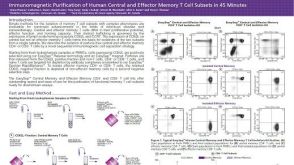 科学海报Immunomagnetic Purification of Human Central and Effector Memory T Cell Subsets in 45 Minutes


 沪公网安备31010102008431号