APELIN promotes hematopoiesis from human embryonic stem cells.
Transcriptional profiling of differentiating human embryonic stem cells (hESCs) revealed that MIXL1-positive mesodermal precursors were enriched for transcripts encoding the G-protein-coupled APELIN receptor (APLNR). APLNR-positive cells,identified by binding of the fluoresceinated peptide ligand,APELIN (APLN),or an anti-APLNR mAb,were found in both posterior mesoderm and anterior mesendoderm populations and were enriched in hemangioblast colony-forming cells (Bl-CFC). The addition of APLN peptide to the media enhanced the growth of embryoid bodies (EBs),increased the expression of hematoendothelial genes in differentiating hESCs,and increased the frequency of Bl-CFCs by up to 10-fold. Furthermore,APLN peptide also synergized with VEGF to promote the growth of hESC-derived endothelial cells. These studies identified APLN as a novel growth factor for hESC-derived hematopoietic and endothelial cells.
View Publication
产品类型:
产品号#:
04436
产品名:
MethoCult™ SF H4436
Hakala H et al. (JUL 2009)
Tissue engineering Part A 15 7 1775--85
Comparison of biomaterials and extracellular matrices as a culture platform for multiple, independently derived human embryonic stem cell lines
Long-term in vitro culture of undifferentiated human embryonic stem cells (hESCs) traditionally requires a fibroblast feeder cell layer. Using feeder cells in hESC cultures is highly laborious and limits large-scale hESC production for potential application in regenerative medicine. Replacing feeder cells with defined human extracellular matrix (ECM) components or synthetic biomaterials would be ideal for large-scale production of clinical-grade hESCs. We tested and compared different feeder cell-free hESC culture methods based on different human ECM proteins,human and animal sera matrices,and a Matrigel matrix. Also selected biomaterials were tested for feeder cell-free propagation of undifferentiated hESCs. The matrices were tested together with conventional and modified hESC culture media,human foreskin fibroblast-conditioned culture medium,chemically defined medium,TeSR1,and modified TeSR1 media. The results showed the undefined,xenogeneic Matrigel to be a superior matrix for hESC culture compared with the purified human ECM proteins,serum matrices,and the biomaterials tested. A long-term,feeder cell-free culture system was successful on Matrigel in combination with mTeSR1 culture medium,but a xeno-free,fully defined,and reproducible feeder cell-free hESC culture method still remains to be developed.
View Publication
产品类型:
产品号#:
05850
05857
05870
05875
85850
85857
85870
85875
产品名:
mTeSR™1
mTeSR™1
Perez JE et al. (FEB 2017)
Nanotechnology 28 5 55703
Mesenchymal stem cells cultured on magnetic nanowire substrates.
Stem cells have been shown to respond to extracellular mechanical stimuli by regulating their fate through the activation of specific signaling pathways. In this work,an array of iron nanowires (NWs) aligned perpendicularly to the surface was fabricated by pulsed electrodepositon in porous alumina templates followed by a partial removal of the alumina to reveal 2-3 μm of the NWs. This resulted in alumina substrates with densely arranged NWs of 33 nm in diameter separated by 100 nm. The substrates were characterized by scanning electron microscopy (SEM) energy dispersive x-ray analysis and vibrating sample magnetometer. The NW array was then used as a platform for the culture of human mesenchymal stem cells (hMSCs). The cells were stained for the cell nucleus and actin filaments,as well as immuno-stained for the focal adhesion protein vinculin,and then observed by fluorescence microscopy in order to characterize their spreading behavior. Calcein AM/ethidium homodimer-1 staining allowed the determination of cell viability. The interface between the cells and the NWs was studied using SEM. Results showed that hMSCs underwent a re-organization of actin filaments that translated into a change from an elongated to a spherical cell shape. Actin filaments and vinculin accumulated in bundles,suggesting the attachment and formation of focal adhesion points of the cells on the NWs. Though the overall number of cells attached on the NWs was lower compared to the control,the attached cells maintained a high viability (>90%) for up to 6 d. Analysis of the interface between the NWs and the cells confirmed the re-organization of F-actin and revealed the adhesion points of the cells on the NWs. Additionally,a net of filopodia surrounded each cell,suggesting the probing of the array to find additional adhesion points. The cells maintained their round shape for up to 6 d of culture. Overall,the NW array is a promising nanostructured platform for studying and influencing hMSCs differentiation.
View Publication
产品类型:
产品号#:
70022
70071
产品名:
Wu X et al. (JAN 2018)
Cell 172 3 423--438.e25
Intrinsic Immunity Shapes Viral Resistance of Stem Cells.
Stem cells are highly resistant to viral infection compared to their differentiated progeny; however,the mechanism is mysterious. Here,we analyzed gene expression in mammalian stem cells and cells at various stages of differentiation. We find that,conserved across species,stem cells express a subset of genes previously classified as interferon (IFN) stimulated genes (ISGs) but that expression is intrinsic,as stem cells are refractory to interferon. This intrinsic ISG expression varies in a cell-type-specific manner,and many ISGs decrease upon differentiation,at which time cells become IFN responsive,allowing induction of a broad spectrum of ISGs by IFN signaling. Importantly,we show that intrinsically expressed ISGs protect stem cells against viral infection. We demonstrate the in vivo importance of intrinsic ISG expression for protecting stem cells and their differentiation potential during viral infection. These findings have intriguing implications for understanding stem cell biology and the evolution of pathogen resistance.
View Publication
产品类型:
产品号#:
02691
04434
04444
05110
05711
05712
05872
05873
18056
18056RF
72052
72054
72302
72304
72307
72308
70039
70039.1
70039.2
70039.3
70039.4
70039.5
70039.6
60062
60062BT
60062FI
60062FI.1
60062PE
60062PE.1
60045
60045AZ
60045AZ.1
60045BT
60045FI
60045FI.1
600
产品名:
StemSpan™ CD34+扩增添加物 (10X)
MethoCult™ H4434 Classic
MethoCult™ H4434 Classic
STEMdiff™定型内胚层检测试剂盒
NeuroCult™ SM1 神经添加物
CHIR99021
CHIR99021
Y-27632(二盐酸盐)
Y-27632(二盐酸盐)
Y-27632(二盐酸盐)
Y-27632(二盐酸盐)
抗人SSEA-4抗体,克隆号MC-813-70,生物素
抗人SSEA-4抗体,克隆号MC-813-70,FITC
抗人SSEA-4抗体, 克隆号MC-813-70,FITC
抗人SSEA-4抗体,克隆号MC-813-70,PE
抗人SSEA-4抗体,克隆号MC-813-70,PE
抗人CD90抗体,克隆5E10
抗人CD90抗体,克隆5E10,APC
抗人CD90抗体,克隆5E10,APC
抗人CD90抗体,克隆5E10,Biotin
抗人CD90抗体,克隆5E10,FITC
抗人CD90抗体,克隆5E10,FITC
Moore JJC et al. (JAN 2010)
Stem Cell Research & Therapy 1 3 23
Efficient, high-throughput transfection of human embryonic stem cells.
Genetic manipulation of human embryonic stem cells (hESC) has been limited by their general resistance to common methods used to introduce exogenous DNA or RNA. Efficient and high throughput transfection of nucleic acids into hESC would be a valuable experimental tool to manipulate these cells for research and clinical applications. We investigated the ability of two commercially available electroporation systems,the Nucleofection® 96-well Shuttle® System from Lonza and the Neon™ Transfection System from Invitrogen to efficiently transfect hESC. Transfection efficiency was measured by flow cytometry for the expression of the green fluorescent protein and the viability of the transfected cells was determined by an ATP catalyzed luciferase reaction. The transfected cells were also analyzed by flow cytometry for common markers of pluripotency. Both systems are capable of transfecting hESC at high efficiencies with little loss of cell viability. However,the reproducibility and the ease of scaling for high throughput applications led us to perform more comprehensive tests on the Nucleofection® 96-well Shuttle® System. We demonstrate that this method yields a large fraction of transiently transfected cells with minimal loss of cell viability and pluripotency,producing protein expression from plasmid vectors in several different hESC lines. The method scales to a 96-well plate with similar transfection efficiencies at the start and end of the plate. We also investigated the efficiency with which stable transfectants can be generated and recovered under antibiotic selection. Finally,we found that this method is effective in the delivery of short synthetic RNA oligonucleotides (siRNA) into hESC for knockdown of translation activity via RNA interference. Our results indicate that these electroporation methods provide a reliable,efficient,and high-throughput approach to the genetic manipulation of hESC.
View Publication
Naive embryonic stem cells hold great promise for research and therapeutics as they have broad and robust developmental potential. While such cells are readily derived from mouse blastocysts it has not been possible to isolate human equivalents easily,although human naive-like cells have been artificially generated (rather than extracted) by coercion of human primed embryonic stem cells by modifying culture conditions or through transgenic modification. Here we show that a sub-population within cultures of human embryonic stem cells (hESCs) and induced pluripotent stem cells (hiPSCs) manifests key properties of naive state cells. These naive-like cells can be genetically tagged,and are associated with elevated transcription of HERVH,a primate-specific endogenous retrovirus. HERVH elements provide functional binding sites for a combination of naive pluripotency transcription factors,including LBP9,recently recognized as relevant to naivety in mice. LBP9-HERVH drives hESC-specific alternative and chimaeric transcripts,including pluripotency-modulating long non-coding RNAs. Disruption of LBP9,HERVH and HERVH-derived transcripts compromises self-renewal. These observations define HERVH expression as a hallmark of naive-like hESCs,and establish novel primate-specific transcriptional circuitry regulating pluripotency.
View Publication
产品类型:
产品号#:
05850
05857
05870
05875
85850
85857
85870
85875
产品名:
mTeSR™1
mTeSR™1
Zhou T et al. (JUL 2011)
Journal of the American Society of Nephrology : JASN 22 7 1221--1228
Generation of induced pluripotent stem cells from urine
Forced expression of selected transcription factors can transform somatic cells into embryonic stem cell (ESC)-like cells,termed induced pluripotent stem cells (iPSCs). There is no consensus regarding the preferred tissue from which to harvest donor cells for reprogramming into iPSCs,and some donor cell types may be more prone than others to accumulation of epigenetic imprints and somatic cell mutations. Here,we present a simple,reproducible,noninvasive method for generating human iPSCs from renal tubular cells present in urine. This procedure eliminates many problems associated with other protocols,and the resulting iPSCs display an excellent ability to differentiate. These data suggest that urine may be a preferred source for generating iPSCs.
View Publication
产品类型:
产品号#:
05850
05857
05870
05875
05920
85850
85857
85870
85875
产品名:
mTeSR™1
mTeSR™1
Kokubu Y et al. (APR 2017)
Biochemical and biophysical research communications 486 2 577--583
In vitro model of cerebral ischemia by using brain microvascular endothelial cells derived from human induced pluripotent stem cells.
Brain-derived microvascular endothelial cells (BMECs),which play a central role in blood brain barrier (BBB),can be used for the evaluation of drug transport into the brain. Although human BMEC cell lines have already been reported,they lack original properties such as barrier integrity. Pluripotent stem cells (PSCs) can be used for various applications such as regenerative therapy,drug screening,and pathological study. In the recent study,an induction method of BMECs from PSCs has been established,making it possible to more precisely study the in vitro human BBB function. Here,using induced pluripotent stem (iPS) cell-derived BMECs,we examined the effects of oxygen-glucose deprivation (OGD) and OGD/reoxygenation (OGD/R) on BBB permeability. OGD disrupted the barrier function,and the dysfunction was rapidly restored by re-supply of the oxygen and glucose. Interestingly,TNF-α,which is known to be secreted from astrocytes and microglia in the cerebral ischemia,prevented the restoration of OGD-induced barrier dysfunction in an apoptosis-independent manner. Thus,we could establish the in vitro BBB disease model that mimics the cerebral ischemia by using iPS cell-derived BMECs.
View Publication
产品类型:
产品号#:
05850
05857
05870
05875
85850
85857
85870
85875
产品名:
mTeSR™1
mTeSR™1
Claassen DA et al. (AUG 2009)
Molecular Reproduction and Development 76 8 722--732
ROCK inhibition enhances the recovery and growth of cryopreserved human embryonic stem cells and human induced pluripotent stem cells
Poor recovery of cryopreserved human embryonic stem (hES) cells and induced pluripotent stem (iPS) cells is a significant impediment to progress with pluripotent stem cells. In this study,we demonstrate that Y-27632,a specific inhibitor of Rho kinase (ROCK) activity,significantly enhances recovery of hES cells from cryopreserved stocks when cultured with or without a growth inactivated feeder layer. Furthermore,treatment with the ROCK inhibitor for several days increased the number of colonies and colony size of hES cells compared to shorter exposures. Remarkably,hES cells that had formed relatively few colonies 5 days after thawing exhibited rapid growth upon addition of Y-27632. Additionally,we determined that Y-27632 significantly improves the recovery of cryopreserved human iPS cells and their growth upon subculture. Thus,Y-27632 provides a means to kick-start" slow-growing human pluripotent stem cells�
View Publication
Castro-Diaz N et al. (JUL 2014)
Genes and Development 28 13 1397--1409
Evolutionally dynamic L1 regulation in embryonic stem cells
Mobile elements are important evolutionary forces that challenge genomic integrity. Long interspersed element-1 (L1,also known as LINE-1) is the only autonomous transposon still active in the human genome. It displays an unusual pattern of evolution,with,at any given time,a single active L1 lineage amplifying to thousands of copies before getting replaced by a new lineage,likely under pressure of host restriction factors,which act notably by silencing L1 expression during early embryogenesis. Here,we demonstrate that in human embryonic stem (hES) cells,KAP1 (KRAB [Kruppel-associated box domain]-associated protein 1),the master cofactor of KRAB-containing zinc finger proteins (KRAB-ZFPs) previously implicated in the restriction of endogenous retroviruses,represses a discrete subset of L1 lineages predicted to have entered the ancestral genome between 26.8 million and 7.6 million years ago. In mice,we documented a similar chronologically conditioned pattern,albeit with a much contracted time scale. We could further identify an L1-binding KRAB-ZFP,suggesting that this rapidly evolving protein family is more globally responsible for L1 recognition. KAP1 knockdown in hES cells induced the expression of KAP1-bound L1 elements,but their younger,human-specific counterparts (L1Hs) were unaffected. Instead,they were stimulated by depleting DNA methyltransferases,consistent with recent evidence demonstrating that the PIWI-piRNA (PIWI-interacting RNA) pathway regulates L1Hs in hES cells. Altogether,these data indicate that the early embryonic control of L1 is an evolutionarily dynamic process and support a model in which newly emerged lineages are first suppressed by DNA methylation-inducing small RNA-based mechanisms before KAP1-recruiting protein repressors are selected.
View Publication
产品类型:
产品号#:
05850
05857
05870
05875
85850
85857
85870
85875
产品名:
mTeSR™1
mTeSR™1
West FD et al. (AUG 2010)
Stem cells and development 19 8 1211--1220
Porcine induced pluripotent stem cells produce chimeric offspring.
Ethical and moral issues rule out the use of human induced pluripotent stem cells (iPSCs) in chimera studies that would determine the full extent of their reprogrammed state,instead relying on less rigorous assays such as teratoma formation and differentiated cell types. To date,only mouse iPSC lines are known to be truly pluripotent. However,initial mouse iPSC lines failed to form chimeric offspring,but did generate teratomas and differentiated embryoid bodies,and thus these specific iPSC lines were not completely reprogrammed or truly pluripotent. Therefore,there is a need to address whether the reprogramming factors and process used eventually to generate chimeric mice are universal and sufficient to generate reprogrammed iPSC that contribute to chimeric offspring in additional species. Here we show that porcine mesenchymal stem cells transduced with 6 human reprogramming factors (POU5F1,SOX2,NANOG,KLF4,LIN28,and C-MYC) injected into preimplantation-stage embryos contributed to multiple tissue types spanning all 3 germ layers in 8 of 10 fetuses. The chimerism rate was high,85.3% or 29 of 34 live offspring were chimeras based on skin and tail biopsies harvested from 2- to 5-day-old pigs. The creation of pluripotent porcine iPSCs capable of generating chimeric offspring introduces numerous opportunities to study the facets significantly affecting cell therapies,genetic engineering,and other aspects of stem cell and developmental biology.
View Publication


 EasySep™小鼠TIL(CD45)正选试剂盒





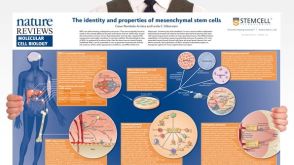 挂图The Identity and Properties of Mesenchymal Stem Cells Overview of MSC expansion, differentiation, immunoregulatory properties and therapeutic potential
 沪公网安备31010102008431号