Fé et al. (MAR 2006)
The Journal of clinical investigation 116 3 715--23
Blocking the alpha 4 integrin-paxillin interaction selectively impairs mononuclear leukocyte recruitment to an inflammatory site.
Antagonists to alpha4 integrin show promise for several autoimmune and inflammatory diseases but may exhibit mechanism-based toxicities. We tested the capacity of blockade of alpha4 integrin signaling to perturb functions involved in inflammation,while limiting potential adverse effects. We generated and characterized mice bearing a Y991A mutation in alpha4 integrin [alpha4(Y991A) mice],which blocks paxillin binding and inhibits alpha4 integrin signals that support leukocyte migration. In contrast to the embryonic-lethal phenotype of alpha4 integrin-null mice,mice bearing the alpha4(Y991A) mutation were viable and fertile; however,they exhibited defective recruitment of mononuclear leukocytes into thioglycollate-induced peritonitis. Alpha4 integrins are essential for definitive hematopoiesis; however,the alpha4(Y991A) mice had intact lymphohematopoiesis and,with the exception of reduced Peyer's patches,normal architecture and cellularity of secondary lymphoid tissues. We conclude that interference with alpha4 integrin signaling can selectively impair mononuclear leukocyte recruitment to sites of inflammation while sparing vital functions of alpha4 integrins in development and hematopoiesis.
View Publication
产品类型:
产品号#:
03434
03444
04960
04902
04900
04963
04962
04970
产品名:
MethoCult™ GF M3434
MethoCult™ GF M3434
MegaCult™-C胶原和无细胞因子培养基
胶原蛋白溶液
MegaCult™-C无细胞因子培养基
双室载玻片套件
MegaCult™-C CFU-Mk染色试剂盒
MegaCult™-C无细胞因子全套试剂盒
Matsumura-Takeda K et al. (APR 2007)
Stem cells (Dayton,Ohio) 25 4 862--70
CD41+/CD45+ cells without acetylcholinesterase activity are immature and a major megakaryocytic population in murine bone marrow.
Murine megakaryocytes (MKs) are defined by CD41/CD61 expression and acetylcholinesterase (AChE) activity; however,their stages of differentiation in bone marrow (BM) have not been fully elucidated. In murine lineage-negative (Lin(-))/CD45(+) BM cells,we found CD41(+) MKs without AChE activity (AChE(-)) except for CD41(++) MKs with AChE activity (AChE(+)),in which CD61 expression was similar to their CD41 level. Lin(-)/CD41(+)/CD45(+)/AChE(-) MKs could differentiate into AChE(+),with an accompanying increase in CD41/CD61 during in vitro culture. Both proplatelet formation (PPF) and platelet (PLT) production for Lin(-)/CD41(+)/CD45(+)/AChE(-) MKs were observed later than for Lin(-)/CD41(++)/CD45(+)/AChE(+) MKs,whereas MK progenitors were scarcely detected in both subpopulations. GeneChip and semiquantitative polymerase chain reaction analyses revealed that the Lin(-)/CD41(+)/CD45(+)/AChE(-) MKs are assigned at the stage between the progenitor and PPF preparation phases in respect to the many MK/PLT-specific gene expressions,including beta1-tubulin. In normal mice,the number of Lin(-)/CD41(+)/CD45(+)/AChE(-) MKs was 100 times higher than that of AChE(+) MKs in BM. When MK destruction and consequent thrombocytopenia were caused by an antitumor agent,mitomycin-C,Lin(-)/CD41(+)/CD45(+)/AChE(-) MKs led to an increase in AChE(+) MKs and subsequent PLT recovery with interleukin-11 administration. It was concluded that MKs in murine BM at least in part consist of immature Lin(-)/CD41(+)/CD45(+)/AChE(-) MKs and more differentiated Lin(-)/CD41(++)/CD45(+)/AChE(+) MKs. Immature Lin(-)/CD41(+)/CD45(+)/AChE(-) MKs are a major MK population compared with AChE(+) MKs in BM and play an important role in rapid PLT recovery in vivo.
View Publication
产品类型:
产品号#:
03231
04960
04902
04900
04961
04901
04963
04962
04970
04971
产品名:
MethoCult™ M3231
MegaCult™-C胶原和无细胞因子培养基
胶原蛋白溶液
MegaCult™-C无细胞因子培养基
MegaCult™-C胶原和含细胞因子培养基
MegaCult™-C含细胞因子培养基
双室载玻片套件
MegaCult™-C CFU-Mk染色试剂盒
MegaCult™-C无细胞因子全套试剂盒
MegaCult™-C含细胞因子全套试剂盒
Levay K and Slepak VZ (SEP 2007)
The Journal of clinical investigation 117 9 2672--83
Tescalcin is an essential factor in megakaryocytic differentiation associated with Ets family gene expression.
We show here that the process of megakaryocytic differentiation requires the presence of the recently discovered protein tescalcin. Tescalcin is dramatically upregulated during the differentiation and maturation of primary megakaryocytes or upon PMA-induced differentiation of K562 cells. This upregulation requires sustained signaling through the ERK pathway. Overexpression of tescalcin in K562 cells initiates events of spontaneous megakaryocytic differentiation,such as expression of specific cell surface antigens,inhibition of cell proliferation,and polyploidization. Conversely,knockdown of this protein in primary CD34+ hematopoietic progenitors and cell lines by RNA interference suppresses megakaryocytic differentiation. In cells lacking tescalcin,the expression of Fli-1,Ets-1,and Ets-2 transcription factors,but not GATA-1 or MafB,is blocked. Thus,tescalcin is essential for the coupling of ERK cascade activation with the expression of Ets family genes in megakaryocytic differentiation.
View Publication
产品类型:
产品号#:
04960
04902
04900
04961
04901
04963
04962
04970
04971
产品名:
MegaCult™-C胶原和无细胞因子培养基
胶原蛋白溶液
MegaCult™-C无细胞因子培养基
MegaCult™-C胶原和含细胞因子培养基
MegaCult™-C含细胞因子培养基
双室载玻片套件
MegaCult™-C CFU-Mk染色试剂盒
MegaCult™-C无细胞因子全套试剂盒
MegaCult™-C含细胞因子全套试剂盒
Drayer AL et al. (JAN 2006)
Stem cells (Dayton,Ohio) 24 1 105--14
Mammalian target of rapamycin is required for thrombopoietin-induced proliferation of megakaryocyte progenitors.
Thrombopoietin (TPO) is a potent regulator of megakaryopoiesis and stimulates megakaryocyte (MK) progenitor expansion and MK differentiation. In this study,we show that TPO induces activation of the mammalian target of rapamycin (mTOR) signaling pathway,which plays a central role in translational regulation and is required for proliferation of MO7e cells and primary human MK progenitors. Treatment of MO7e cells,human CD34+,and primary MK cells with the mTOR inhibitor rapamycin inhibits TPO-induced cell cycling by reducing cells in S phase and blocking cells in G0/G1. Rapamycin markedly inhibits the clonogenic growth of MK progenitors with high proliferative capacity but does not reduce the formation of small MK colonies. Addition of rapamycin to MK suspension cultures reduces the number of MK cells,but inhibition of mTOR does not significantly affect expression of glycoproteins IIb/IIIa (CD41) and glycoprotein Ib (CD42),nuclear polyploidization levels,cell size,or cell survival. The downstream effectors of mTOR,p70 S6 kinase (S6K) and 4E-binding protein 1 (4E-BP1),are phosphorylated by TPO in a rapamycin- and LY294002-sensitive manner. Part of the effect of the phosphatidyl inositol 3-kinase pathway in regulating megakaryopoiesis may be mediated by the mTOR/S6K/4E-BP1 pathway. In conclusion,these data demonstrate that the mTOR pathway is activated by TPO and plays a critical role in regulating proliferation of MK progenitors,without affecting differentiation or cell survival.
View Publication
产品类型:
产品号#:
04961
04902
04901
04971
04963
04962
产品名:
MegaCult™-C胶原和含细胞因子培养基
胶原蛋白溶液
MegaCult™-C含细胞因子培养基
MegaCult™-C含细胞因子全套试剂盒
双室载玻片套件
MegaCult™-C CFU-Mk染色试剂盒
Wang Q et al. (FEB 2004)
Blood 103 4 1278--85
BUBR1 deficiency results in abnormal megakaryopoiesis.
The physiologic function of BUBR1,a key component of the spindle checkpoint,was examined by generating BUBR1-mutant mice. BUBR1(-/-) embryos failed to survive beyond day 8.5 in utero as a result of extensive apoptosis. Whereas BUBR1(+/-) blastocysts grew relatively normally in vitro,BUBR1(-/-) blastocysts exhibited impaired proliferation and atrophied. Adult BUBR1(+/-) mice manifested splenomegaly and abnormal megakaryopoiesis. BUBR1 haploinsufficiency resulted in an increase in the number of splenic megakaryocytes,which was correlated with an increase in megakaryocytic,but a decrease in erythroid,progenitors in bone marrow cells. RNA interference-mediated down-regulation of BUBR1 also caused an increase in polyploidy formation in murine embryonic fibroblast cells and enhanced megakaryopoiesis in bone marrow progenitor cells. However,enhanced megakaryopoiesis in BUBR1(+/-) mice was not correlated with a significant increase in platelets in peripheral blood,which was at least partly due to a defect in the formation of proplatelet-producing megakaryocytes. Together,these results indicate that BUBR1 is essential for early embryonic development and normal hematopoiesis.
View Publication
产品类型:
产品号#:
09600
09650
04960
04902
04900
04961
04901
04963
04962
04970
04971
产品名:
StemSpan™ SFEM
StemSpan™ SFEM
MegaCult™-C胶原和无细胞因子培养基
胶原蛋白溶液
MegaCult™-C无细胞因子培养基
MegaCult™-C胶原和含细胞因子培养基
MegaCult™-C含细胞因子培养基
双室载玻片套件
MegaCult™-C CFU-Mk染色试剂盒
MegaCult™-C无细胞因子全套试剂盒
MegaCult™-C含细胞因子全套试剂盒
Migliaccio AR et al. (FEB 2003)
The Journal of experimental medicine 197 3 281--96
GATA-1 as a regulator of mast cell differentiation revealed by the phenotype of the GATA-1low mouse mutant.
Here it is shown that the phenotype of adult mice lacking the first enhancer (DNA hypersensitive site I) and the distal promoter of the GATA-1 gene (neo Delta HS or GATA-1(low) mutants) reveals defects in mast cell development. These include the presence of morphologically abnormal alcian blue(+) mast cells and apoptotic metachromatic(-) mast cell precursors in connective tissues and peritoneal lavage and numerous (60-70% of all the progenitors) unique" trilineage cells committed to erythroid�
View Publication
产品类型:
产品号#:
04960
04902
04900
04961
04901
04963
04962
04970
04971
产品名:
MegaCult™-C胶原和无细胞因子培养基
胶原蛋白溶液
MegaCult™-C无细胞因子培养基
MegaCult™-C胶原和含细胞因子培养基
MegaCult™-C含细胞因子培养基
双室载玻片套件
MegaCult™-C CFU-Mk染色试剂盒
MegaCult™-C无细胞因子全套试剂盒
MegaCult™-C含细胞因子全套试剂盒
Halene S et al. (SEP 2010)
Blood 116 11 1942--50
Serum response factor is an essential transcription factor in megakaryocytic maturation.
Serum response factor (Srf) is a MADS-box transcription factor that is critical for muscle differentiation. Its function in hematopoiesis has not yet been revealed. Mkl1,a cofactor of Srf,is part of the t(1;22) translocation in acute megakaryoblastic leukemia,and plays a critical role in megakaryopoiesis. To test the role of Srf in megakaryocyte development,we crossed Pf4-Cre mice,which express Cre recombinase in cells committed to the megakaryocytic lineage,to Srf(F/F) mice in which functional Srf is no longer expressed after Cre-mediated excision. Pf4-Cre/Srf(F/F) knockout (KO) mice are born with normal Mendelian frequency,but have significant macrothrombocytopenia with approximately 50% reduction in platelet count. In contrast,the BM has increased number and percentage of CD41(+) megakaryocytes (WT: 0.41% ± 0.06%; KO: 1.92% ± 0.12%) with significantly reduced ploidy. KO mice show significantly increased megakaryocyte progenitors in the BM by FACS analysis and CFU-Mk. Megakaryocytes lacking Srf have abnormal stress fiber and demarcation membrane formation,and platelets lacking Srf have abnormal actin distribution. In vitro and in vivo assays reveal platelet function defects in KO mice. Critical actin cytoskeletal genes are down-regulated in KO megakaryocytes. Thus,Srf is required for normal megakaryocyte maturation and platelet production partly because of regulation of cytoskeletal genes.
View Publication
产品类型:
产品号#:
09500
09600
09650
04971
04902
04901
04963
04962
产品名:
BIT 9500血清替代物
StemSpan™ SFEM
StemSpan™ SFEM
MegaCult™-C含细胞因子全套试剂盒
胶原蛋白溶液
MegaCult™-C含细胞因子培养基
双室载玻片套件
MegaCult™-C CFU-Mk染色试剂盒
Cheng E-C et al. (MAR 2009)
Blood 113 12 2826--34
Role for MKL1 in megakaryocytic maturation.
Megakaryoblastic leukemia 1 (MKL1),identified as part of the t(1;22) translocation specific to acute megakaryoblastic leukemia,is highly expressed in differentiated muscle cells and promotes muscle differentiation by activating serum response factor (SRF). Here we show that Mkl1 expression is up-regulated during murine megakaryocytic differentiation and that enforced overexpression of MKL1 enhances megakaryocytic differentiation. When the human erythroleukemia (HEL) cell line is induced to differentiate with 12-O-tetradecanoylphorbol 13-acetate,overexpression of MKL1 results in an increased number of megakaryocytes with a concurrent increase in ploidy. MKL1 overexpression also promotes megakaryocytic differentiation of primary human CD34(+) cells cultured in the presence of thrombopoietin. The effect of MKL1 is abrogated when SRF is knocked down,suggesting that MKL1 acts through SRF. Consistent with these findings in human cells,knockout of Mkl1 in mice leads to reduced platelet counts in peripheral blood,and reduced ploidy in bone marrow megakaryocytes. In conclusion,MKL1 promotes physiologic maturation of human and murine megakaryocytes.
View Publication
Dobo I et al. (DEC 1999)
Journal of hematotherapy & stem cell research 8 6 601--7
Endogenous erythroid and megakaryocytic colony formation in serum-free, cytokine-free collagen gels.
We studied the suitability of collagen-based semisolid medium for assay of endogenous erythroid colony formation performed in myeloproliferative disorders. Bone marrow (BM) mononuclear cells (MNC) from 103 patients suspected of having polycythemia vera (PV,76 patients) or essential thrombocythemia (ET,27 patients) were grown in collagen-based,serum-free,cytokine-free semisolid medium. Colony analysis at day 8 or 10 showed that this collagen assay is specific,as endogenous growth of erythroid colonies was never observed in cultures of 16 healthy donors and 6 chronic myelogenous leukemia (CML) patients. Endogenous erythroid colony formation was observed in 53.3% of patients suspected of PV,with only 15.4% of positive cultures for patients with 1 minor PV criterion and 72% (p = 0.009) of positive cultures for patients with textgreater or =2 minor or 1 major PV criterion. Similarly,endogenous growth of erythroid colonies was found in 44.4% of patients suspected of ET,with 31.6% of positive cultures for patients with 1 ET criterion versus 75% for patients with textgreater or =2 ET criteria. In addition,we found that in collagen gels,tests of erythropoietin (EPO) hypersensitivity in the presence of 0.01 or 0.05 U/ml of EPO and tests of endogenous colony-forming units-megakaryocyte (CFU-MK) formation cannot be used to detect PV or ET,as these tests were positive for,respectively,21.4% and 50% of healthy donors and 83% and 50% of CML patients. A retrospective analysis suggests that collagen assays are more sensitive than methylcellulose assays to assess endogenous growth of erythroid colonies. In summary,serum-free collagen-based colony assays are simple and reliable assays of endogenous growth of erythroid colonies in myeloproliferative diseases. They also appear to be more sensitive than methylcellulose-based assays.
View Publication
产品类型:
产品号#:
04961
04965
04962
04915
04807
04809
04906
04913
04803
04804
04905
04850
04974
04902
04960
04900
04901
04963
04970
04971
产品名:
MegaCult™-C胶原和含细胞因子培养基
MegaCult™-C CFU-Mk染色试剂盒
MegaCult-C 10% BSA, 6mL
MegaCult-C Human Serum, 6mL
Alkaline Phosphatase Substrate Tabs, pk
Biotin/Conjugate Goat Anti-Mu lgG, 125uL
MegaCult-C Evans Blue Stain, 5mL
Primary Ab, Anti-HuAnti-GPIIb/IIIa 360uL
MegaCult-C Control Antibody, 100 µL
Avidin-Alk Phosphatase Conjugate, 200 uL
MegaCult™-C含脂质培养基
MegaCult™-C胶原和含脂质培养基
胶原蛋白溶液
MegaCult™-C胶原和无细胞因子培养基
MegaCult™-C无细胞因子培养基
MegaCult™-C含细胞因子培养基
双室载玻片套件
MegaCult™-C无细胞因子全套试剂盒
MegaCult™-C含细胞因子全套试剂盒
Ito CY et al. (JAN 2003)
Blood 101 2 517--23
Hematopoietic stem cell and progenitor defects in Sca-1/Ly-6A-null mice.
Despite its wide use as a marker for hematopoietic stem cells (HSCs),the function of stem cell antigen-1 (Sca-1) (also known as lymphocyte activation protein-6A [Ly-6A]) in hematopoiesis remains poorly defined. We have previously established that Sca-1(-/-) T cells develop normally,although they are hyperresponsive to antigen. Here,we report detailed analysis of hematopoiesis in Sca-1-deficient animals. The differentiation potential of Sca-1-null bone marrow was determined from examination of the most mature precursors (culture colony-forming units [CFU-Cs]) to less committed progenitors (spleen CFUs [CFU-Ss]) to long-term repopulating HSCs. Sca-1-null mice are mildly thrombocytopenic with a concomitant decrease in megakaryocytes and their precursors. Bone marrow cells derived from Sca-1(-/-) mice also have decreased multipotential granulocyte,erythroid,macrophage,and megakaryocyte CFU (GEMM-CFU) and CFU-S progenitor activity. Competitive repopulation assays demonstrated that Sca-1(-/-) HSCs are at a competitive disadvantage compared with wild-type HSCs. To further analyze the potential of Sca-1(-/-) HSCs,serial transplantations were performed. While secondary repopulations using wild-type bone marrow completely repopulated Sca-1(-/-) mice,Sca-1(-/-) bone marrow failed to rescue one third of lethally irradiated wild-type mice receiving secondary bone marrow transplants from irradiation-induced anemia and contributed poorly to the surviving transplant recipients. These data strongly suggest that Sca-1 is required for regulating HSC self-renewal and the development of committed progenitor cells,megakaryocytes,and platelets. Thus,our studies conclusively demonstrate that Sca-1,in addition to being a marker of HSCs,regulates the developmental program of HSCs and specific progenitor populations.
View Publication
产品类型:
产品号#:
03434
03444
04960
04902
04900
04961
04901
04963
04962
04970
04971
产品名:
MethoCult™ GF M3434
MethoCult™ GF M3434
MegaCult™-C胶原和无细胞因子培养基
胶原蛋白溶液
MegaCult™-C无细胞因子培养基
MegaCult™-C胶原和含细胞因子培养基
MegaCult™-C含细胞因子培养基
双室载玻片套件
MegaCult™-C CFU-Mk染色试剂盒
MegaCult™-C无细胞因子全套试剂盒
MegaCult™-C含细胞因子全套试剂盒
Kimura Y et al. (APR 2004)
Proceedings of the National Academy of Sciences of the United States of America 101 16 6015--20
Targeted mutations of the juxtamembrane tyrosines in the Kit receptor tyrosine kinase selectively affect multiple cell lineages.
Loss-of-function mutations in the murine dominant white spotting/c-kit locus affect a diverse array of biological processes and cell lineages and cause a range of phenotypes,including severe anemia,defective pigmentation,sterility,mast cell deficits,a lack of interstitial cells of Cajal,spatial learning memory deficits,and defects in peripheral nerve regeneration. Here we show that tyrosine residues 567 and 569 in the juxtamembrane (Jx) domain of the murine Kit receptor tyrosine kinase are crucial for the function of Kit in melanogenesis and mast cell development,but are dispensable for the normal development of erythroid,interstitial cells of Cajal and germ cells. Furthermore,adult mice lacking both tyrosines exhibit splenomegaly,dysregulation of B-cell and megakaryocyte development,and enlarged stomachs. Analysis of signal transduction events induced by the mutant receptors after ligand stimulation indicates that Jx tyrosine mutations diminish receptor autophosphorylation and selectively attenuate activation of extracellular signal-regulated kinase/mitogen-activated protein kinases. Together,these observations demonstrate that the Jx domain of Kit plays a cell-type specific regulatory role in vivo and illustrate how engineered mutations in Kit can be used to understand the complex biological and molecular events that result from activating a receptor tyrosine kinase.
View Publication


 EasySep™小鼠TIL(CD45)正选试剂盒





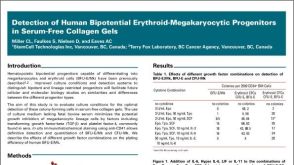 科学海报Detection of Human Bipotential Erythroid-Megakaryocytic Progenitors in Serum-Free Collagen Gels
 沪公网安备31010102008431号