Directed differentiation and mass cultivation of pure erythroid progenitors from mouse embryonic stem cells.
Differentiating embryonic stem (ES) cells are an increasingly important source of hematopoietic progenitors,useful for both basic research and clinical applications. Besides their characterization in colony assays,protocols exist for the cultivation of lymphoid,myeloid,and erythroid cells. With the possible exception of mast cells,however,long-term expansion of pure hematopoietic progenitors from ES cells has not been possible without immortalization caused by overexpression of exogenous genes. Here,we describe for the first time an efficient yet easy strategy to generate mass cultures of pure,immature erythroid progenitors from mouse ES cells (ES-EPs),using serum-free medium plus recombinant cytokines and hormones. ES-EPs represent long-lived,adult,definitive erythroid progenitors that resemble immature erythroid cells expanding in vivo during stress erythropoiesis. When exposed to terminal differentiation conditions,ES-EPs differentiated into mature,enucleated erythrocytes. Importantly,ES-EPs injected into mice did not exhibit tumorigenic potential but differentiated into normal erythrocytes. Both the virtually unlimited supply of cells and the defined culture conditions render our system a valuable tool for the analysis of factors influencing proliferation and maturation of erythroid progenitors. In addition,the system allows detailed characterization of processes during erythroid proliferation and differentiation using wild-type (wt) and genetically modified ES cells.
View Publication
产品类型:
产品号#:
03234
03434
03444
产品名:
MethoCult™ M3234
MethoCult™ GF M3434
MethoCult™ GF M3434
Xia Y et al. (DEC 2013)
Nature Cell Biology 15 12 1507--1515
Directed differentiation of human pluripotent cells to ureteric bud kidney progenitor-like cells
Diseases affecting the kidney constitute a major health issue worldwide. Their incidence and poor prognosis affirm the urgent need for the development of new therapeutic strategies. Recently,differentiation of pluripotent cells to somatic lineages has emerged as a promising approach for disease modelling and cell transplantation. Unfortunately,differentiation of pluripotent cells into renal lineages has demonstrated limited success. Here we report on the differentiation of human pluripotent cells into ureteric-bud-committed renal progenitor-like cells. The generated cells demonstrated rapid and specific expression of renal progenitor markers on 4-day exposure to defined media conditions. Further maturation into ureteric bud structures was accomplished on establishment of a three-dimensional culture system in which differentiated human cells assembled and integrated alongside murine cells for the formation of chimeric ureteric buds. Altogether,our results provide a new platform for the study of kidney diseases and lineage commitment,and open new avenues for the future application of regenerative strategies in the clinic.
View Publication
产品类型:
产品号#:
05850
05857
05870
05875
85850
85857
85870
85875
产品名:
mTeSR™1
mTeSR™1
Loh KM et al. (JAN 2014)
Cell Stem Cell 14 2 237--252
Efficient endoderm induction from human pluripotent stem cells by logically directing signals controlling lineage bifurcations
Human pluripotent stem cell (hPSC) differentiation typically yields heterogeneous populations. Knowledge of signals controlling embryonic lineage bifurcations could efficiently yield desired cell types through exclusion of alternate fates. Therefore,we revisited signals driving induction and anterior-posterior patterning of definitive endoderm to generate a coherent roadmap for endoderm differentiation. With striking temporal dynamics,BMP and Wnt initially specified anterior primitive streak (progenitor to endoderm),yet,24 hr later,suppressed endoderm and induced mesoderm. At lineage bifurcations,cross-repressive signals separated mutually exclusive fates; TGF-?? and BMP/MAPK respectively induced pancreas versus liver from endoderm by suppressing the alternate lineage. We systematically blockaded alternate fates throughout multiple consecutive bifurcations,thereby efficiently differentiating multiple hPSC lines exclusively into endoderm and its derivatives. Comprehensive transcriptional and chromatin mapping of highly pure endodermal populations revealed that endodermal enhancers existed in a surprising diversity of pre-enhancer" states before activation�
View Publication
产品类型:
产品号#:
05850
05857
05870
05875
85850
85857
85870
85875
产品名:
mTeSR™1
mTeSR™1
Wang M et al. (MAR 2015)
ACS applied materials & interfaces 7 8 4560--4572
In Vitro Culture and Directed Osteogenic Differentiation of Human Pluripotent Stem Cells on Peptides-Decorated Two Dimensional Microenvironment
Human pluripotent stem cells (hPSCs) are a promising cell source with pluripotency and capacity to differentiate into all human somatic cell types. Designing simple and safe biomaterials with an innate ability to induce osteoblastic lineage from hPSCs is desirable to realize their clinical adoption in bone regenerative medicine. To address the issue,here we developed a fully defined synthetic peptides-decorated two dimensional (2D) microenvironment assisted via polydopamine (pDA) chemistry and subsequent carboxymethyl chitosan (CMC) grafting to enhance the culture and osteogenic potential of hPSCs in vitro. The hPSCs including human embryonic stem cells (hESCs) and human induced pluripotent stem cells (hiPSCs) were successfully cultured on the peptides-decorated surface without Matrigel- and ECM protein-coating and underwent promoted osteogenic differentiation in vitro,determined from the alkaline phosphate (ALP) activity,gene expression,and protein production as well as calcium deposit amount. It was found that directed osteogenic differentiation of hPSCs could be achieved through a peptides-decorated niche. This chemical-defined and safe 2D microenvironment which facilitates proliferation and osteo-differentiation of hPSCs,not only helps to accelerate the translational perspectives of hPSCs,but also provides tissue-specific functions such as directing stem cell differentiation commitment,having great potential in bone tissue engineering and presenting new avenues for bone regenerative medicine.
View Publication
产品类型:
产品号#:
05850
05857
05870
05875
07920
85850
85857
85870
85875
07922
产品名:
ACCUTASE™
mTeSR™1
mTeSR™1
ACCUTASE™
Miranda C et al. (OCT 2015)
Biotechnology Journal 10 10 1612--1624
Spatial and temporal control of cell aggregation efficiently directs human pluripotent stem cells towards neural commitment
3D suspension culture is generally considered a promising method to achieve efficient expansion and controlled differentiation of human pluripotent stem cells (hPSCs). In this work,we focused on developing an integrated culture platform for expansion and neural commitment of hPSCs into neural precursors using 3D suspension conditions and chemically-defined culture media. We evaluated different inoculation methodologies for hPSC expansion as 3D aggregates and characterized the resulting cultures in terms of aggregate size distribution. It was demonstrated that upon single-cell inoculation,after four days of culture,3D aggregates were composed of homogenous populations of hPSC and were characterized by an average diameter of 139 ± 26 μm,which was determined to be the optimal size to initiate neural commitment. Temporal analysis revealed that upon neural specification it is possible to maximize the percentage of neural precursor cells expressing the neural markers Sox1 and Pax6 after nine days of culture. These results highlight our ability to define a robust method for production of hPSC-derived neural precursors that minimizes processing steps and that constitutes a promising alternative to the traditional planar adherent culture system due to a high potential for scaling-up.
View Publication
产品类型:
产品号#:
05850
05857
05870
05875
27305
85850
85857
85870
85875
产品名:
mTeSR™1
mTeSR™1
Porayette P et al. (AUG 2009)
The Journal of Biological Chemistry 284 35 23806--17
Differential Processing of Amyloid-β Precursor Protein Directs Human Embryonic Stem Cell Proliferation and Differentiation into Neuronal Precursor Cells
The amyloid-beta precursor protein (AbetaPP) is a ubiquitously expressed transmembrane protein whose cleavage product,the amyloid-beta (Abeta) protein,is deposited in amyloid plaques in neurodegenerative conditions such as Alzheimer disease,Down syndrome,and head injury. We recently reported that this protein,normally associated with neurodegenerative conditions,is expressed by human embryonic stem cells (hESCs). We now report that the differential processing of AbetaPP via secretase enzymes regulates the proliferation and differentiation of hESCs. hESCs endogenously produce amyloid-beta,which when added exogenously in soluble and fibrillar forms but not oligomeric forms markedly increased hESC proliferation. The inhibition of AbetaPP cleavage by beta-secretase inhibitors significantly suppressed hESC proliferation and promoted nestin expression,an early marker of neural precursor cell (NPC) formation. The induction of NPC differentiation via the non-amyloidogenic pathway was confirmed by the addition of secreted AbetaPPalpha,which suppressed hESC proliferation and promoted the formation of NPCs. Together these data suggest that differential processing of AbetaPP is normally required for embryonic neurogenesis.
View Publication
产品类型:
产品号#:
05850
05857
05870
05875
85850
85857
85870
85875
产品名:
mTeSR™1
mTeSR™1
Bao X et al. ( 2016)
Methods in molecular biology (Clifton,N.J.) 1481 183--196
Directed Endothelial Progenitor Differentiation from Human Pluripotent Stem Cells Via Wnt Activation Under Defined Conditions.
Efficient derivation of endothelial cells and their progenitors from human pluripotent stem cells (hPSCs) can facilitate studies of human vascular development,disease modeling,drug discovery,and cell-based therapy. Here we provide a detailed protocol for directing hPSCs to functional endothelial cells and their progenitors in a completely defined,growth factor- and serum-free system by temporal modulation of Wnt/$$-catenin signaling via small molecules. We demonstrate a 10-day,two-stage process that recapitulates endothelial cell development,in which hPSCs first differentiate to endothelial progenitors that then generate functional endothelial cells and smooth muscle cells. Methods to characterize endothelial cell identity and function are also described.
View Publication
产品类型:
产品号#:
05850
05857
05870
05875
05940
85850
85857
85870
85875
产品名:
mTeSR™1
mTeSR™1
Jaramillo M and Banerjee I (MAR 2012)
Journal of visualized experiments : JoVE 61 2--7
Endothelial cell co-culture mediates maturation of human embryonic stem cell to pancreatic insulin producing cells in a directed differentiation approach.
Embryonic stem cells (ESC) have two main characteristics: they can be indefinitely propagated in vitro in an undifferentiated state and they are pluripotent,thus having the potential to differentiate into multiple lineages. Such properties make ESCs extremely attractive for cell based therapy and regenerative treatment applications. However for its full potential to be realized the cells have to be differentiated into mature and functional phenotypes,which is a daunting task. A promising approach in inducing cellular differentiation is to closely mimic the path of organogenesis in the in vitro setting. Pancreatic development is known to occur in specific stages,starting with endoderm,which can develop into several organs,including liver and pancreas. Endoderm induction can be achieved by modulation of the nodal pathway through addition of Activin A in combination with several growth factors. Definitive endoderm cells then undergo pancreatic commitment by inhibition of sonic hedgehog inhibition,which can be achieved in vitro by addition of cyclopamine. Pancreatic maturation is mediated by several parallel events including inhibition of notch signaling; aggregation of pancreatic progenitors into 3-dimentional clusters; induction of vascularization; to name a few. By far the most successful in vitro maturation of ESC derived pancreatic progenitor cells have been achieved through inhibition of notch signaling by DAPT supplementation. Although successful,this results in low yield of the mature phenotype with reduced functionality. A less studied area is the effect of endothelial cell signaling in pancreatic maturation,which is increasingly being appreciated as an important contributing factor in in-vivo pancreatic islet maturation. The current study explores such effect of endothelial cell signaling in maturation of human ESC derived pancreatic progenitor cells into insulin producing islet-like cells. We report a multi-stage directed differentiation protocol where the human ESCs are first induced towards endoderm by Activin A along with inhibition of PI3K pathway. Pancreatic specification of endoderm cells is achieved by inhibition of sonic hedgehog signaling by Cyclopamine along with retinoid induction by addition of Retinoic Acid. The final stage of maturation is induced by endothelial cell signaling achieved by a co-culture configuration. While several endothelial cells have been tested in the co-culture,herein we present our data with rat heart microvascular endothelial Cells (RHMVEC),primarily for the ease of analysis.
View Publication
产品类型:
产品号#:
05850
05857
05870
05875
85850
85857
85870
85875
产品名:
mTeSR™1
mTeSR™1
Levi B et al. (DEC 2012)
Proceedings of the National Academy of Sciences of the United States of America 109 50 20379--84
In vivo directed differentiation of pluripotent stem cells for skeletal regeneration.
Pluripotent cells represent a powerful tool for tissue regeneration,but their clinical utility is limited by their propensity to form teratomas. Little is known about their interaction with the surrounding niche following implantation and how this may be applied to promote survival and functional engraftment. In this study,we evaluated the ability of an osteogenic microniche consisting of a hydroxyapatite-coated,bone morphogenetic protein-2-releasing poly-L-lactic acid scaffold placed within the context of a macroenvironmental skeletal defect to guide in vivo differentiation of both embryonic and induced pluripotent stem cells. In this setting,we found de novo bone formation and participation by implanted cells in skeletal regeneration without the formation of a teratoma. This finding suggests that local cues from both the implanted scaffold/cell micro- and surrounding macroniche may act in concert to promote cellular survival and the in vivo acquisition of a terminal cell fate,thereby allowing for functional engraftment of pluripotent cells into regenerating tissue.
View Publication
产品类型:
产品号#:
05850
05857
05870
05875
85850
85857
85870
85875
产品名:
mTeSR™1
mTeSR™1
Amita M et al. (MAR 2013)
Proceedings of the National Academy of Sciences of the United States of America 110 13 E1212--E1221
Complete and unidirectional conversion of human embryonic stem cells to trophoblast by BMP4
Human ES cells (hESC) exposed to bone morphogenic protein 4 (BMP4) in the absence of FGF2 have become widely used for studying trophoblast development,but the soundness of this model has been challenged by others,who concluded that differentiation was primarily toward mesoderm rather than trophoblast. Here we confirm that hESC grown under the standard conditions on a medium conditioned by mouse embryonic fibroblasts in the presence of BMP4 and absence of FGF2 on a Matrigel substratum rapidly convert to an epithelium that is largely KRT7+ within 48 h,with minimal expression of mesoderm markers,including T (Brachyury). Instead,they begin to express a series of trophoblast markers,including HLA-G,demonstrate invasive properties that are independent of the continued presence of BMP4 in the medium,and,over time,produce extensive amounts of human chorionic gonadotropin,progesterone,placental growth factor,and placental lactogen. This process of differentiation is not dependent on conditioning of the medium by mouse embryonic fibroblasts and is accelerated in the presence of inhibitors of Activin and FGF2 signaling,which at day 2 provide colonies that are entirely KRT7+ and in which the majority of cells are transiently CDX2+. Colonies grown on two chemically defined media,including the one in which BMP4 was reported to drive mesoderm formation,also differentiate at least partially to trophoblast in response to BMP4. The experiments demonstrate that the in vitro BMP4/hESC model is valid for studying the emergence and differentiation of trophoblasts.
View Publication


 EasySep™小鼠TIL(CD45)正选试剂盒





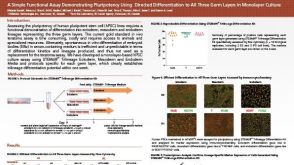 科学海报A Simple Functional Assay Demonstrating Pluripotency Using Directed Differentiation to All Three Germ Layers in Monolayer Culture
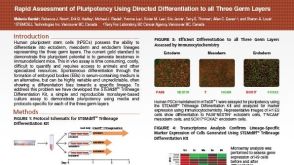 科学海报Rapid Assessment of Pluripotency Using Directed Differentiation to all Three Germ Layers
 沪公网安备31010102008431号