Su YR et al. (AUG 2008)
Arteriosclerosis,thrombosis,and vascular biology 28 8 1439--46
Lentiviral transduction of apoAI into hematopoietic progenitor cells and macrophages: applications to cell therapy of atherosclerosis.
OBJECTIVE: We used genetically engineered mouse hematopoietic progenitor cells (HPCs) to investigate the therapeutic effects of human apoAI on atherosclerosis in apoE(-/-) mice. METHODS AND RESULTS: Lentiviral constructs expressing either human apoAI (LV-apoAI) or green fluorescent protein (LV-GFP) cDNA under a macrophage specific promoter (CD68) were generated and used for ex vivo transduction of mouse HPCs and macrophages. The transduction efficiency was textgreater25% for HPCs and textgreater70% for macrophages. ApoAI was found in the macrophage culture media,mostly associated with the HDL fraction. Interestingly,a significant increase in mRNA and protein levels for ATP binding cassette A1 (ABCA1) and ABCG1 were found in apoAI-expressing macrophages after acLDL loading. Expression of apoAI significantly increased cholesterol efflux in wild-type and apoE(-/-) macrophages. HPCs transduced with LV-apoAI ex vivo and then transplanted into apoE(-/-) mice caused a 50% reduction in atherosclerotic lesion area compared to GFP controls,without influencing plasma HDL-C levels. CONCLUSIONS: Lentiviral transduction of apoAI into HPCs reduces atherosclerosis in apoE(-/-) mice. Expression of apoAI in macrophages improves cholesterol trafficking in wild-type apoE-producing macrophages and causes upregulation of ABCA1 and ABCG1. These novel observations set the stage for a cell therapy approach to atherosclerosis regression,exploiting the cooperation between apoE and apoAI to maximize cholesterol exit from the plaque.
View Publication
产品类型:
产品号#:
09600
09650
18756
18756RF
18757
18757RF
产品名:
StemSpan™ SFEM
StemSpan™ SFEM
EasySep™小鼠SCA1正选试剂盒
RoboSep™ 小鼠SCA1正选试剂盒含滤芯吸头
EasySep™小鼠CD117(cKIT)正选试剂盒
RoboSep™ 小鼠CD117(cKIT)正选试剂盒含滤芯吸头
Gkountela S et al. (APR 2014)
Stem Cell Reviews and Reports 10 2 230--239
PRMT5 is required for human embryonic stem cell proliferation but not pluripotency.
Human pluripotent stem cells (PSCs) are critical in vitro tools forbackslashnunderstanding mechanisms that regulate lineage differentiation inbackslashnthe human embryo as well as a potentially unlimited supply of stembackslashncells for regenerative medicine. Pluripotent human and mouse embryonicbackslashnstem cells (ESCs) derived from the inner cell mass of blastocystsbackslashnshare a similar transcription factor network to maintain pluripotencybackslashnand self-renewal,yet there are considerable molecular differencesbackslashnreflecting the diverse environments in which mouse and human ESCsbackslashnare derived. In the current study we evaluated the role of Proteinbackslashnarginine methyltransferase 5 (PRMT5) in human ESC (hESC) self-renewalbackslashnand pluripotency given its critical role in safeguarding mouse ESCbackslashnpluripotency. Unlike the mouse,we discovered that PRMT5 has no rolebackslashnin hESC pluripotency. Using microarray analysis we discovered thatbackslashna significant depletion in PRMT5 RNA and protein from hESCs changedbackslashnthe expression of only 78 genes,with the majority being repressed.backslashnFunctionally,we discovered that depletion of PRMT5 had no effectbackslashnon expression of OCT4,NANOG or SOX2,and did not prevent teratomabackslashnformation. Instead,we show that PRMT5 functions in hESCs to regulatebackslashnproliferation in the self-renewing state by regulating the fractionbackslashnof cells in Gap 1 (G1) of the cell cycle and increasing expressionbackslashnof the G1 cell cycle inhibitor P57. Taken together our data unveilsbackslashna distinct role for PRMT5 in hESCs and identifies P57 as new target.
View Publication
产品类型:
产品号#:
05850
05857
05870
05875
85850
85857
85870
85875
产品名:
mTeSR™1
mTeSR™1
Rodin S et al. (JUN 2010)
Nature biotechnology 28 6 611--5
Long-term self-renewal of human pluripotent stem cells on human recombinant laminin-511.
We describe a system for culturing human embryonic stem (hES) cells and induced pluripotent stem (iPS) cells on a recombinant form of human laminin-511,a component of the natural hES cell niche. The system is devoid of animal products and feeder cells and contains only one undefined component,human albumin. The hES cells self-renewed with normal karyotype for at least 4 months (20 passages),after which the cells could produce teratomas containing cell lineages of all three germ layers. When plated on laminin-511 in small clumps,hES cells spread out in a monolayer,maintaining cellular homogeneity with approximately 97% OCT4-positive cells. Adhesion of hES cells was dependent on alpha6beta1 integrin. The use of homogeneous monolayer hES or iPS cell cultures provides more controllable conditions for the design of differentiation methods. This xeno-free and feeder-free system may be useful for the development of cell lineages for therapeutic purposes.
View Publication
产品类型:
产品号#:
05850
05857
05870
05875
85850
85857
85870
85875
产品名:
mTeSR™1
mTeSR™1
Bartulos O et al. (JUL 2016)
JCI insight 1 10
ISL1 cardiovascular progenitor cells for cardiac repair after myocardial infarction.
Cardiovascular progenitor cells (CPCs) expressing the ISL1-LIM-homeodomain transcription factor contribute developmentally to cardiomyocytes in all 4 chambers of the heart. Here,we show that ISL1-CPCs can be applied to myocardial regeneration following injury. We used a rapid 3D methylcellulose approach to form murine and human ISL1-CPC spheroids that engrafted after myocardial infarction in murine hearts,where they differentiated into cardiomyocytes and endothelial cells,integrating into the myocardium and forming new blood vessels. ISL1-CPC spheroid-treated mice exhibited reduced infarct area and increased blood vessel formation compared with control animals. Moreover,left ventricular (LV) contractile function was significantly better in mice transplanted with ISL1-CPCs 4 weeks after injury than that in control animals. These results provide proof-of-concept of a cardiac repair strategy employing ISL1-CPCs that,based on our previous lineage-tracing studies,are committed to forming heart tissue,in combination with a robust methylcellulose spheroid-based delivery approach.
View Publication
产品类型:
产品号#:
05850
05857
05870
05875
85850
85857
85870
85875
产品名:
mTeSR™1
mTeSR™1
Corcione A et al. (JAN 2006)
Blood 107 1 367--72
Human mesenchymal stem cells modulate B-cell functions.
Human mesenchymal stem cells (hMSCs) suppress T-cell and dendritic-cell function and represent a promising strategy for cell therapy of autoimmune diseases. Nevertheless,no information is currently available on the effects of hMSCs on B cells,which may have a large impact on the clinical use of these cells. hMSCs isolated from the bone marrow and B cells purified from the peripheral blood of healthy donors were cocultured with different B-cell tropic stimuli. B-cell proliferation was inhibited by hMSCs through an arrest in the G0/G1 phase of the cell cycle and not through the induction of apoptosis. A major mechanism of B-cell suppression was hMSC production of soluble factors,as indicated by transwell experiments. hMSCs inhibited B-cell differentiation because IgM,IgG,and IgA production was significantly impaired. CXCR4,CXCR5,and CCR7 B-cell expression,as well as chemotaxis to CXCL12,the CXCR4 ligand,and CXCL13,the CXCR5 ligand,were significantly down-regulated by hMSCs,suggesting that these cells affect chemotactic properties of B cells. B-cell costimulatory molecule expression and cytokine production were unaffected by hMSCs. These results further support the potential therapeutic use of hMSCs in immune-mediated disorders,including those in which B cells play a major role.
View Publication
产品类型:
产品号#:
05401
05402
05411
产品名:
MesenCult™ MSC 基础培养基(人)
MesenCult™ MSC刺激添加物(人)
MesenCult™ 增殖试剂盒(人)
Yazdi PG et al. (AUG 2015)
PloS one 10 8 e0136314
Nucleosome Organization in Human Embryonic Stem Cells.
The fundamental repeating unit of eukaryotic chromatin is the nucleosome. Besides being involved in packaging DNA,nucleosome organization plays an important role in transcriptional regulation and cellular identity. Currently,there is much debate about the major determinants of the nucleosome architecture of a genome and its significance with little being known about its role in stem cells. To address these questions,we performed ultra-deep sequencing of nucleosomal DNA in two human embryonic stem cell lines and integrated our data with numerous epigenomic maps. Our analyses have revealed that the genome is a determinant of nucleosome organization with transcriptionally inactive regions characterized by a ground state" of nucleosome profiles driven by underlying DNA sequences. DNA sequence preferences are associated with heterogeneous chromatin organization around transcription start sites. Transcription�
View Publication
产品类型:
产品号#:
05850
05857
05870
05875
85850
85857
85870
85875
产品名:
mTeSR™1
mTeSR™1
Zhao H et al. (MAY 2013)
PLoS ONE 8 5 e64503
Induced Pluripotency of Human Prostatic Epithelial Cells
Induced pluripotent stem (iPS) cells are a valuable resource for discovery of epigenetic changes critical to cell type-specific differentiation. Although iPS cells have been generated from other terminally differentiated cells,the reprogramming of normal adult human basal prostatic epithelial (E-PZ) cells to a pluripotent state has not been reported. Here,we attempted to reprogram E-PZ cells by forced expression of Oct4,Sox2,c-Myc,and Klf4 using lentiviral vectors and obtained embryonic stem cell (ESC)-like colonies at a frequency of 0.01%. These E-PZ-iPS-like cells with normal karyotype gained expression of pluripotent genes typical of iPS cells (Tra-1-81,SSEA-3,Nanog,Sox2,and Oct4) and lost gene expression characteristic of basal prostatic epithelial cells (CK5,CK14,and p63). E-PZ-iPS-like cells demonstrated pluripotency by differentiating into ectodermal,mesodermal,and endodermal cells in vitro,although lack of teratoma formation in vivo and incomplete demethylation of pluripotency genes suggested only partial reprogramming. Importantly,E-PZ-iPS-like cells re-expressed basal epithelial cell markers (CD44,p63,MAO-A) in response to prostate-specific medium in spheroid culture. Androgen induced expression of androgen receptor (AR),and co-culture with rat urogenital sinus further induced expression of prostate-specific antigen (PSA),a hallmark of secretory cells,suggesting that E-PZ-iPS-like cells have the capacity to differentiate into prostatic basal and secretory epithelial cells. Finally,when injected into mice,E-PZ-iPS-like cells expressed basal epithelial cell markers including CD44 and p63. When co-injected with rat urogenital mesenchyme,E-PZ-iPS-like cells expressed AR and expression of p63 and CD44 was repressed. DNA methylation profiling identified epigenetic changes in key pathways and genes involved in prostatic differentiation as E-PZ-iPS-like cells converted to differentiated AR- and PSA-expressing cells. Our results suggest that iPS-like cells derived from prostatic epithelial cells are pluripotent and capable of prostatic differentiation; therefore,provide a novel model for investigating epigenetic changes involved in prostate cell lineage specification.
View Publication
产品类型:
产品号#:
05850
05857
05870
05875
85850
85857
85870
85875
产品名:
mTeSR™1
mTeSR™1
Singbrant S et al. (JUN 2010)
Blood 115 23 4689--98
Canonical BMP signaling is dispensable for hematopoietic stem cell function in both adult and fetal liver hematopoiesis, but essential to preserve colon architecture.
Numerous publications have described the importance of bone morphogenetic protein (BMP) signaling in the specification of hematopoietic tissue in developing embryos. Here we investigate the full role of canonical BMP signaling in both adult and fetal liver hematopoiesis using conditional knockout strategies because conventional disruption of components of the BMP signaling pathway result in early death of the embryo. By targeting both Smad1 and Smad5,we have generated a double-knockout mouse with complete disruption of canonical BMP signaling. Interestingly,concurrent deletion of Smad1 and Smad5 results in death because of extrahematopoietic pathologic changes in the colon. However,Smad1/Smad5-deficient bone marrow cells can compete normally with wild-type cells and display unaffected self-renewal and differentiation capacity when transplanted into lethally irradiated recipients. Moreover,although BMP receptor expression is increased in fetal liver,fetal liver cells deficient in both Smad1 and Smad5 remain competent to long-term reconstitute lethally irradiated recipients in a multilineage manner. In conclusion,canonical BMP signaling is not required to maintain either adult or fetal liver hematopoiesis,despite its crucial role in the initial patterning of hematopoiesis in early embryonic development.
View Publication
Alison MR et al. (DEC 2010)
The Journal of pathology 222 4 335--44
Finding cancer stem cells: are aldehyde dehydrogenases fit for purpose?
Despite many years of intensive effort,there is surprisingly little consensus on the most suitable markers with which to locate and isolate stem cells from adult tissues. By comparison,the study of cancer stem cells is still in its infancy; so,unsurprisingly,there is great uncertainty as to the identity of these cells. Stem cell markers can be broadly categorized into molecular determinants of self-renewal,clonogenicity,multipotentiality,adherence to the niche,and longevity. This review assesses the utility of recognizing cancer stem cells by virtue of high expression of aldehyde dehydrogenases (ALDHs),probably significant determinants of cell survival through their ability to detoxify many potentially cytotoxic molecules,and contributing to drug resistance. Antibodies are available against the ALDH enzyme family,but the vast majority of studies have used cell sorting techniques to enrich for cells expressing these enzymes. Live cells expressing high ALDH activity are usually identified by the ALDEFLUOR kit and sorted by fluorescence activated cell sorting (FACS). For many human tumours,but notably breast cancer,cell selection based upon ALDH activity appears to be a useful marker for enriching for cells with tumour-initiating activity (presumed cancer stem cells) in immunodeficient mice,and indeed the frequency of so-called ALDH(bri) cells in many tumours can be an independent prognostic indicator.
View Publication
产品类型:
产品号#:
01700
01705
01702
产品名:
ALDEFLUOR™ 试剂盒
ALDEFLUOR™ DEAB试剂, 1.5 mM, 1 mL
ALDEFLUOR™检测缓冲液
Kishino Y et al. (MAY 2014)
PLoS ONE 9 5 e97397
Derivation of transgene-free human induced pluripotent stem cells from human peripheral T cells in defined culture conditions
Recently,induced pluripotent stem cells (iPSCs) were established as promising cell sources for revolutionary regenerative therapies. The initial culture system used for iPSC generation needed fetal calf serum in the culture medium and mouse embryonic fibroblast as a feeder layer,both of which could possibly transfer unknown exogenous antigens and pathogens into the iPSC population. Therefore,the development of culture systems designed to minimize such potential risks has become increasingly vital for future applications of iPSCs for clinical use. On another front,although donor cell types for generating iPSCs are wide-ranging,T cells have attracted attention as unique cell sources for iPSCs generation because T cell-derived iPSCs (TiPSCs) have a unique monoclonal T cell receptor genomic rearrangement that enables their differentiation into antigen-specific T cells,which can be applied to novel immunotherapies. In the present study,we generated transgene-free human TiPSCs using a combination of activated human T cells and Sendai virus under defined culture conditions. These TiPSCs expressed pluripotent markers by quantitative PCR and immunostaining,had a normal karyotype,and were capable of differentiating into cells from all three germ layers. This method of TiPSCs generation is more suitable for the therapeutic application of iPSC technology because it lowers the risks associated with the presence of undefined,animal-derived feeder cells and serum. Therefore this work will lead to establishment of safer iPSCs and extended clinical application.
View Publication
产品类型:
产品号#:
05850
05857
05870
05875
85850
85857
85870
85875
产品名:
mTeSR™1
mTeSR™1
Telugu BP et al. (JUL 2013)
Placenta 34 7 536--543
Comparison of extravillous trophoblast cells derived from human embryonic stem cells and from first trimester human placentas
AbstractIntroduction Preeclampsia and other placental pathologies are characterized by a lack of spiral artery remodeling associated with insufficient invasion by extravillous trophoblast cells (EVT). Because trophoblast invasion occurs in early pregnancy when access to human placental tissue is limited,there is a need for model systems for the study of trophoblast differentiation and invasion. Human embryonic stem cells (hESC) treated with BMP4- differentiate to trophoblast,and express HLA-G,a marker of EVT. The goals of the present study were to further characterize the HLA-G+ cells derived from BMP4-treated hESC,and determine their suitability as a model. Methods HESC were treated with BMP4 under 4% or 20% oxygen and tested in Matrigel invasion chambers. Both BMP4-treated hESC and primary human placental cells were separated into HLA-G+ and HLA-G−/TACSTD2+ populations with immunomagnetic beads and expression profiles analyzed by microarray. Results There was a 10-fold increase in invasion when hESC were BMP4-treated. There was also an independent,stimulatory effect of oxygen on this process. Invasive cells expressed trophoblast marker KRT7,and the majority were also HLA-G+. Gene expression profiles revealed that HLA-G+,BMP4-treated hESC were similar to,but distinct from,HLA-G+ cells isolated from first trimester placentas. Whereas HLA-G+ and HLA-G− cells from first trimester placentas had highly divergent gene expression profiles,HLA-G+ and HLA-G− cells from BMP4-treated hESC had somewhat similar profiles,and both expressed genes characteristic of early trophoblast development. Conclusions We conclude that hESC treated with BMP4 provide a model for studying transition to the EVT lineage.
View Publication


 EasySep™小鼠TIL(CD45)正选试剂盒





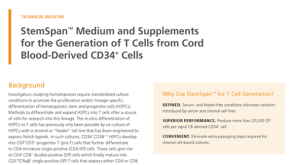 技术公告StemSpan™ Medium and Supplements for the Generation of T Cells from Cord Blood-Derived CD34+ Cells
 沪公网安备31010102008431号