Lohmann F and Bieker JJ (JUN 2008)
Development (Cambridge,England) 135 12 2071--82
Activation of Eklf expression during hematopoiesis by Gata2 and Smad5 prior to erythroid commitment.
The hierarchical progression of stem and progenitor cells to their more-committed progeny is mediated through cell-to-cell signaling pathways and intracellular transcription factor activity. However,the mechanisms that govern the genetic networks underlying lineage fate decisions and differentiation programs remain poorly understood. Here we show how integration of Bmp4 signaling and Gata factor activity controls the progression of hematopoiesis,as exemplified by the regulation of Eklf during establishment of the erythroid lineage. Utilizing transgenic reporter assays in differentiating mouse embryonic stem cells as well as in the murine fetal liver,we demonstrate that Eklf expression is initiated prior to erythroid commitment during hematopoiesis. Applying phylogenetic footprinting and in vivo binding studies in combination with newly developed loss-of-function technology in embryoid bodies,we find that Gata2 and Smad5 cooperate to induce Eklf in a progenitor population,followed by a switch to Gata1-controlled regulation of Eklf transcription upon erythroid commitment. This stage- and lineage-dependent control of Eklf expression defines a novel role for Eklf as a regulator of lineage fate decisions during hematopoiesis.
View Publication
产品类型:
产品号#:
03234
产品名:
MethoCult™ M3234
Zhou L et al. (OCT 2008)
Blood 112 8 3434--43
Inhibition of the TGF-beta receptor I kinase promotes hematopoiesis in MDS.
MDS is characterized by ineffective hematopoiesis that leads to peripheral cytopenias. Development of effective treatments has been impeded by limited insight into pathogenic pathways governing dysplastic growth of hematopoietic progenitors. We demonstrate that smad2,a downstream mediator of transforming growth factor-beta (TGF-beta) receptor I kinase (TBRI) activation,is constitutively activated in MDS bone marrow (BM) precursors and is overexpressed in gene expression profiles of MDS CD34(+) cells,providing direct evidence of overactivation of TGF-beta pathway in this disease. Suppression of the TGF-beta signaling by lentiviral shRNA-mediated down-regulation of TBRI leads to in vitro enhancement of hematopoiesis in MDS progenitors. Pharmacologic inhibition of TBRI (alk5) kinase by a small molecule inhibitor,SD-208,inhibits smad2 activation in hematopoietic progenitors,suppresses TGF-beta-mediated gene activation in BM stromal cells,and reverses TGF-beta-mediated cell-cycle arrest in BM CD34(+) cells. Furthermore,SD-208 treatment alleviates anemia and stimulates hematopoiesis in vivo in a novel murine model of bone marrow failure generated by constitutive hepatic expression of TGF-beta1. Moreover,in vitro pharmacologic inhibition of TBRI kinase leads to enhancement of hematopoiesis in varied morphologic MDS subtypes. These data directly implicate TGF-beta signaling in the pathobiology of ineffective hematopoiesis and identify TBRI as a potential therapeutic target in low-risk MDS.
View Publication
产品类型:
产品号#:
03534
03436
84434
84444
产品名:
MethoCult™ GF M3534
MethoCult™ SF M3436
Madonna R and De Caterina R (NOV 2008)
American journal of physiology. Cell physiology 295 5 C1271--80
In vitro neovasculogenic potential of resident adipose tissue precursors.
Adipose tissue development is associated with neovascularization,which might be exploited therapeutically. We investigated the neovasculogenesis antigenic profile and kinetics in adipose tissue-derived stromal cells (ADSCs) to understand the potential of ADSCs to generate new vessels. Murine and human visceral adipose tissues were processed with collagenase to obtain ADSCs from the stromal vascular fraction. Freshly isolated murine and human ADSCs featured the expression of early markers of endothelial differentiation [uptake of DiI-labeled acetylated LDL,CD133,CD34,kinase insert domain receptor (KDR)],but not markers for more mature endothelial cells (CD31 and von Willebrand factor). In methylcellulose medium,multilocular cells positive for Oil Red O staining appeared after 6 days. After 10 days,clusters of ADSCs spontaneously formed branched tubelike structures,which were strongly positive for CD34 and CD31,while losing their ability to undergo adipocyte differentiation. In Matrigel,in the presence of endothelial growth factors ADSCs formed branched tubelike structures. By clonal assays in methylcellulose we also determined the frequency of granulocyte-macrophage (CFU-GM) and erythroid (BFU-E) colony-forming units from ADSCs,compared with bone marrow-derived stromal cells (BMSCs) used as a positive control. After 4-14 days,BMSCs formed 8 +/- 3 BFU-E and 40 +/- 10 CFU-GM,while ADSCs never produced colonies of myeloid progenitors. The developing adipose tissue has neovasculogenic potential,based on the recruitment of local rather than circulating progenitors. Adipose tissue might therefore be a viable autonomous source of cells for postnatal neovascularization.
View Publication
产品类型:
产品号#:
03534
产品名:
MethoCult™ GF M3534
Pimanda JE et al. (DEC 2008)
Blood 112 12 4512--22
Endoglin expression in blood and endothelium is differentially regulated by modular assembly of the Ets/Gata hemangioblast code.
Endoglin is an accessory receptor for TGF-beta signaling and is required for normal hemangioblast,early hematopoietic,and vascular development. We have previously shown that an upstream enhancer,Eng -8,together with the promoter region,mediates robust endothelial expression yet is inactive in blood. To identify hematopoietic regulatory elements,we used array-based methods to determine chromatin accessibility across the entire locus. Subsequent transgenic analysis of candidate elements showed that an endothelial enhancer at Eng +9 when combined with an element at Eng +7 functions as a strong hemato-endothelial enhancer. Chromatin immunoprecipitation (ChIP)-chip analysis demonstrated specific binding of Ets factors to the promoter as well as to the -8,+7+9 enhancers in both blood and endothelial cells. By contrast Pu.1,an Ets factor specific to the blood lineage,and Gata2 binding was only detected in blood. Gata2 was bound only at +7 and GATA motifs were required for hematopoietic activity. This modular assembly of regulators gives blood and endothelial cells the regulatory freedom to independently fine-tune gene expression and emphasizes the role of regulatory divergence in driving functional divergence.
View Publication
产品类型:
产品号#:
03434
03444
产品名:
MethoCult™ GF M3434
MethoCult™ GF M3434
Praetor A et al. (FEB 2009)
Blood 113 9 1919--28
Genetic deletion of JAM-C reveals a role in myeloid progenitor generation.
Hematopoietic stem cells (HSCs) have the capacity to self-renew and continuously differentiate into all blood cell lineages throughout life. At each branching point during differentiation,interactions with the environment are key in the generation of daughter cells with distinct fates. Here,we examined the role of the cell adhesion molecule JAM-C,a protein known to mediate cellular polarity during spermatogenesis,in hematopoiesis. We show that murine JAM-C is highly expressed on HSCs in the bone marrow (BM). Expression correlates with self-renewal,the highest being on long-term repopulating HSCs,and decreases with differentiation,which is maintained longest among myeloid committed progenitors. Inclusion of JAM-C as a sole marker on lineage-negative BM cells yields HSC enrichments and long-term multilineage reconstitution when transferred to lethally irradiated mice. Analysis of Jam-C-deficient mice showed that two-thirds die within 48 hours after birth. In the surviving animals,loss of Jam-C leads to an increase in myeloid progenitors and granulocytes in the BM. Stem cells and myeloid cells from fetal liver are normal in number and homing to the BM. These results provide evidence that JAM-C defines HSCs in the BM and that JAM-C plays a role in controlling myeloid progenitor generation in the BM.
View Publication
产品类型:
产品号#:
03434
03444
产品名:
MethoCult™ GF M3434
MethoCult™ GF M3434
Chan G et al. (APR 2009)
Blood 113 18 4414--24
Leukemogenic Ptpn11 causes fatal myeloproliferative disorder via cell-autonomous effects on multiple stages of hematopoiesis.
PTPN11,which encodes the tyrosine phosphatase SHP2,is mutated in approximately 35% of patients with juvenile myelomonocytic leukemia (JMML) and at a lower incidence in other neoplasms. To model JMML pathogenesis,we generated knockin mice that conditionally express the leukemia-associated mutant Ptpn11(D61Y). Expression of Ptpn11(D61Y) in all hematopoietic cells evokes a fatal myeloproliferative disorder (MPD),featuring leukocytosis,anemia,hepatosplenomegaly,and factor-independent colony formation by bone marrow (BM) and spleen cells. The Lin(-)Sca1(+)cKit(+) (LSK) compartment is expanded and right-shifted�
View Publication
产品类型:
产品号#:
03234
03334
03434
03444
产品名:
MethoCult™ M3234
MethoCult™ M3334
MethoCult™ GF M3434
MethoCult™ GF M3434
Miyazaki K et al. (MAY 2009)
Blood 113 19 4702--10
Enhanced expression of p210BCR/ABL and aberrant expression of Zfp423/ZNF423 induce blast crisis of chronic myelogenous leukemia.
Chronic myelogenous leukemia (CML) is a hematopoietic disorder originating from p210BCR/ABL-transformed stem cells,which begins as indolent chronic phase (CP) but progresses into fatal blast crisis (BC). To investigate molecular mechanism(s) underlying disease evolution,CML-exhibiting p210BCR/ABL transgenic mice were crossed with BXH2 mice that transmit a replication-competent retrovirus. Whereas nontransgenic mice in the BXH2 background exclusively developed acute myeloid leukemia,p210BCR/ABL transgenic littermates developed nonmyeloid leukemias,in which inverse polymerase chain reaction detected 2 common viral integration sites (CISs). Interestingly,one CIS was transgene's own promoter,which up-regulated p210BCR/ABL expression. The other was the 5' noncoding region of a transcription factor,Zfp423,which induced aberrant Zfp423 expression. The cooperative activities of Zfp423 and p210BCR/ABL were demonstrated as follows: (1) introduction of Zfp423 in p210BCR/ABL transgenic bone marrow (BM) cells increased colony-forming ability,(2) suppression of ZNF423 (human homologue of Zfp423) in ZNF423-expressing,p210BCR/ABL-positive hematopoietic cells retarded cell growth,(3) mice that received a transplant of BM cells transduced with Zfp423 and p210BCR/ABL developed acute leukemia,and (4) expression of ZNF423 was found in human BCR/ABL-positive cell lines and CML BC samples. These results demonstrate that enhanced expression of p210BCR/ABL and deregulated expression of Zfp423/ZNF423 contribute to CML BC.
View Publication


 EasySep™小鼠TIL(CD45)正选试剂盒





 产品手册Frozen Cord Blood Proficiency Testing Worksheet (French)
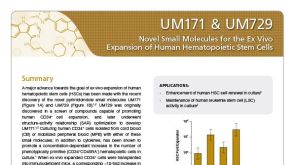 产品手册UM171和UM729 新型小分子,用于人造血干细胞的体外扩增


 沪公网安备31010102008431号