Musah S et al. (SEP 2014)
Proceedings of the National Academy of Sciences of the United States of America 111 38 13805--10
Substratum-induced differentiation of human pluripotent stem cells reveals the coactivator YAP is a potent regulator of neuronal specification.
Physical stimuli can act in either a synergistic or antagonistic manner to regulate cell fate decisions,but it is less clear whether insoluble signals alone can direct human pluripotent stem (hPS) cell differentiation into specialized cell types. We previously reported that stiff materials promote nuclear localization of the Yes-associated protein (YAP) transcriptional coactivator and support long-term self-renewal of hPS cells. Here,we show that even in the presence of soluble pluripotency factors,compliant substrata inhibit the nuclear localization of YAP and promote highly efficient differentiation of hPS cells into postmitotic neurons. In the absence of neurogenic factors,the effective substrata produce neurons rapidly (2 wk) and more efficiently (textgreater75%) than conventional differentiation methods. The neurons derived from substrate induction express mature markers and possess action potentials. The hPS differentiation observed on compliant surfaces could be recapitulated on stiff surfaces by adding small-molecule inhibitors of F-actin polymerization or by depleting YAP. These studies reveal that the matrix alone can mediate differentiation of hPS cells into a mature cell type,independent of soluble inductive factors. That mechanical cues can override soluble signals suggests that their contributions to early tissue development and lineage commitment are profound.
View Publication
产品类型:
产品号#:
05850
05857
05870
05875
85850
85857
85870
85875
产品名:
mTeSR™1
mTeSR™1
Ohmine S et al. (JAN 2011)
Stem Cell Research & Therapy 2 6 46
Induced pluripotent stem cells from GMP-grade hematopoietic progenitor cells and mononuclear myeloid cells
INTRODUCTION: The induced pluripotent stem cell (iPSC) technology allows generation of patient-specific pluripotent stem cells,thereby providing a novel cell-therapy platform for severe degenerative diseases. One of the key issues for clinical-grade iPSC derivation is the accessibility of donor cells used for reprogramming. METHODS: We examined the feasibility of reprogramming mobilized GMP-grade hematopoietic progenitor cells (HPCs) and peripheral blood mononuclear cells (PBMCs) and tested the pluripotency of derived iPS clones. RESULTS: Ectopic expression of OCT4,SOX2,KLF4,and c-MYC in HPCs and PBMCs resulted in rapid iPSC derivation. Long-term time-lapse imaging revealed efficient iPSC growth under serum- and feeder-free conditions with frequent mitotic events. HPC- and PBMC-derived iPS cells expressed pluripotency-associated markers,including SSEA-4,TRA-1-60,and NANOG. The global gene-expression profiles demonstrated the induction of endogenous pluripotent genes,such as LIN28,TERT,DPPA4,and PODXL,in derived iPSCs. iPSC clones from blood and other cell sources showed similar ultrastructural morphologies and genome-wide gene-expression profiles. On spontaneous and guided differentiation,HPC- and PBMC-derived iPSCs were differentiated into cells of three germ layers,including insulin-producing cells through endodermal lineage,verifying the pluripotency of the blood-derived iPSC clones. CONCLUSIONS: Because the use of blood cells allows minimally invasive tissue procurement under GMP conditions and rapid cellular reprogramming,mobilized HPCs and unmobilized PBMCs would be ideal somatic cell sources for clinical-grade iPSC derivation,especially from diabetes patients complicated by slow-healing wounds.
View Publication
Pierre-Louis O et al. (OCT 2009)
Stem cells (Dayton,Ohio) 27 10 2552--62
Dual SP/ALDH functionalities refine the human hematopoietic Lin-CD34+CD38- stem/progenitor cell compartment.
Identification of prevalent specific markers is crucial to stem/progenitor cell purification. Determinants such as the surface antigens CD34 and CD38 are traditionally used to analyze and purify hematopoietic stem/progenitor cells (HSCs/HPCs). However,the variable expression of these membrane antigens poses some limitations to their use in HSC/HPC purification. Techniques based on drug/stain efflux through the ATP-binding cassette (ABC)G2 pump (side population [SP] phenotype) or on detection of aldehyde dehydrogenase (ALDH) activity have been independently developed and distinguish the SP and ALDH(Bright) (ALDH(Br)) cell subsets for their phenotype and proliferative capability. In this study,we developed a multiparametric flow cytometric method associating both SP and ALDH activities on human lineage negative (Lin(-)) bone marrow cells and sorted different cell fractions according to their SP/ALDH activity level. We find that Lin(-)CD34(+)CD38(Low/-) cells are found throughout the spectrum of ALDH expression and are enriched especially in ALDH(Br) cells when associated with SP functionality (SP/ALDH(Br) fraction). Furthermore,the SP marker identified G(0) cells in all ALDH fractions,allowing us to sort quiescent cells regardless of ALDH activity. Moreover,we show that,within the Lin(-)CD34(+)CD38(-)ALDH(Br) population,the SP marker identifies cells with higher primitive characteristics,in terms of stemness-related gene expression and in vitro and in vivo proliferative potential,than the Lin(-)CD34(+) CD38(-)ALDH(Br) main population cells. In conclusion,our study shows that the coexpression of SP and ALDH markers refines the Lin(-)CD34(+)CD38(-) hematopoietic compartment and identifies an SP/ALDH(Br) cell subset enriched in quiescent primitive HSCs/HPCs.
View Publication
产品类型:
产品号#:
01700
01705
01701
01702
产品名:
ALDEFLUOR™ 试剂盒
ALDEFLUOR™ DEAB试剂, 1.5 mM, 1 mL
ALDEFLUOR™检测缓冲液
Ryan MA et al. (OCT 2010)
Nature medicine 16 10 1141--6
Mobilization of hematopoietic stem and progenitor cells (HSPCs) from bone marrow into peripheral blood by the cytokine granulocyte colony-stimulating factor (G-CSF) has become the preferred source of HSPCs for stem cell transplants. However,G-CSF fails to mobilize sufficient numbers of stem cells in up to 10% of donors,precluding autologous transplantation in those donors or substantially delaying transplant recovery time. Consequently,new regimens are needed to increase the number of stem cells in peripheral blood upon mobilization. Using a forward genetic approach in mice,we mapped the gene encoding the epidermal growth factor receptor (Egfr) to a genetic region modifying G-CSF-mediated HSPC mobilization. Amounts of EGFR in HSPCs inversely correlated with the cells' ability to be mobilized by G-CSF,implying a negative role for EGFR signaling in mobilization. In combination with G-CSF treatment,genetic reduction of EGFR activity in HSPCs (in waved-2 mutant mice) or treatment with the EGFR inhibitor erlotinib increased mobilization. Increased mobilization due to suppression of EGFR activity correlated with reduced activity of cell division control protein-42 (Cdc42),and genetic Cdc42 deficiency in vivo also enhanced G-CSF-induced mobilization. Our findings reveal a previously unknown signaling pathway regulating stem cell mobilization and provide a new pharmacological approach for improving HSPC mobilization and thereby transplantation outcomes.
View Publication
产品类型:
产品号#:
03234
产品名:
MethoCult™ M3234
Zhu H et al. (MAR 2015)
Stem Cells International 2015 621057
Development of a xeno-free substrate for human embryonic stem cell growth
Traditionally,human embryonic stem cells (hESCs) are cultured on inactivated live feeder cells. For clinical application using hESCs,there is a requirement to minimize the risk of contamination with animal components. Extracellular matrix (ECM) derived from feeder cells is the most natural way to provide xeno-free substrates for hESC growth. In this study,we optimized the step-by-step procedure for ECM processing to develop a xeno-free ECM that supports the growth of undifferentiated hESCs. In addition,this newly developed xeno-free substrate can be stored at 4°C and is ready to use upon request,which serves as an easier way to amplify hESCs for clinical applications.
View Publication
Yu J et al. (DEC 2008)
Yearbook of Dermatology and Dermatologic Surgery 2008 5858 301--302
Induced Pluripotent Stem Cell Lines Derived from Human Somatic Cells
Somatic cell nuclear transfer allows trans-acting factors present in the mammalian oocyte to reprogram somatic cell nuclei to an undifferentiated state. We show that four factors (OCT4,SOX2,NANOG,and LIN28) are sufficient to reprogram human somatic cells to pluripotent stem cells that exhibit the essential characteristics of embryonic stem (ES) cells. These induced pluripotent human stem cells have normal karyotypes,express telomerase activity,express cell surface markers and genes that characterize human ES cells,and maintain the developmental potential to differentiate into advanced derivatives of all three primary germ layers. Such induced pluripotent human cell lines should be useful in the production of new disease models and in drug development,as well as for applications in transplantation medicine,once technical limitations (for example,mutation through viral integration) are eliminated.
View Publication
产品类型:
产品号#:
03120
05850
05857
05870
05875
05920
09500
27100
27150
85850
85857
85870
85875
产品名:
BIT 9500血清替代物
35 mm培养皿
35 mm培养皿
mTeSR™1
mTeSR™1
Tsikritsis D et al. (MAY 2016)
Cytometry. Part A : the journal of the International Society for Analytical Cytology 1--23
Label-free biomarkers of human embryonic stem cell differentiation to hepatocytes.
Three different label-free,minimally invasive,live single cell analysis techniques were used to characterize embryonic stem cells,and the hepatocytes into which they were differentiated. Atomic Force Microscopy measures the cell's mechanical properties,Raman spectroscopy measures its chemical properties,and dielectrophoresis measures the membrane's capacitance. We were able to assign cell type of individual cells with accuracies of 96.5% (Atomic Force Microscopy),92.5 % (Raman spectroscopy),and *** % (Dielectrophoresis). These techniques,used either independently or in combination,offer label-free methods to study individual living cells. Although they can be applied to any phenotypical or environmental change,these techniques have most potential in human cell therapies where the use of biomarkers is best avoided. If all three properties are independent,then a combined accuracy of *** % can be achieved in cell characterization. We suggest how these methods could be combined into one microfluidic chip for cell sorting,and how they can be applied to cell culture.
View Publication
产品类型:
产品号#:
05850
05857
05870
05875
85850
85857
85870
85875
产品名:
mTeSR™1
mTeSR™1
Quadrato G et al. (MAY 2017)
Nature 545 7652 48--53
Cell diversity and network dynamics in photosensitive human brain organoids.
In vitro models of the developing brain such as three-dimensional brain organoids offer an unprecedented opportunity to study aspects of human brain development and disease. However,the cells generated within organoids and the extent to which they recapitulate the regional complexity,cellular diversity and circuit functionality of the brain remain undefined. Here we analyse gene expression in over 80,000 individual cells isolated from 31 human brain organoids. We find that organoids can generate a broad diversity of cells,which are related to endogenous classes,including cells from the cerebral cortex and the retina. Organoids could be developed over extended periods (more than 9 months),allowing for the establishment of relatively mature features,including the formation of dendritic spines and spontaneously active neuronal networks. Finally,neuronal activity within organoids could be controlled using light stimulation of photosensitive cells,which may offer a way to probe the functionality of human neuronal circuits using physiological sensory stimuli.
View Publication
Hughes JN et al. (MAR 2014)
Differentiation; research in biological diversity 87 3-4 101--110
Regulation of pluripotent cell differentiation by a small molecule, staurosporine
Research in the embryo and in culture has resulted in a sophisticated understanding of many regulators of pluripotent cell differentiation. As a consequence,protocols for the differentiation of pluripotent cells generally rely on a combination of exogenous growth factors and endogenous signalling. Little consideration has been given to manipulating other pathways to achieve pluripotent cell differentiation. The integrity of cell:cell contacts has been shown to influence lineage choice during pluripotent cell differentiation,with disruption of cell:cell contacts promoting mesendoderm formation and maintenance of cell:cell contacts resulting in the preferential formation of neurectoderm. Staurosporine is a broad spectrum inhibitor of serine/threonine kinases which has several effects on cell function,including interruption of cell:cell contacts,decreasing focal contact size,inducing epithelial to mesenchyme transition (EMT) and promoting cell differentiation. The possibility that staurosporine could influence lineage choice from pluripotent cells in culture was investigated. The addition of staurosporine to differentiating mouse EPL resulted in preferential formation of mesendoderm and mesoderm populations,and inhibited the formation of neurectoderm. Addition of staurosporine to human ES cells similarly induced primitive streak marker gene expression. These data demonstrate the ability of staurosporine to influence lineage choice during pluripotent cell differentiation and to mimic the effect of disrupting cell:cell contacts. Staurosporine induced mesendoderm in the absence of known inducers of formation,such as serum and BMP4. Staurosporine induced the expression of mesendoderm markers,including markers that were not induced by BMP4,suggesting it acted as a broad spectrum inducer of molecular gastrulation. This approach has identified a small molecule regulator of lineage choice with potential applications in the commercial development of ES cell derivatives,specifically as a method for forming mesendoderm progenitors or as a culture adjunct to prevent the formation of ectoderm progenitors during pluripotent cell differentiation. ?? 2014.
View Publication


 EasySep™小鼠TIL(CD45)正选试剂盒





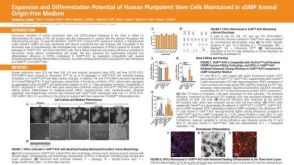 科学海报Expansion and Differentiation Potential of Human Pluripotent Stem Cells Maintained in cGMP Animal Origin-Free Medium

 沪公网安备31010102008431号