A time course analysis of the electrophysiological properties of neurons differentiated from human induced Pluripotent Stem Cells (iPSCs)
Many protocols have been designed to differentiate human embryonic stem cells (ESCs) and human induced pluripotent stem cells (iPSCs) into neurons. Despite the relevance of electrophysiological properties for proper neuronal function,little is known about the evolution over time of important neuronal electrophysiological parameters in iPSC-derived neurons. Yet,understanding the development of basic electrophysiological characteristics of iPSC-derived neurons is critical for evaluating their usefulness in basic and translational research. Therefore,we analyzed the basic electrophysiological parameters of forebrain neurons differentiated from human iPSCs,from day 31 to day 55 after the initiation of neuronal differentiation. We assayed the developmental progression of various properties,including resting membrane potential,action potential,sodium and potassium channel currents,somatic calcium transients and synaptic activity. During the maturation of iPSC-derived neurons,the resting membrane potential became more negative,the expression of voltage-gated sodium channels increased,the membrane became capable of generating action potentials following adequate depolarization and,at day 48-55,50% of the cells were capable of firing action potentials in response to a prolonged depolarizing current step,of which 30% produced multiple action potentials. The percentage of cells exhibiting miniature excitatory post-synaptic currents increased over time with a significant increase in their frequency and amplitude. These changes were associated with an increase of Ca2+ transient frequency. Co-culturing iPSC-derived neurons with mouse glial cells enhanced the development of electrophysiological parameters as compared to pure iPSC-derived neuronal cultures. This study demonstrates the importance of properly evaluating the electrophysiological status of the newly generated neurons when using stem cell technology,as electrophysiological properties of iPSC-derived neurons mature over time.
View Publication
产品类型:
产品号#:
05850
05857
05870
05875
85850
85857
85870
85875
产品名:
mTeSR™1
mTeSR™1
Madison JM et al. (JUN 2015)
Molecular Psychiatry 20 November 2013 703--17
Characterization of bipolar disorder patient-specific induced pluripotent stem cells from a family reveals neurodevelopmental and mRNA expression abnormalities.
Bipolar disorder (BD) is a common neuropsychiatric disorder characterized by chronic recurrent episodes of depression and mania. Despite evidence for high heritability of BD,little is known about its underlying pathophysiology. To develop new tools for investigating the molecular and cellular basis of BD,we applied a family-based paradigm to derive and characterize a set of 12 induced pluripotent stem cell (iPSC) lines from a quartet consisting of two BD-affected brothers and their two unaffected parents. Initially,no significant phenotypic differences were observed between iPSCs derived from the different family members. However,upon directed neural differentiation,we observed that CXCR4 (CXC chemokine receptor-4) expressing central nervous system (CNS) neural progenitor cells (NPCs) from both BD patients compared with their unaffected parents exhibited multiple phenotypic differences at the level of neurogenesis and expression of genes critical for neuroplasticity,including WNT pathway components and ion channel subunits. Treatment of the CXCR4(+) NPCs with a pharmacological inhibitor of glycogen synthase kinase 3,a known regulator of WNT signaling,was found to rescue a progenitor proliferation deficit in the BD patient NPCs. Taken together,these studies provide new cellular tools for dissecting the pathophysiology of BD and evidence for dysregulation of key pathways involved in neurodevelopment and neuroplasticity. Future generation of additional iPSCs following a family-based paradigm for modeling complex neuropsychiatric disorders in conjunction with in-depth phenotyping holds promise for providing insights into the pathophysiological substrates of BD and is likely to inform the development of targeted therapeutics for its treatment and ideally prevention.
View Publication
产品类型:
产品号#:
05850
05857
05870
05875
85850
85857
85870
85875
27845
27945
27840
27865
27940
27965
产品名:
mTeSR™1
mTeSR™1
Mandal A et al. (FEB 2016)
In Vitro Cellular and Developmental Biology - Animal 52 2 243--251
Long-term culture and cryopreservation does not affect the stability and functionality of human embryonic stem cell-derived hepatocyte-like cells
Human embryonic stem cells (hESCs) are predicted to be an unlimited source of hepatocytes which can pave the way for applications such as cell replacement therapies or as a model of human development or even to predict the hepatotoxicity of drug compounds. We have optimized a 23-d differentiation protocol to generate hepatocyte-like cells (HLCs) from hESCs,obtaining a relatively pure population which expresses the major hepatic markers and is functional and mature. The stability of the HLCs in terms of hepato-specific marker expression and functionality was found to be intact even after an extended period of in vitro culture and cryopreservation. The hESC-derived HLCs have shown the capability to display sensitivity and an alteration in the level of CYP enzyme upon drug induction. This illustrates the potential of such assays in predicting the hepatotoxicity of a drug compound leading to advancement of pharmacology
View Publication
产品类型:
产品号#:
05850
05857
05870
05875
85850
85857
85870
85875
产品名:
mTeSR™1
mTeSR™1
Chung HCY et al. (JAN 2012)
Stem cells and development 21 2 206--16
Human induced pluripotent stem cells derived under feeder-free conditions display unique cell cycle and DNA replication gene profiles.
Use of animal feeder layers and serum containing media in the derivation and propagation of induced pluripotent stem cells (iPSCs) can hinder clinical translation,because of the presence of xeno-material/pathogens. A defined and standardized system would be ideal for generating a homogenous population of iPSCs,which closely resembles human embryonic stem cells (hESCs). This article presents a novel and extensive comparison between in-house produced iPSCs and hESCs under feeder" and "feeder-free" conditions�
View Publication
A practical synthesis of Rho-Kinase inhibitor Y-27632 and fluoro derivatives and their evaluation in human pluripotent stem cells.
A practical synthesis of the Rho-Kinase inhibitor Y-27632 and two new fluoro derivatives was achieved in seven steps and with a good overall yield of 45% starting from commercially available (R)-1-phenylethylamine. Compared to Y-27632 the new fluoro derivatives showed reduced or no effect on hPSC vitality and expansion after dissociation in human pluripotent stem cells.
View Publication
产品类型:
产品号#:
05850
05857
05870
05875
85850
85857
85870
85875
产品名:
mTeSR™1
mTeSR™1
Iacovino M et al. (OCT 2011)
Stem Cells 29 10 1580--1587
Inducible cassette exchange: A rapid and efficient system enabling conditional gene expression in embryonic stem and primary cells
Genetic modification is critically enabling for studies addressing specification and maintenance of cell fate; however,methods for engineering modifications are inefficient. We demonstrate a rapid and efficient recombination system in which an inducible,floxed cre allele replaces itself with an incoming transgene. We target this inducible cassette exchange (ICE) allele to the (HPRT) locus and demonstrate recombination in murine embryonic stem cells (ESCs) and primary cells from derivative ICE mice. Using lentivectors,we demonstrate recombination at a randomly integrated ICE locus in human ESCs. To illustrate the utility of this system,we insert the myogenic regulator,Myf5,into the ICE locus in each platform. This enables efficient directed differentiation of mouse and human ESCs into skeletal muscle and conditional myogenic transdetermination of primary cells cultured in vitro. This versatile tool is thus well suited to gain-of-function studies probing gene function in the specification and reprogramming of cell fate.
View Publication
产品类型:
产品号#:
05850
05857
05870
05875
85850
85857
85870
85875
产品名:
mTeSR™1
mTeSR™1
Davis RP et al. (JUL 2013)
Differentiation 86 1–2 30--37
Generation of induced pluripotent stem cells from human foetal fibroblasts using the Sleeping Beauty transposon gene delivery system
Transposon gene delivery systems offer an alternative,non-viral-based approach to generate induced pluripotent stem cells (iPSCs). Here we used the Sleeping Beauty (SB) transposon to generate four human iPSC lines from foetal fibroblasts. In contrast to other gene delivery systems,the SB transposon does not exhibit an integration bias towards particular genetic elements,thereby reducing the risk of insertional mutagenesis. Furthermore,unlike the alternative transposon piggyBac,SB has no SB-like elements within the human genome,minimising the possibility of mobilising endogenous transposon elements. All iPSC lines exhibited the expected characteristics of pluripotent human cells,including the ability to differentiate to derivatives of all three germ layers in vitro. Re-expression of the SB transposase in the iPSCs after reprogramming resulted in the mobilisation of some of the transposons. These results indicate that the SB transposon system is a useful addition to methods for generating human iPSCs,both for basic and applied biomedical research,and in the context of future therapeutic application. textcopyright 2013 International Society of Differentiation.
View Publication
产品类型:
产品号#:
05850
05857
05870
05875
85850
85857
85870
85875
产品名:
mTeSR™1
mTeSR™1
Thoma EC et al. (OCT 2016)
Scientific reports 6 35830
Establishment of a translational endothelial cell model using directed differentiation of induced pluripotent stem cells from Cynomolgus monkey.
Due to their broad differentiation potential,pluripotent stem cells (PSCs) offer a promising approach for generating relevant cellular models for various applications. While human PSC-based cellular models are already advanced,similar systems for non-human primates (NHPs) are still lacking. However,as NHPs are the most appropriate animals for evaluating the safety of many novel pharmaceuticals,the availability of in vitro systems would be extremely useful to bridge the gap between cellular and animal models. Here,we present a NHP in vitro endothelial cell system using induced pluripotent stem cells (IPSCs) from Cynomolgus monkey (Macaca fascicularis). Based on an adapted protocol for human IPSCs,we directly differentiated macaque IPSCs into endothelial cells under chemically defined conditions. The resulting endothelial cells can be enriched using immuno-magnetic cell sorting and display endothelial marker expression and function. RNA sequencing revealed that the differentiation process closely resembled vasculogenesis. Moreover,we showed that endothelial cells derived from macaque and human IPSCs are highly similar with respect to gene expression patterns and key endothelial functions,such as inflammatory responses. These data demonstrate the power of IPSC differentiation technology to generate defined cell types for use as translational in vitro models to compare cell type-specific responses across species.
View Publication
产品类型:
产品号#:
05850
05857
05870
05875
85850
85857
85870
85875
产品名:
mTeSR™1
mTeSR™1
Guo D et al. (JAN 2017)
Stem cell research 18 64--66
Generation of non-integrated induced pluripotent stem cells from a 59-year-old female with multiple endocrine neoplasia type 1 syndrome.
Urine resource cells were collected from a 59-year-old female patient with multiple endocrine neoplasia type 1 syndrome (MEN1) for generating iPS cells with episomal plasmids carrying Oct4,Sox2,Klf4 and miR-302-367. The patient sustained a heterozygous GtextgreaterT transition mutation on the exon 9 of Men1 gene that was confirmed by sequencing analysis on the obtained iPSC lines. Karyotyping indicated the chromosomes with normal appearances and numbers. Their pluripotency was demonstrated by gene expression,as well as their abilities for differentiating into three germ layers. This cell line provides an ideal model for studying MEN1.
View Publication
产品类型:
产品号#:
05850
05857
05870
05875
85850
85857
85870
85875
产品名:
mTeSR™1
mTeSR™1
Jara-Avaca M et al. (FEB 2017)
Stem cell reports 8 2 305--317
EBIO Does Not Induce Cardiomyogenesis in Human Pluripotent Stem Cells but Modulates Cardiac Subtype Enrichment by Lineage-Selective Survival.
Subtype-specific human cardiomyocytes (CMs) are valuable for basic and applied research. Induction of cardiomyogenesis and enrichment of nodal-like CMs was described for mouse pluripotent stem cells (mPSCs) in response to 1-ethyl-2-benzimidazolinone (EBIO),a chemical modulator of small-/intermediate-conductance Ca(2+)-activated potassium channels (SKs 1-4). Investigating EBIO in human pluripotent stem cells (PSCs),we have applied three independent differentiation protocols of low to high cardiomyogenic efficiency. Equivalent to mPSCs,timed EBIO supplementation during hPSC differentiation resulted in dose-dependent enrichment of up to 80% CMs,including an increase in nodal- and atrial-like phenotypes. However,our study revealed extensive EBIO-triggered cell loss favoring cardiac progenitor preservation and,subsequently,CMs with shortened action potentials. Proliferative cells were generally more sensitive to EBIO,presumably via an SK-independent mechanism. Together,EBIO did not promote cardiogenic differentiation of PSCs,opposing previous findings,but triggered lineage-selective survival at a cardiac progenitor stage,which we propose as a pharmacological strategy to modulate CM subtype composition.
View Publication
Mariotti J et al. (JAN 2008)
Journal of immunology (Baltimore,Md. : 1950) 180 1 89--105
Ex vivo rapamycin generates apoptosis-resistant donor Th2 cells that persist in vivo and prevent hemopoietic stem cell graft rejection.
Because ex vivo rapamycin generates murine Th2 cells that prevent Graft-versus-host disease more potently than control Th2 cells,we hypothesized that rapamycin would generate Th2/Tc2 cells (Th2/Tc2.R cells) that abrogate fully MHC-disparate hemopoietic stem cell rejection more effectively than control Th2/Tc2 cells. In a B6-into-BALB/c graft rejection model,donor Th2/Tc2.R cells were indeed enriched in their capacity to prevent rejection; importantly,highly purified CD4+ Th2.R cells were also highly efficacious for preventing rejection. Rapamycin-generated Th2/Tc2 cells were less likely to die after adoptive transfer,accumulated in vivo at advanced proliferative cycles,and were present in 10-fold higher numbers than control Th2/Tc2 cells. Th2.R cells had a multifaceted,apoptosis-resistant phenotype,including: 1) reduced apoptosis after staurosporine addition,serum starvation,or CD3/CD28 costimulation; 2) reduced activation of caspases 3 and 9; and 3) increased anti-apoptotic Bcl-xL expression and reduced proapoptotic Bim and Bid expression. Using host-versus-graft reactivity as an immune correlate of graft rejection,we found that the in vivo efficacy of Th2/Tc2.R cells 1) did not require Th2/Tc2.R cell expression of IL-4,IL-10,perforin,or Fas ligand; 2) could not be reversed by IL-2,IL-7,or IL-15 posttransplant therapy; and 3) was intact after therapy with Th2.R cells relatively devoid of Foxp3 expression. We conclude that ex vivo rapamycin generates Th2 cells that are resistant to apoptosis,persist in vivo,and effectively prevent rejection by a mechanism that may be distinct from previously described graft-facilitating T cells.
View Publication


 EasySep™小鼠TIL(CD45)正选试剂盒





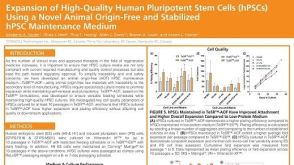 科学海报Expansion of High-Quality Human Pluripotent Stem Cells (hPSCs) Using a Novel Animal Origin-Free and Stabilized hPSC Maintenance Medium
 沪公网安备31010102008431号