Strö et al. (APR 2010)
In vitro cellular & developmental biology. Animal 46 3-4 337--344
Derivation of 30 human embryonic stem cell lines-improving the quality
We have derived 30 human embryonic stem cell lines from supernumerary blastocysts in our laboratory. During the derivation process,we have studied new and safe method to establish good quality lines. All our human embryonic stem cell lines have been derived using human foreskin fibroblasts as feeder cells. The 26 more recent lines were derived in a medium containing serum replacement instead of fetal calf serum. Mechanical isolation of the inner cell mass using flexible metal needles was used in deriving the 10 latest lines. The lines are karyotypically normal,but culture adaptation in two lines has been observed. Our human embryonic stem cell lines are banked,and they are available for researchers.
View Publication
产品类型:
产品号#:
05850
05857
05870
05875
07913
85850
85857
85870
85875
产品名:
Dispase(5 U/mL)
mTeSR™1
mTeSR™1
Pevsner-Fischer M et al. (FEB 2007)
Blood 109 4 1422--32
Toll-like receptors and their ligands control mesenchymal stem cell functions.
Mesenchymal stem cells (MSCs) are widespread in adult organisms and may be involved in tissue maintenance and repair as well as in the regulation of hematopoiesis and immunologic responses. Thus,it is important to discover the factors controlling MSC renewal and differentiation. Here we report that adult MSCs express functional Toll-like receptors (TLRs),confirmed by the responses of MSCs to TLR ligands. Pam3Cys,a prototypic TLR-2 ligand,augmented interleukin-6 secretion by MSC,induced nuclear factor kappa B (NF-kappaB) translocation,reduced MSC basal motility,and increased MSC proliferation. The hallmark of MSC function is the capacity to differentiate into several mesodermal lineages. We show herein that Pam3Cys inhibited MSC differentiation into osteogenic,adipogenic,and chondrogenic cells while sparing their immunosuppressive effect. Our study therefore shows that a TLR ligand can antagonize MSC differentiation triggered by exogenous mediators and consequently maintains the cells in an undifferentiated and proliferating state in vitro. Moreover,MSCs derived from myeloid factor 88 (MyD88)-deficient mice lacked the capacity to differentiate effectively into osteogenic and chondrogenic cells. It appears that TLRs and their ligands can serve as regulators of MSC proliferation and differentiation and might affect the maintenance of MSC multipotency.
View Publication
产品类型:
产品号#:
05501
05502
产品名:
Hughes CS et al. (OCT 2011)
Proteomics 11 20 3983--3991
Proteomic analysis of extracellular matrices used in stem cell culture.
Numerous matrices for the growth of human embryonic stem cells (hESC) in vitro have been described. However,their exact composition is typically unknown. Information on the components of these matrices will aid in the development of a fully defined growth surface for hESCs. These matrices typically consist of mixture of proteins present in a wide range of abundance making their characterization challenging. In this study,we performed the proteomic analysis of five previously uncharacterized matrices: CellStart,Human Basement Membrane Extract (Human BME),StemXVivo,Bridge Human Extracellular Matrix (BridgeECM),and mouse embryonic fibroblast conditioned matrix (MEF-CMTX). Based on a proteomics protocol optimized using lysates from HeLa cells,we undertook the analysis of the five complex extracellular matrix (ECM) samples using a combination of strong anion and cation exchange chromatography and SDS-PAGE. For each of these matrices,we identify numerous proteins,indicating their complex nature. We also compared these results with a similar proteomics analysis of the growth matrix,Matrigel™. From these analyses,we observed that fibronectin is a primary component of nearly all hESC supportive matrices. This observation led to the investigation of the suitability of fibronectin as a defined ECM for the growth of hESCs. We found that fibronectin promotes the maintenance of pluripotent H9 and CA1 hESCs in an undifferentiated state using mTeSR1 medium. This finding validates the utility of characterizing matrices used for hESC growth in revealing ECM components required for culturing hESCs in a universally applicable defined system.
View Publication
产品类型:
产品号#:
05850
05857
05870
05875
85850
85857
85870
85875
产品名:
mTeSR™1
mTeSR™1
Matsuura K et al. (AUG 2012)
Biochemical and biophysical research communications 425 2 321--7
Creation of human cardiac cell sheets using pluripotent stem cells
Although we previously reported the development of cell-dense thickened cardiac tissue by repeated transplantation-based vascularization of neonatal rat cardiac cell sheets,the cell sources for human cardiac cells sheets and their functions have not been fully elucidated. In this study,we developed a bioreactor to expand and induce cardiac differentiation of human induced pluripotent stem cells (hiPSCs). Bioreactor culture for 14 days produced around 8×10(7) cells/100 ml vessel and about 80% of cells were positive for cardiac troponin T. After cardiac differentiation,cardiomyocytes were cultured on temperature-responsive culture dishes and showed spontaneous and synchronous beating,even after cell sheets were detached from culture dishes. Furthermore,extracellular action potential propagation was observed between cell sheets when two cardiac cell sheets were partially overlaid. These findings suggest that cardiac cell sheets formed by hiPSC-derived cardiomyocytes might have sufficient properties for the creation of thickened cardiac tissue.
View Publication
Hsiao C et al. (MAY 2016)
Biotechnology Journal 11 5 662--675
Human pluripotent stem cell culture density modulates YAP signaling
Human pluripotent stem cell (hPSC) density is an important factor in self-renewal and differentiation fates; however,the mechanisms through which hPSCs sense cell density and process this information in making cell fate decisions remain to be fully understood. One particular pathway that may prove important in density-dependent signaling in hPSCs is the Hippo pathway,which is regulated by cell-cell contact and mechanosensing through the cytoskeleton and has been linked to the maintenance of stem cell pluripotency. To probe regulation of Hippo pathway activity in hPSCs,we assessed whether Hippo pathway transcriptional activator YAP was differentially modulated by cell density. At higher cell densities,YAP phosphorylation and localization to the cytoplasm increased,which led to decreased YAP-mediated transcriptional activity. Furthermore,total YAP protein levels diminished at high cell density due to the phosphorylation-targeted degradation of YAP. Inducible shRNA knockdown of YAP reduced expression of YAP target genes and pluripotency genes. Finally,the density-dependent increase of neuroepithelial cell differentiation was mitigated by shRNA knockdown of YAP. Our results suggest a pivotal role of YAP in cell density-mediated fate decisions in hPSCs.
View Publication
Delivery of Proteases in Aqueous Two-Phase Systems Enables Direct Purification of Stem Cell Colonies from Feeder Cell Co-Cultures for Differentiation into Functional Cardiomyocytes
Patterning of bioactive enzymes with subcellular resolution is achieved by dispensing droplets of dextran (DEX) onto polyethylene glycol (PEG)-covered cells though a glass capillary needle connected to a pneumatic pump. This technique is applied to purify colonies of induced pluripotent stem cells (iPSCs) from mouse embryonic fibroblast (MEF) feeder cultures and inefficiently induced iPSC colonies by selectively dissociating the iPSCs with proteases.
View Publication
产品类型:
产品号#:
05850
05857
05870
05875
85850
85857
85870
85875
产品名:
mTeSR™1
mTeSR™1
Lin GG et al. (JAN 2010)
Methods in molecular biology (Clifton,N.J.) 636 1--24
Human embryonic stem cell derivation, maintenance, and differentiation to trophoblast.
Since the first report of derivation of human embryonic stem cell (hESC) lines in 1998,many progresses have been achieved to reliably and efficiently derive,maintain,and differentiate this therapeutically promising cell type. This chapter introduces some basic and widely recognized methods that we use in our hESC core laboratory. Specifically,it includes methods for (1) deriving hESC lines without using enzyme and antibody to isolate the inner cell mass; (2) sustaining hESC self-renewal under feeder-dependent,feeder-conditioned,and defined conditions as well as pluripotency validation and quality control assays; and (3) inducing hESC differentiation to trophoblast with BMP4.
View Publication
产品类型:
产品号#:
05850
05857
05870
05875
85850
85857
85870
85875
产品名:
mTeSR™1
mTeSR™1
Meng G et al. (JUN 2010)
Biochemistry and cell biology = Biochimie et biologie cellulaire 88 3 479--490
Derivation of human embryonic stem cell lines after blastocyst microsurgery.
Embryonic stem cells (ESCs) are derived from the inner cell mass (ICM) of the blastocyst. Because of their ability to differentiate into a variety of cell types,human embryonic stem cells (hESCs) provide an unlimited source of cells for clinical medicine and have begun to be used in clinical trials. Presently,although several hundred hESC lines are available in the word,only few have been widely used in basic and applied research. More and more hESC lines with differing genetic backgrounds are required for establishing a bank of hESCs. Here,we report the first Canadian hESC lines to be generated from cryopreserved embryos and we discuss how we navigated through the Canadian regulatory process. The cryopreserved human zygotes used in this study were cultured to the blastocyst stage,and used to isolate ICM via microsurgery. Unlike previous microsurgery methods,which use specialized glass or steel needles,our method conveniently uses syringe needles for the isolation of ICM and subsequent hESC lines. ICM were cultured on MEF feeders in medium containing FBS or serum replacer (SR). Resulting outgrowths were isolated,cut into several cell clumps,and transferred onto fresh feeders. After more than 30 passages,the two hESC lines established using this method exhibited normal morphology,karyotype,and growth rate. Moreover,they stained positively for a variety of pluripotency markers and could be differentiated both in vitro and in vivo. Both cell lines could be maintained under a variety of culture conditions,including xeno-free conditions we have previously described. We suggest that this microsurgical approach may be conducive to deriving xeno-free hESC lines when outgrown on xeno-free human foreskin fibroblast feeders.
View Publication
产品类型:
产品号#:
05850
05857
05870
05875
07923
85850
85857
85870
85875
产品名:
Dispase (1 U/mL)
mTeSR™1
mTeSR™1
Xie X et al. (JAN 2011)
Stem cells and development 20 1 127--138
Effects of long-term culture on human embryonic stem cell aging.
In recent years,human embryonic stem (hES) cells have become a promising cell source for regenerative medicine. Although hES cells have the ability for unlimited self-renewal,potential adverse effects of long-term cell culture upon hES cells must be investigated before therapeutic applications of hES cells can be realized. Here we investigated changes in molecular profiles associated with young (textless60 passages) and old (textgreater120 passages) cells of the H9 hES cell line as well as young (textless85 passages) and old (textgreater120 passages) cells of the PKU1 hES cell line. Our results show that morphology,stem cell markers,and telomerase activity do not differ significantly between young and old passage cells. Cells from both age groups were also shown to differentiate into derivatives of all 3 germ layers upon spontaneous differentiation in vitro. Interestingly,mitochondrial dysfunction was found to occur with prolonged culture. Old passage cells of both the H9 and PKU1 lines were characterized by higher mitochondrial membrane potential,larger mitochondrial morphology,and higher reactive oxygen species content than their younger counterparts. Teratomas derived from higher passage cells were also found to have an uneven preference for differentiation compared with tumors derived from younger cells. These findings suggest that prolonged culture of hES cells may negatively impact mitochondrial function and possibly affect long-term pluripotency.
View Publication


 EasySep™小鼠TIL(CD45)正选试剂盒





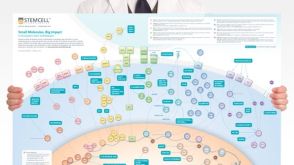 挂图Small Molecules, Big Impact in Pluripotent Stem Cell Research Overview of signaling pathways and small molecules in pluripotent stem cell research

 沪公网安备31010102008431号