Smith D et al. (JAN 2016)
Biotechnology progress 32 1 215--223
Automated image analysis with the potential for process quality control applications in stem cell maintenance and differentiation.
The translation of laboratory processes into scaled production systems suitable for manufacture is a significant challenge for cell based therapies; in particular there is a lack of analytical methods that are informative and efficient for process control. Here the potential of image analysis as one part of the solution to this issue is explored,using pluripotent stem cell colonies as a valuable and challenging exemplar. The Cell-IQ live cell imaging platform was used to build image libraries of morphological culture attributes such as colony edge�
View Publication
产品类型:
产品号#:
05850
05857
05870
05875
07923
85850
85857
85870
85875
产品名:
Dispase (1 U/mL)
mTeSR™1
mTeSR™1
Lassailly F et al. (JUL 2010)
Blood 115 26 5347--54
Microenvironmental contaminations" induced by fluorescent lipophilic dyes used for noninvasive in vitro and in vivo cell tracking."
Determining how normal and leukemic stem cells behave in vivo,in a dynamic and noninvasive way,remains a major challenge. Most optical tracking technologies rely on the use of fluorescent or bioluminescent reporter genes,which need to be stably expressed in the cells of interest. Because gene transfer in primary leukemia samples represents a major risk to impair their capability to engraft in a xenogenic context,we evaluated the possibility to use gene transfer-free labeling technologies. The lipophilic dye 3,3,3',3' tetramethylindotricarbocyanine iodide (DiR) was selected among 4 near-infrared (NIR) staining technologies. Unfortunately we report here a massive transfer of the dye occurring toward the neighbor cells both in vivo and in vitro. We further demonstrate that all lipophilic dyes tested in this study (1,1'-dioctadecyl-3,3,3',3'-tetramethylindotricarbocyanine perchlorate [DiI],DiD,DiR,and PKH26) can give rise to microenvironmental contamination,including when used in suboptimal concentration,after extensive washing procedures and in the absence of phagocytosis or marked cell death. This was observed from all cell types tested. Eventually,we show that this microenvironmental contamination is mediated by both direct cell-cell contacts and diffusible microparticles. We conclude that tracking of labeled cells using non-genetically encoded markers should always be accompanied by drastic cross validation using multimodality approaches.
View Publication
产品类型:
产品号#:
09600
09650
19756
19756RF
产品名:
StemSpan™ SFEM
StemSpan™ SFEM
Hsiao C et al. (MAY 2016)
Biotechnology Journal 11 5 662--675
Human pluripotent stem cell culture density modulates YAP signaling
Human pluripotent stem cell (hPSC) density is an important factor in self-renewal and differentiation fates; however,the mechanisms through which hPSCs sense cell density and process this information in making cell fate decisions remain to be fully understood. One particular pathway that may prove important in density-dependent signaling in hPSCs is the Hippo pathway,which is regulated by cell-cell contact and mechanosensing through the cytoskeleton and has been linked to the maintenance of stem cell pluripotency. To probe regulation of Hippo pathway activity in hPSCs,we assessed whether Hippo pathway transcriptional activator YAP was differentially modulated by cell density. At higher cell densities,YAP phosphorylation and localization to the cytoplasm increased,which led to decreased YAP-mediated transcriptional activity. Furthermore,total YAP protein levels diminished at high cell density due to the phosphorylation-targeted degradation of YAP. Inducible shRNA knockdown of YAP reduced expression of YAP target genes and pluripotency genes. Finally,the density-dependent increase of neuroepithelial cell differentiation was mitigated by shRNA knockdown of YAP. Our results suggest a pivotal role of YAP in cell density-mediated fate decisions in hPSCs.
View Publication
产品类型:
产品号#:
05850
05857
05870
05875
85850
85857
85870
85875
产品名:
mTeSR™1
mTeSR™1
Stockmann M et al. (AUG 2013)
Stem Cell Reviews and Reports 9 4 475--492
Developmental and Functional Nature of Human iPSC Derived Motoneurons
Mehta A et al. (FEB 2013)
Toxicological Sciences 131 2 458--469
Pharmacoelectrophysiology of viral-free induced pluripotent stem cell-derived human cardiomyocytes
Development of pharmaceutical agents for cardiac indication demands elaborate safety screening in which assessing repolarization of cardiac cells remains a critical path in risk evaluations. An efficient platform for evaluating cardiac repolarization in vitro significantly facilitates drug developmental programs. In a proof of principle study,we examined the effect of antiarrhythmogenic drugs (Vaughan Williams class I-IV) and noncardiac active drugs (terfenadine and cisapride) on the repolarization profile of viral-free human-induced pluripotent stem cell-derived cardiomyocytes (hiPSC-CMs). Extracellular field potential (FP) recording using microelectrode arrays demonstrated significant delayed repolarization as prolonged corrected FP durations (cFPDs) by class I (quinidine and flecainide),class III (sotalol and amiodarone),and class IV (verapamil),whereas class II drugs (propranolol and nadolol) had no effects. Consistent with their sodium channel-blocking ability,class I drugs also significantly reduced FPmin and conduction velocity. Although lidocaine (class IB) had no effects on cFPDs,verapamil shortened cFPD and FPmin by 25 and 50%,respectively. Furthermore,verapamil reduced beating frequencies drastically. Importantly,the examined drugs exhibited dose-response curve on prolongation of cFPDs at an effective range that correlated significantly with therapeutic plasma concentrations achieved clinically. Consistent with clinical outcomes,drug-induced arrhythmia of tachycardia and bigeminy-like waveforms by quinidine,flecainide,and sotalol was demonstrated at supraphysiological concentrations. Furthermore,off-target effects of terfenadine and cisapride on cFPD and Na( + ) channel blockage were similarly revealed. These results suggest that hiPSC-CMs may be useful for safety evaluation of cardioactive and noncardiac acting drugs for personalized medicine.
View Publication
产品类型:
产品号#:
05850
05857
05870
05875
85850
85857
85870
85875
产品名:
mTeSR™1
mTeSR™1
Ahrens N et al. (SEP 2004)
Transplantation 78 6 925--9
Mesenchymal stem cell content of human vertebral bone marrow.
Mesenchymal stem cells (MSCs) are capable of down-regulating alloimmune responses and promoting the engraftment of hematopoietic stem cells. MSCs may therefore be suitable for improving donor-specific tolerance induction in solid-organ transplantation. Cells from cadaveric vertebral bone marrow (V-BM),aspirated iliac crest-BM,and peripheral blood progenitor cells were compared. Cells were characterized by flow cytometry and colony assays. MSCs generated from V-BM were assayed for differentiation capacity and immunomodulatory function. A median 5.7 x 10(8) nucleated cells (NCs) were recovered per vertebral body. The mesenchymal progenitor,colony-forming unit-fibroblast,frequency in V-BM (11.6/10(5) NC,range: 6.0-20.0) was considerably higher than in iliac crest-BM (1.4/10(5) NC,range: 0.4-2.6) and peripheral blood progenitor cells (not detectable). MSC generated from V-BM had the typical MSC phenotype (CD105(pos)CD73(pos)CD45(neg)CD34(neg)),displayed multilineage differentiation potential,and suppressed alloreactivity in mixed lymphocyte reactions. V-BM may be an excellent source for MSC cotransplantation approaches.
View Publication
产品类型:
产品号#:
05401
05402
05411
产品名:
MesenCult™ MSC 基础培养基(人)
MesenCult™ MSC刺激添加物(人)
MesenCult™ 增殖试剂盒(人)
Maillet A et al. ( 2016)
Scientific reports 6 April 25333
Modeling Doxorubicin-Induced Cardiotoxicity in Human Pluripotent Stem Cell Derived-Cardiomyocytes.
Doxorubicin is a highly efficacious anti-cancer drug but causes cardiotoxicity in many patients. The mechanisms of doxorubicin-induced cardiotoxicity (DIC) remain incompletely understood. We investigated the characteristics and molecular mechanisms of DIC in human pluripotent stem cell-derived cardiomyocytes (hPSC-CMs). We found that doxorubicin causes dose-dependent increases in apoptotic and necrotic cell death,reactive oxygen species production,mitochondrial dysfunction and increased intracellular calcium concentration. We characterized genome-wide changes in gene expression caused by doxorubicin using RNA-seq,as well as electrophysiological abnormalities caused by doxorubicin with multi-electrode array technology. Finally,we show that CRISPR-Cas9-mediated disruption of TOP2B,a gene implicated in DIC in mouse studies,significantly reduces the sensitivity of hPSC-CMs to doxorubicin-induced double stranded DNA breaks and cell death. These data establish a human cellular model of DIC that recapitulates many of the cardinal features of this adverse drug reaction and could enable screening for protective agents against DIC as well as assessment of genetic variants involved in doxorubicin response.
View Publication
产品类型:
产品号#:
05850
05857
05870
05875
85850
85857
85870
85875
产品名:
mTeSR™1
mTeSR™1
Au KF et al. (DEC 2013)
Proceedings of the National Academy of Sciences of the United States of America 110 50 E4821----30
Characterization of the human ESC transcriptome by hybrid sequencing.
Although transcriptional and posttranscriptional events are detected in RNA-Seq data from second-generation sequencing,full-length mRNA isoforms are not captured. On the other hand,third-generation sequencing,which yields much longer reads,has current limitations of lower raw accuracy and throughput. Here,we combine second-generation sequencing and third-generation sequencing with a custom-designed method for isoform identification and quantification to generate a high-confidence isoform dataset for human embryonic stem cells (hESCs). We report 8,084 RefSeq-annotated isoforms detected as full-length and an additional 5,459 isoforms predicted through statistical inference. Over one-third of these are novel isoforms,including 273 RNAs from gene loci that have not previously been identified. Further characterization of the novel loci indicates that a subset is expressed in pluripotent cells but not in diverse fetal and adult tissues; moreover,their reduced expression perturbs the network of pluripotency-associated genes. Results suggest that gene identification,even in well-characterized human cell lines and tissues,is likely far from complete.
View Publication
产品类型:
产品号#:
05850
05857
05870
05875
85850
85857
85870
85875
产品名:
mTeSR™1
mTeSR™1
Lee Y-K et al. (NOV 2011)
Stem cell reviews 7 4 976--86
Calcium homeostasis in human induced pluripotent stem cell-derived cardiomyocytes.
RATIONALE: Cardiomyocytes generated from human induced pluripotent stem cells (hiPSCs) are suggested as the most promising candidate to replenish cardiomyocyte loss in regenerative medicine. Little is known about their calcium homeostasis,the key process underlying excitation-contraction coupling. OBJECTIVE: We investigated the calcium handling properties of hiPSC-derived cardiomyocytes and compared with those from human embryonic stem cells (hESCs). METHODS AND RESULTS: We differentiated cardiomyocytes from hiPSCs (IMR90 and KS1) and hESCs (H7 and HES3) with established protocols. Beating outgrowths from embryoid bodies were typically observed 2 weeks after induction. Cells in these outgrowths were stained positively for tropomyosin and sarcomeric alpha-actinin. Reverse-transcription polymerase chain reaction studies demonstrated the expressions of cardiac-specific markers in both hiPSC- and hESC-derived cardiomyocytes. Calcium handling properties of 20-day-old hiPSC- and hESC-derived cardiomyocytes were investigated using fluorescence confocal microscopy. Compared with hESC-derived cardiomyocytes,spontaneous calcium transients from both lines of hiPSC-derived cardiomyocytes were of significantly smaller amplitude and with slower maximal upstroke velocity. Better caffeine-induced calcium handling kinetics in hESC-CMs indicates a higher sacroplasmic recticulum calcium store. Furthermore,in contrast with hESC-derived cardiomyocytes,ryanodine did not reduce the amplitudes,maximal upstroke and decay velocity of calcium transients of hiPSC-derived cardiomyocytes. In addition,spatial inhomogeneity in temporal properties of calcium transients across the width of cardiomyocytes was more pronounced in hiPSC-derived cardiomyocytes than their hESC counterpart as revealed line-scan calcium imaging. Expressions of the key calcium-handling proteins including ryanodine recptor-2 (RyR2),sacroplasmic recticulum calcium-ATPase (SERCA),junction (Jun) and triadin (TRDN),were significantly lower in hiPSC than in hESCs. CONCLUSIONS: The results indicate the calcium handling properties of hiPSC-derived cardiomyocytes are relatively immature to hESC counterparts.
View Publication
产品类型:
产品号#:
05850
05857
05870
05875
85850
85857
85870
85875
产品名:
mTeSR™1
mTeSR™1
Sweeney CL et al. (FEB 2017)
Molecular therapy : the journal of the American Society of Gene Therapy 25 2 321--330
Targeted Repair of CYBB in X-CGD iPSCs Requires Retention of Intronic Sequences for Expression and Functional Correction.
X-linked chronic granulomatous disease (X-CGD) is an immune deficiency resulting from defective production of microbicidal reactive oxygen species (ROS) by phagocytes. Causative mutations occur throughout the CYBB gene,resulting in absent or defective gp91(phox) protein expression. To correct CYBB exon 5 mutations while retaining normal gene regulation,we utilized TALEN or Cas9 for exon 5 replacement in induced pluripotent stem cells (iPSCs) from patients,which restored gp91(phox) expression and ROS production in iPSC-derived granulocytes. Alternate approaches for correcting the majority of X-CGD mutations were assessed,involving TALEN- or Cas9-mediated insertion of CYBB minigenes at exon 1 or 2 of the CYBB locus. Targeted insertion of an exon 1-13 minigene into CYBB exon 1 resulted in no detectable gp91(phox) expression or ROS activity in iPSC-derived granulocytes. In contrast,targeted insertion of an exon 2-13 minigene into exon 2 restored both gp91(phox) and ROS activity. This demonstrates the efficacy of two correction strategies: seamless repair of specific CYBB mutations by exon replacement or targeted insertion of an exon 2-13 minigene to CYBB exon 2 while retaining exon/intron 1. Furthermore,it highlights a key issue for targeted insertion strategies for expression from an endogenous promoter: retention of intronic elements can be necessary for expression.
View Publication
产品类型:
产品号#:
05850
05857
05870
05875
85850
85857
85870
85875
产品名:
mTeSR™1
mTeSR™1
Lindvall C et al. (NOV 2006)
The Journal of biological chemistry 281 46 35081--7
The Wnt signaling receptor Lrp5 is required for mammary ductal stem cell activity and Wnt1-induced tumorigenesis.
Canonical Wnt signaling has emerged as a critical regulatory pathway for stem cells. The association between ectopic activation of Wnt signaling and many different types of human cancer suggests that Wnt ligands can initiate tumor formation through altered regulation of stem cell populations. Here we have shown that mice deficient for the Wnt co-receptor Lrp5 are resistant to Wnt1-induced mammary tumors,which have been shown to be derived from the mammary stem/progenitor cell population. These mice exhibit a profound delay in tumorigenesis that is associated with reduced Wnt1-induced accumulation of mammary progenitor cells. In addition to the tumor resistance phenotype,loss of Lrp5 delays normal mammary development. The ductal trees of 5-week-old Lrp5-/- females have fewer terminal end buds,which are structures critical for juvenile ductal extension presumed to be rich in stem/progenitor cells. Consequently,the mature ductal tree is hypomorphic and does not completely fill the fat pad. Furthermore,Lrp5-/- ductal cells from mature females exhibit little to no stem cell activity in limiting dilution transplants. Finally,we have shown that Lrp5-/- embryos exhibit substantially impaired canonical Wnt signaling in the primitive stem cell compartment of the mammary placodes. These findings suggest that Lrp5-mediated canonical signaling is required for mammary ductal stem cell activity and for tumor development in response to oncogenic Wnt effectors.
View Publication


 EasySep™小鼠TIL(CD45)正选试剂盒




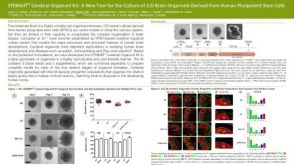 科学海报STEMdiff™ Cerebral Organoid Kit: A New Tool for the Culture of 3D Brain Organoids Derived from hPSCs

 沪公网安备31010102008431号