Conversion of adult endothelium to immunocompetent haematopoietic stem cells.
Developmental pathways that orchestrate the fleeting transition of endothelial cells into haematopoietic stem cells remain undefined. Here we demonstrate a tractable approach for fully reprogramming adult mouse endothelial cells to haematopoietic stem cells (rEC-HSCs) through transient expression of the transcription-factor-encoding genes Fosb,Gfi1,Runx1,and Spi1 (collectively denoted hereafter as FGRS) and vascular-niche-derived angiocrine factors. The induction phase (days 0-8) of conversion is initiated by expression of FGRS in mature endothelial cells,which results in endogenous Runx1 expression. During the specification phase (days 8-20),RUNX1(+) FGRS-transduced endothelial cells commit to a haematopoietic fate,yielding rEC-HSCs that no longer require FGRS expression. The vascular niche drives a robust self-renewal and expansion phase of rEC-HSCs (days 20-28). rEC-HSCs have a transcriptome and long-term self-renewal capacity similar to those of adult haematopoietic stem cells,and can be used for clonal engraftment and serial primary and secondary multi-lineage reconstitution,including antigen-dependent adaptive immune function. Inhibition of TGFβ and CXCR7 or activation of BMP and CXCR4 signalling enhanced generation of rEC-HSCs. Pluripotency-independent conversion of endothelial cells into autologous authentic engraftable haematopoietic stem cells could aid treatment of haematological disorders.
View Publication
产品类型:
产品号#:
09600
09650
产品名:
StemSpan™ SFEM
StemSpan™ SFEM
Sugimura R et al. (MAY 2017)
Nature 545 7655 432--438
Haematopoietic stem and progenitor cells from human pluripotent stem cells.
A variety of tissue lineages can be differentiated from pluripotent stem cells by mimicking embryonic development through stepwise exposure to morphogens,or by conversion of one differentiated cell type into another by enforced expression of master transcription factors. Here,to yield functional human haematopoietic stem cells,we perform morphogen-directed differentiation of human pluripotent stem cells into haemogenic endothelium followed by screening of 26 candidate haematopoietic stem-cell-specifying transcription factors for their capacity to promote multi-lineage haematopoietic engraftment in mouse hosts. We recover seven transcription factors (ERG,HOXA5,HOXA9,HOXA10,LCOR,RUNX1 and SPI1) that are sufficient to convert haemogenic endothelium into haematopoietic stem and progenitor cells that engraft myeloid,B and T cells in primary and secondary mouse recipients. Our combined approach of morphogen-driven differentiation and transcription-factor-mediated cell fate conversion produces haematopoietic stem and progenitor cells from pluripotent stem cells and holds promise for modelling haematopoietic disease in humanized mice and for therapeutic strategies in genetic blood disorders.
View Publication
产品类型:
产品号#:
04434
04444
05850
05857
05870
05875
85850
85857
85870
85875
产品名:
MethoCult™ H4434 Classic
MethoCult™ H4434 Classic
mTeSR™1
mTeSR™1
Douvaras P et al. (MAY 2017)
Stem cell reports
Directed Differentiation of Human Pluripotent Stem Cells to Microglia.
Microglia,the immune cells of the brain,are crucial to proper development and maintenance of the CNS,and their involvement in numerous neurological disorders is increasingly being recognized. To improve our understanding of human microglial biology,we devised a chemically defined protocol to generate human microglia from pluripotent stem cells. Myeloid progenitors expressing CD14/CX3CR1 were generated within 30 days of differentiation from both embryonic and induced pluripotent stem cells (iPSCs). Further differentiation of the progenitors resulted in ramified microglia with highly motile processes,expressing typical microglial markers. Analyses of gene expression and cytokine release showed close similarities between iPSC-derived (iPSC-MG) and human primary microglia as well as clear distinctions from macrophages. iPSC-MG were able to phagocytose and responded to ADP by producing intracellular Ca(2+) transients,whereas macrophages lacked such response. The differentiation protocol was highly reproducible across several pluripotent stem cell lines.
View Publication
产品类型:
产品号#:
05850
05857
05870
05875
85850
85857
85870
85875
产品名:
mTeSR™1
mTeSR™1
Artyukhov AS et al. (MAY 2017)
Gene
New genes for accurate normalization of qRT-PCR results in study of iPS and iPS-derived cells.
iPSC-derived cells (from induced pluripotent stem cells) are a useful source that provide a powerful and widely accepted tool for the study of various types of human cells in vitro. Indeed,iPSC-derived cells from patients with hereditary diseases have been shown to reproduce the hallmarks of these diseases in vitro,phenotypes that can then also be manipulated in vitro. Quantitative reverse transcription PCR (qRT-PCR) is often used to characterize the progress of iPSC differentiation,validate mature cell types and to determine levels of pathological markers. Quantitative reverse transcription PCR (qRT-PCR) is used to quantify mRNA levels. This method requires some way of normalizing the data,typically by relating the obtained levels of gene expression to the levels of expression of a house keeping gene"�
View Publication
产品类型:
产品号#:
05850
05857
05870
05875
85850
85857
85870
85875
产品名:
mTeSR™1
mTeSR™1
Ounpuu L et al. (MAY 2017)
Biochimica et biophysica acta
2102Ep embryonal carcinoma cells have compromised respiration and shifted bioenergetic profile distinct from H9 human embryonic stem cells.
Recent studies have shown that cellular bioenergetics may be involved in stem cell differentiation. Considering that during cancerogenesis cells acquire numerous properties of stem cells,it is possible to assume that the energy metabolism in tumorigenic cells might be differently regulated. The aim of this study was to compare the mitochondrial bioenergetic profile of normal pluripotent human embryonic stem cells (hESC) and relatively nullipotent embryonal carcinoma cells (2102Ep cell line). We examined three parameters related to cellular bioenergetics: phosphotransfer system,aerobic glycolysis,and oxygen consumption. Activities and expression levels of main enzymes that facilitate energy transfer were measured. The oxygen consumption rate studies were performed to investigate the respiratory capacity of cells. 2102Ep cells showed a shift in energy distribution towards adenylate kinase network. The total AK activity was almost 3 times higher in 2102Ep cells compared to hESCs (179.85±5.73 vs 64.39±2.55mU/mg of protein) and the expression of AK2 was significantly higher in these cells,while CK was downregulated. 2102Ep cells displayed reduced levels of oxygen consumption and increased levels of aerobic glycolysis compared to hESCs. The compromised respiration of 2102Ep cells is not the result of increased mitochondrial mass,increased proton leak,and reduced respiratory reserve capacity of the cells or impairment of respiratory chain complexes. Our data showed that the bioenergetic profile of 2102Ep cells clearly distinguishes them from normal hESCs. This should be considered when this cell line is used as a reference,and highlight the importance of further research concerning energy metabolism of stem cells.
View Publication
产品类型:
产品号#:
05850
05857
05870
05875
85850
85857
85870
85875
产品名:
mTeSR™1
mTeSR™1
Bain G et al. (APR 1995)
Developmental biology 168 2 342--57
Embryonic stem cells express neuronal properties in vitro.
Mouse embryonic stem (ES) cells cultured as aggregates and exposed to retinoic acid are induced to express multiple phenotypes normally associated with neurons. A large percentage of treated aggregates produce a rich neuritic outgrowth. Dissociating the induced aggregates with trypsin and plating the cells as a monolayer results in cultures in which a sizable percentage of the cells have a neuronal appearance. These neuron-like cells express class III beta-tubulin and the neurofilament M subunit. Induced cultures express transcripts for neural-associated genes including the neurofilament L subunit,glutamate receptor subunits,the transcription factor Brn-3,and GFAP. Levels of neurofilament L and GAD67 and GAD65 transcripts rise dramatically upon induction. Physiological studies show that the neuron-like cells generate action potentials and express TTX-sensitive sodium channels,as well as voltage-gated potassium channels and calcium channels. We conclude that a complex system of neuronal gene expression can be activated in cultured ES cells. This system should be favorable for investigating some of the mechanisms that regulate neuronal differentiation.
View Publication
产品类型:
产品号#:
06902
06952
00321
00322
00323
00324
00325
产品名:
Nakano T et al. (AUG 1994)
Science (New York,N.Y.) 265 5175 1098--101
Generation of lymphohematopoietic cells from embryonic stem cells in culture.
An efficient system was developed that induced the differentiation of embryonic stem (ES) cells into blood cells of erythroid,myeloid,and B cell lineages by coculture with the stromal cell line OP9. This cell line does not express functional macrophage colony-stimulating factor (M-CSF). The presence of M-CSF had inhibitory effects on the differentiation of ES cells to blood cells other than macrophages. Embryoid body formation or addition of exogenous growth factors was not required,and differentiation was highly reproducible even after the selection of ES cells with the antibiotic G418. Combined with the ability to genetically manipulate ES cells,this system will facilitate the study of molecular mechanisms involved in development and differentiation of hematopoietic cells.
View Publication
产品类型:
产品号#:
06902
06952
00321
00322
00323
00324
00325
产品名:
Jones RJ et al. (JUL 1996)
Blood 88 2 487--91
Characterization of mouse lymphohematopoietic stem cells lacking spleen colony-forming activity.
The classical definition of lymphohematopoietic stem cells (LHSC),the most primitive progenitors of all blood cells,requires that they have the capacity for self-renewal and for the long-term production of all blood cell lineages. However,other characteristics of LHSC have been debated. Our previous data suggested that mouse LHSC are very slowly proliferating cells that generate delayed multilineage engraftment,while radioprotection" (rapid engraftment that will prevent early death from radiation-induced marrow aplasia) results from more committed progenitors. Alternatively�
View Publication
产品类型:
产品号#:
01700
01705
01701
01702
产品名:
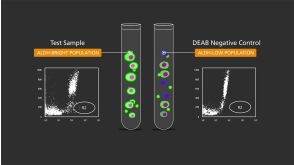
ALDEFLUOR™ 试剂盒
ALDEFLUOR™ DEAB试剂, 1.5 mM, 1 mL
ALDEFLUOR™检测缓冲液
Smith GH (JAN 1996)
Breast cancer research and treatment 39 1 21--31
Experimental mammary epithelial morphogenesis in an in vivo model: evidence for distinct cellular progenitors of the ductal and lobular phenotype.
An in vivo transplantation system has been used to evaluate the developmental capacities of specific mouse mammary epithelial cell populations. Specifically,mouse mammary epithelial cells with distinctly limited developmental potentials have been identified using this procedure. Two distinct epithelial cell progenitors have been identified by experiments designed to determine whether basal lobular and ductal phenotypes could develop independently under conditions imposed by a limiting dilution. The prediction that these separate epithelial progenitors must exist was based upon the results from transplantation experiments carried out in epithelium-divested mammary fat pads of syngeneic mice with mammary epithelium from two different transgenic mouse models. The results presented here demonstrate the following points: 1) lobular,i.e. secretory,progenitor cells are present as distinct entities among the mammary epithelial cells found in immature virgin female mice; 2) similarly,ductal epithelial progenitors are present within the same population; 3) lobular progenitors are present in greater numbers,although both cell populations are extremely small; 4) as expected,some inocula produce outgrowths with simultaneous development of both lobular and ductal phenotypes--it is not known whether this indicates cooperative interaction between the two epithelial progenitors or signals the presence of a third progenitor type capable of producing both ductular and lobular committed daughters; 5) these findings have important consequences in the design of experiments aimed at testing the effects of known and putative mammary oncogenes and tumor suppressor genes,using techniques which include cellular transformation in vitro followed by in vivo cultivation and evaluation.
View Publication
Yen J et al. (JUL 2013)
Biomaterials Science 1 7 719--727
Cationic, helical polypeptide-based gene delivery for IMR-90 fibroblasts and human embryonic stem cells
Diblock copolymers consisting of poly(ethylene glycol)-block-poly(γ-4-(((2-(piperidin-1-yl)ethyl)amino)methyl)benzyl-l-glutamate) (PEG-b-PVBLG-8) were synthesized and evaluated for their ability to mediate gene delivery in hard-to-transfect cells like IMR-90 human fetal lung fibroblasts and human embryonic s
View Publication
产品类型:
产品号#:
05850
05857
05870
05875
85850
85857
85870
85875
产品名:
mTeSR™1
mTeSR™1
Trilck et al. ( 2013)
Orphanet journal of rare diseases 8 144
Niemann-Pick type C1 patient-specific induced pluripotent stem cells display disease specific hallmarks.
BACKGROUND: Niemann-Pick type C1 disease (NPC1) is a rare progressive neurodegenerative disorder caused by mutations in the NPC1 gene. In this lysosomal storage disorder the intracellular transport and sequestration of several lipids like cholesterol is severely impaired,resulting in an accumulation of lipids in late endosomes and lysosomes. The neurological manifestation of the disease is caused by dysfunction and cell death in the central nervous system. Several animal models were used to analyze the impaired pathways. However,the underlying pathogenic mechanisms are still not completely understood and the genetic variability in humans cannot be reflected in these models. Therefore,a human model using patient-specific induced pluripotent stem cells provides a promising approach. METHODS: We reprogrammed human fibroblasts from a NPC1 patient and a healthy control by retroviral transduction with Oct4,Klf4,Sox2 and c-Myc. The obtained human induced pluripotent stem cells (hiPSCs) were characterized by immunocytochemical analyses. Neural progenitor cells were generated and patch clamp recordings were performed for a functional analysis of derived neuronal cells. Filipin stainings and the Amplex Red assay were used to demonstrate and quantify cholesterol accumulation. RESULTS: The hiPSCs expressed different stem cell markers,e.g. Nanog,Tra-1-81 and SSEA4. Using the embryoid body assay,the cells were differentiated in cells of all three germ layers and induced teratoma in immunodeficient mice,demonstrating their pluripotency. In addition,neural progenitor cells were derived and differentiated into functional neuronal cells. Patch clamp recordings revealed voltage dependent channels,spontaneous action potentials and postsynaptic currents. The accumulation of cholesterol in different tissues is the main hallmark of NPC1. In this study we found an accumulation of cholesterol in fibroblasts of a NPC1 patient,derived hiPSCs,and neural progenitor cells,but not in cells derived from fibroblasts of a healthy individual. These findings were quantified by the Amplex Red assay,demonstrating a significantly elevated cholesterol level in cells derived from fibroblasts of a NPC1 patient. CONCLUSIONS: We generated a neuronal model based on induced pluripotent stem cells derived from patient fibroblasts,providing a human in vitro model to study the pathogenic mechanisms of NPC1 disease.
View Publication


 EasySep™小鼠TIL(CD45)正选试剂盒






 沪公网安备31010102008431号