Tissue-Engineered Vascular Rings from Human iPSC-Derived Smooth Muscle Cells
There is an urgent need for an efficient approach to obtain a large-scale and renewable source of functional human vascular smooth muscle cells (VSMCs) to establish robust,patient-specific tissue model systems for studying the pathogenesis of vascular disease,and for developing novel therapeutic interventions. Here,we have derived a large quantity of highly enriched functional VSMCs from human induced pluripotent stem cells (hiPSC-VSMCs). Furthermore,we have engineered 3D tissue rings from hiPSC-VSMCs using a facile one-step cellular self-assembly approach. The tissue rings are mechanically robust and can be used for vascular tissue engineering and disease modeling of supravalvular aortic stenosis syndrome. Our method may serve as a model system,extendable to study other vascular proliferative diseases for drug screening. Thus,this report describes an exciting platform technology with broad utility for manufacturing cell-based tissues and materials for various biomedical applications.
View Publication
Tan BSN et al. (JUN 2016)
Mechanisms of development 141 32--39
Regulation of amino acid transporters in pluripotent cell populations in the embryo and in culture; novel roles for sodium-coupled neutral amino acid transporters.
The developmental outcomes of preimplantation mammalian embryos are regulated directly by the surrounding microenvironment,and inappropriate concentrations of amino acids,or the loss of amino acid-sensing mechanisms,can be detrimental and impact further development. A specific role for l-proline in the differentiation of embryonic stem (ES) cells,a cell population derived from the blastocyst,has been shown in culture. l-proline acts as a signalling molecule,exerting its effects through cell uptake and subsequent metabolism. Uptake in ES cells occurs predominantly through the sodium-coupled neutral amino acid transporter 2,Slc38a2 (SNAT2). Dynamic expression of amino acid transporters has been shown in the early mammalian embryo,reflecting functional roles for amino acids in embryogenesis. The expression of SNAT2 and family member Slc38a1 (SNAT1) was determined in mouse embryos from the 2-cell stage through to the early post-implantation pre-gastrulation embryo. Key changes in expression were validated in cell culture models of development. Both transporters showed temporal dynamic expression patterns and changes in intracellular localisation as differentiation progressed. Changes in transporter expression likely reflect different amino acid requirements during development. Findings include the differential expression of SNAT1 in the inner and outer cells of the compacted morula and nuclear localisation of SNAT2 in the trophectoderm and placental lineages. Furthermore,SNAT2 expression was up-regulated in the epiblast prior to primitive ectoderm formation,an expression pattern consistent with a role for the transporter in later developmental decisions within the pluripotent lineage. We propose that the differential expression of SNAT2 in the epiblast provides evidence for an l-proline-mediated mechanism contributing to the regulation of embryonic development.
View Publication
Delivery of Proteases in Aqueous Two-Phase Systems Enables Direct Purification of Stem Cell Colonies from Feeder Cell Co-Cultures for Differentiation into Functional Cardiomyocytes
Patterning of bioactive enzymes with subcellular resolution is achieved by dispensing droplets of dextran (DEX) onto polyethylene glycol (PEG)-covered cells though a glass capillary needle connected to a pneumatic pump. This technique is applied to purify colonies of induced pluripotent stem cells (iPSCs) from mouse embryonic fibroblast (MEF) feeder cultures and inefficiently induced iPSC colonies by selectively dissociating the iPSCs with proteases.
View Publication
产品类型:
产品号#:
05850
05857
05870
05875
85850
85857
85870
85875
产品名:
mTeSR™1
mTeSR™1
Xu Q et al. (AUG 2003)
Blood 102 3 972--80
Survival of acute myeloid leukemia cells requires PI3 kinase activation.
The mechanisms that regulate the growth and survival of acute myeloid leukemia (AML) cells are largely unknown. We hypothesized that constitutive activation of phosphatidyl-inositide 3 kinase (PI3 kinase) could regulate survival in primary cells from patients with AML. Here we demonstrate that Akt,a critical substrate of PI3 kinase,is activated in AML blasts. In a short-term culture system,most AML patient samples showed a dose-dependent decrease in survival after incubation with the PI3 kinase inhibitor LY294002. This decrease in survival was partially due to the induction of apoptosis. Furthermore,we have shown that p70 S6 kinase and 4EBP-1,downstream mediators of Akt signaling,also are phosphorylated in AML blasts. Phosphorylation of these proteins is inhibited by the mTOR inhibitor RAD001. Incubation of AML blasts with RAD001 induces only a small decrease in survival of the cells; however,when combined with Ara-C,RAD001 enhances the toxicity of Ara-C. These results demonstrate that constitutive activation of the PI3 kinase pathway is necessary for the survival of AML blasts and that targeting of this pathway with pharmacologic inhibitors may be of clinical benefit in treatment of AML.
View Publication
产品类型:
产品号#:
09500
产品名:
BIT 9500血清替代物
Yu J et al. (DEC 2008)
Yearbook of Dermatology and Dermatologic Surgery 2008 5858 301--302
Induced Pluripotent Stem Cell Lines Derived from Human Somatic Cells
Somatic cell nuclear transfer allows trans-acting factors present in the mammalian oocyte to reprogram somatic cell nuclei to an undifferentiated state. We show that four factors (OCT4,SOX2,NANOG,and LIN28) are sufficient to reprogram human somatic cells to pluripotent stem cells that exhibit the essential characteristics of embryonic stem (ES) cells. These induced pluripotent human stem cells have normal karyotypes,express telomerase activity,express cell surface markers and genes that characterize human ES cells,and maintain the developmental potential to differentiate into advanced derivatives of all three primary germ layers. Such induced pluripotent human cell lines should be useful in the production of new disease models and in drug development,as well as for applications in transplantation medicine,once technical limitations (for example,mutation through viral integration) are eliminated.
View Publication
产品类型:
产品号#:
03120
05850
05857
05870
05875
05920
09500
27100
27150
85850
85857
85870
85875
产品名:
BIT 9500血清替代物
35 mm培养皿
35 mm培养皿
mTeSR™1
mTeSR™1
Walker A et al. (JAN 2010)
Nature communications 1 6 71
Non-muscle myosin II regulates survival threshold of pluripotent stem cells.
Human pluripotent stem (hPS) cells such as human embryonic stem (hES) and induced pluripotent stem (hiPS) cells are vulnerable under single cell conditions,which hampers practical applications; yet,the mechanisms underlying this cell death remain elusive. In this paper,we demonstrate that treatment with a specific inhibitor of non-muscle myosin II (NMII),blebbistatin,enhances the survival of hPS cells under clonal density and suspension conditions,and,in combination with a synthetic matrix,supports a fully defined environment for self-renewal. Consistent with this,genetically engineered mouse embryonic stem cells lacking an isoform of NMII heavy chain (NMHCII),or hES cells expressing a short hairpin RNA to knock down NMHCII,show greater viability than controls. Moreover,NMII inhibition increases the expression of self-renewal regulators Oct3/4 and Nanog,suggesting a mechanistic connection between NMII and self-renewal. These results underscore the importance of the molecular motor,NMII,as a novel target for chemically engineering the survival and self-renewal of hPS cells.
View Publication
产品类型:
产品号#:
05850
05857
05870
05875
72402
72404
85850
85857
85870
85875
产品名:
(-)-Blebbistatin
(-)-Blebbistatin
mTeSR™1
mTeSR™1
Ciampi O et al. (JUN 2016)
Stem Cell Research 17 1 130--139
Generation of functional podocytes from human induced pluripotent stem cells
Generating human podocytes in vitro could offer a unique opportunity to study human diseases. Here,we describe a simple and efficient protocol for obtaining functional podocytes in vitro from human induced pluripotent stem cells. Cells were exposed to a three-step protocol,which induced their differentiation into intermediate mesoderm,then into nephron progenitors and,finally,into mature podocytes. After differentiation,cells expressed the main podocyte markers,such as synaptopodin,WT1,α-Actinin-4,P-cadherin and nephrin at the protein and mRNA level,and showed the low proliferation rate typical of mature podocytes. Exposure to Angiotensin II significantly decreased the expression of podocyte genes and cells underwent cytoskeleton rearrangement. Cells were able to internalize albumin and self-assembled into chimeric 3D structures in combination with dissociated embryonic mouse kidney cells. Overall,these findings demonstrate the establishment of a robust protocol that,mimicking developmental stages,makes it possible to derive functional podocytes in vitro.
View Publication
产品类型:
产品号#:
05850
05857
05870
05875
85850
85857
85870
85875
05270
05275
产品名:
mTeSR™1
mTeSR™1
STEMdiff™ APEL™2 培养基
STEMdiff™ APEL™2 培养基
Baker D et al. (NOV 2016)
Stem cell reports 7 5 998--1012
Detecting Genetic Mosaicism in Cultures of Human Pluripotent Stem Cells.
Genetic changes in human pluripotent stem cells (hPSCs) gained during culture can confound experimental results and potentially jeopardize the outcome of clinical therapies. Particularly common changes in hPSCs are trisomies of chromosomes 1,12,17,and 20. Thus,hPSCs should be regularly screened for such aberrations. Although a number of methods are used to assess hPSC genotypes,there has been no systematic evaluation of the sensitivity of the commonly used techniques in detecting low-level mosaicism in hPSC cultures. We have performed mixing experiments to mimic the naturally occurring mosaicism and have assessed the sensitivity of chromosome banding,qPCR,fluorescence in situ hybridization,and digital droplet PCR in detecting variants. Our analysis highlights the limits of mosaicism detection by the commonly employed methods,a pivotal requirement for interpreting the genetic status of hPSCs and for setting standards for safe applications of hPSCs in regenerative medicine.
View Publication


 EasySep™小鼠TIL(CD45)正选试剂盒





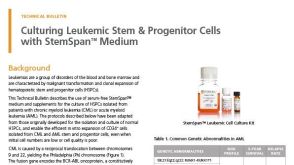 技术公告Culturing Leukemic Stem & Progenitor Cells with StemSpan™ Medium
 实验方案Enzyme-Free Passaging of Human Pluripotent Stem Cells Using ReLeSR™

 沪公网安备31010102008431号