Chang SK et al. (JUN 2008)
Journal of immunology (Baltimore,Md. : 1950) 180 11 7394--403
B lymphocyte stimulator regulates adaptive immune responses by directly promoting dendritic cell maturation.
B lymphocyte stimulator (BLyS) is a well-known direct costimulator of adaptive immune cells,particularly B lineage cells. However,we have reported recently that BLyS is also able to activate monocytes. Other innate immune cells,such as dendritic cells (DCs),play a key role in the initiation of adaptive immune responses and the purpose of the current study was to assess whether there is a direct role for BLyS in modulating human DC functions. In this study,we show that BLyS induces DC activation and maturation. Thus,BLyS strongly induced up-regulation of surface costimulatory molecule expression and secretion of specific cytokines and chemokines in DCs. BLyS-stimulated DCs (BLyS-DCs) were also able to augment allogeneic CD4 T cell proliferation to a greater extent than control DCs. BLyS-DCs secreted elevated levels of the major Th1-polarizing cytokine,IL-12p70,and they promoted naive CD4 T cell differentiation into Th1 T cells. Regarding BLyS receptor expression,DCs primarily express cytoplasmic transmembrane activator and CAML interactor; however,low levels of cell surface transmembrane activator and CAML interactor are expressed as well. Collectively,our data suggest that BLyS may modulate adaptive immune cells indirectly by inducing DC maturation.
View Publication
产品类型:
产品号#:
19155
19155RF
21000
20119
20155
产品名:
RoboSep™- S
RoboSep™ 吸头组件抛光剂
RoboSep™分选管套装(9个塑料管)
Addo MM et al. (FEB 2003)
Journal of virology 77 3 2081--92
Comprehensive epitope analysis of human immunodeficiency virus type 1 (HIV-1)-specific T-cell responses directed against the entire expressed HIV-1 genome demonstrate broadly directed responses, but no correlation to viral load.
Cellular immune responses play a critical role in the control of human immunodeficiency virus type 1 (HIV-1); however,the breadth of these responses at the single-epitope level has not been comprehensively assessed. We therefore screened peripheral blood mononuclear cells (PBMC) from 57 individuals at different stages of HIV-1 infection for virus-specific T-cell responses using a matrix of 504 overlapping peptides spanning all expressed HIV-1 proteins in a gamma interferon-enzyme-linked immunospot (Elispot) assay. HIV-1-specific T-cell responses were detectable in all study subjects,with a median of 14 individual epitopic regions targeted per person (range,2 to 42),and all 14 HIV-1 protein subunits were recognized. HIV-1 p24-Gag and Nef contained the highest epitope density and were also the most frequently recognized HIV-1 proteins. The total magnitude of the HIV-1-specific response ranged from 280 to 25,860 spot-forming cells (SFC)/10(6) PBMC (median,4,245) among all study participants. However,the number of epitopic regions targeted,the protein subunits recognized,and the total magnitude of HIV-1-specific responses varied significantly among the tested individuals,with the strongest and broadest responses detectable in individuals with untreated chronic HIV-1 infection. Neither the breadth nor the magnitude of the total HIV-1-specific CD8+-T-cell responses correlated with plasma viral load. We conclude that a peptide matrix-based Elispot assay allows for rapid,sensitive,specific,and efficient assessment of cellular immune responses directed against the entire expressed HIV-1 genome. These data also suggest that the impact of T-cell responses on control of viral replication cannot be explained by the mere quantification of the magnitude and breadth of the CD8+-T-cell response,even if a comprehensive pan-genome screening approach is applied.
View Publication
产品类型:
产品号#:
15022
15062
15023
15063
产品名:
RosetteSep™人CD4+ T细胞富集抗体混合物
RosetteSep™人CD4+ T细胞富集抗体混合物
RosetteSep™人CD8+ T细胞富集抗体混合物
RosetteSep™人CD8+ T细胞富集抗体混合物
Pike R et al. (NOV 2009)
Journal of virology 83 21 11211--22
Race between retroviral spread and CD4+ T-cell response determines the outcome of acute Friend virus infection.
Retroviruses can establish persistent infection despite induction of a multipartite antiviral immune response. Whether collective failure of all parts of the immune response or selective deficiency in one crucial part underlies the inability of the host to clear retroviral infections is currently uncertain. We examine here the contribution of virus-specific CD4(+) T cells in resistance against Friend virus (FV) infection in the murine host. We show that the magnitude and duration of the FV-specific CD4(+) T-cell response is directly proportional to resistance against acute FV infection and subsequent disease. Notably,significant protection against FV-induced disease is afforded by FV-specific CD4(+) T cells in the absence of a virus-specific CD8(+) T-cell or B-cell response. Enhanced spread of FV infection in hosts with increased genetic susceptibility or coinfection with Lactate dehydrogenase-elevating virus (LDV) causes a proportional increase in the number of FV-specific CD4(+) T cells required to control FV-induced disease. Furthermore,ultimate failure of FV/LDV coinfected hosts to control FV-induced disease is accompanied by accelerated contraction of the FV-specific CD4(+) T-cell response. Conversely,an increased frequency or continuous supply of FV-specific CD4(+) T cells is both necessary and sufficient to effectively contain acute infection and prevent disease,even in the presence of coinfection. Thus,these results suggest that FV-specific CD4(+) T cells provide significant direct protection against acute FV infection,the extent of which critically depends on the ratio of FV-infected cells to FV-specific CD4(+) T cells.
View Publication
产品类型:
产品号#:
18752
18752RF
17852
17852RF
100-0693
产品名:
EasySep™人CD4正选试剂盒II
RoboSep™ 人CD4正选试剂盒II
EasySep™人CD4正选试剂盒II
Hrecka K et al. (JUL 2016)
Proceedings of the National Academy of Sciences of the United States of America 113 27 E3921--30
HIV-1 and HIV-2 exhibit divergent interactions with HLTF and UNG2 DNA repair proteins.
HIV replication in nondividing host cells occurs in the presence of high concentrations of noncanonical dUTP,apolipoprotein B mRNA-editing,enzyme-catalytic,polypeptide-like 3 (APOBEC3) cytidine deaminases,and SAMHD1 (a cell cycle-regulated dNTP triphosphohydrolase) dNTPase,which maintains low concentrations of canonical dNTPs in these cells. These conditions favor the introduction of marks of DNA damage into viral cDNA,and thereby prime it for processing by DNA repair enzymes. Accessory protein Vpr,found in all primate lentiviruses,and its HIV-2/simian immunodeficiency virus (SIV) SIVsm paralogue Vpx,hijack the CRL4(DCAF1) E3 ubiquitin ligase to alleviate some of these conditions,but the extent of their interactions with DNA repair proteins has not been thoroughly characterized. Here,we identify HLTF,a postreplication DNA repair helicase,as a common target of HIV-1/SIVcpz Vpr proteins. We show that HIV-1 Vpr reprograms CRL4(DCAF1) E3 to direct HLTF for proteasome-dependent degradation independent from previously reported Vpr interactions with base excision repair enzyme uracil DNA glycosylase (UNG2) and crossover junction endonuclease MUS81,which Vpr also directs for degradation via CRL4(DCAF1) E3. Thus,separate functions of HIV-1 Vpr usurp CRL4(DCAF1) E3 to remove key enzymes in three DNA repair pathways. In contrast,we find that HIV-2 Vpr is unable to efficiently program HLTF or UNG2 for degradation. Our findings reveal complex interactions between HIV-1 and the DNA repair machinery,suggesting that DNA repair plays important roles in the HIV-1 life cycle. The divergent interactions of HIV-1 and HIV-2 with DNA repair enzymes and SAMHD1 imply that these viruses use different strategies to guard their genomes and facilitate their replication in the host.
View Publication


 EasySep™小鼠TIL(CD45)正选试剂盒




 EasySep™非人灵长类T细胞分选试剂盒 通过免疫磁珠负选从包括恒河猴在内的非人灵长类中分离出无磁珠标记的T细胞
 EasySep™非人灵长类CD4+ T细胞分选试剂盒
 EasySep™非人灵长类CD8+ T细胞分选试剂盒
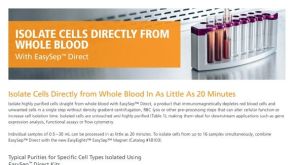 产品手册EasySep™ Direct 仅需20分钟,从全血中分选细胞




 沪公网安备31010102008431号