Dang LTH et al. (SEP 2014)
Biomaterials 35 27 7786--7799
Inhibition of apoptosis in human induced pluripotent stem cells during expansion in a defined culture using angiopoietin-1 derived peptide QHREDGS
Adhesion molecule signaling is critical to human pluripotent stem cell (hPSC) survival,self-renewal,and differentiation. Thus,hPSCs are grown as clumps of cells on feeder cell layers or poorly defined extracellular matrices such as Matrigel. We sought to define a small molecule that would initiate adhesion-based signaling to serve as a basis for a defined substrate for hPSC culture. Soluble angiopoeitin-1 (Ang-1)-derived peptide QHREDGS added to defined serum-free media increased hPSC colony cell number and size during long- and short-term culture when grown on feeder cell layers or Matrigel,i.e. on standard substrates,without affecting hPSC morphology,growth rate or the ability to differentiate into multiple lineages both invitro and invivo. Importantly,QHREDGS treatment decreased hPSC apoptosis during routine passaging and single-cell dissociation. Mechanistically,the interaction of QHREDGS with ??1-integrins increased expression of integrin-linked kinase (ILK),increased expression and activation of extracellular signal-regulated kinases 1/2 (ERK1/2),and decreased caspase-3/7 activity. QHREDGS immobilization to polyethylene glycol hydrogels significantly increased cell adhesion in a dose-dependent manner. We propose QHREDGS as a small molecule inhibitor of hPSC apoptosis and the basis of an affordable defined substrate for hPSC maintenance. ?? 2014 Elsevier Ltd.
View Publication
产品号#:
85850
85857
产品名:
mTeSR™1
mTeSR™1
Hur J et al. (AUG 2014)
Molecular therapy : the journal of the American Society of Gene Therapy 22 8 1518--29
Human podoplanin-positive monocytes and platelets enhance lymphangiogenesis through the activation of the podoplanin/CLEC-2 axis.
Emerging studies suggested that murine podoplanin-positive monocytes (PPMs) are involved in lymphangiogenesis. The goal of this study was to demonstrate the therapeutic lymphangiogenesis of human PPMs by the interaction with platelets. Aggregation culture of human peripheral blood mononuclear cells (PBMCs) resulted in cellular aggregates termed hematospheres. During 5-day culture,PPMs expanded exponentially and expressed several lymphatic endothelial cell-specific markers including vascular endothelial growth factor receptor (VEGFR)-3 and well-established lymphangiogenic transcription factors. Next,we investigated the potential interaction of PPMs with platelets that had C-type lectin-like receptor-2 (CLEC-2),a receptor of podoplanin. In vitro coculture of PPMs and platelets stimulated PPMs to strongly express lymphatic endothelial markers and upregulate lymphangiogenic cytokines. Recombinant human CLEC-2 also stimulated PPMs through Akt and Erk signaling. Likewise,platelets in coculture with PPMs augmented secretion of a lymphangiogenic cytokine,interleukin (IL)-1-β,via podoplanin/CLEC-2 axis. The supernatant obtained from coculture was able to enhance the migration,viability,and proliferation of lymphatic endothelial cell. Local injection of hematospheres with platelets significantly increased lymphatic neovascularization and facilitated wound healing in the full-thickness skin wounds of nude mice. Cotreatment with PPMs and platelets augments lymphangiogenesis through podoplanin/CLEC-2 axis,which thus would be a promising novel strategy of cell therapy to treat human lymphatic vessel disease.
View Publication
产品号#:
85850
85857
产品名:
mTeSR™1
mTeSR™1
Yu J et al. (JAN 2009)
PLoS ONE 4 9 e7040
nAChRs mediate human embryonic stem cell-derived endothelial cells: proliferation, apoptosis, and angiogenesis.
BACKGROUND: Many patients with ischemic heart disease have cardiovascular risk factors such as cigarette smoking. We tested the effect of nicotine (a key component of cigarette smoking) on the therapeutic effects of human embryonic stem cell-derived endothelial cells (hESC-ECs).backslashnbackslashnMETHODS AND RESULTS: To induce endothelial cell differentiation,undifferentiated hESCs (H9 line) underwent 4-day floating EB formation and 8-day outgrowth differentiation in EGM-2 media. After 12 days,CD31(+) cells (13.7+/-2.5%) were sorted by FACScan and maintained in EGM-2 media for further differentiation. After isolation,these hESC-ECs expressed endothelial specific markers such as vWF (96.3+/-1.4%),CD31 (97.2+/-2.5%),and VE-cadherin (93.7+/-2.8%),form vascular-like channels,and incorporated DiI-labeled acetylated low-density lipoprotein (DiI-Ac-LDL). Afterward,5x10(6) hESC-ECs treated for 24 hours with nicotine (10(-8) M) or PBS (as control) were injected into the hearts of mice undergoing LAD ligation followed by administration for two weeks of vehicle or nicotine (100 microg/ml) in the drinking water. Surprisingly,bioluminescence imaging (BLI) showed significant improvement in the survival of transplanted hESC-ECs in the nicotine treated group at 6 weeks. Postmortem analysis confirmed increased presence of small capillaries in the infarcted zones. Finally,in vitro mechanistic analysis suggests activation of the MAPK and Akt pathways following activation of nicotinic acetylcholine receptors (nAChRs).backslashnbackslashnCONCLUSIONS: This study shows for the first time that short-term systemic administrations of low dose nicotine can improve the survival of transplanted hESC-ECs,and enhance their angiogenic effects in vivo. Furthermore,activation of nAChRs has anti-apoptotic,angiogenic,and proliferative effects through MAPK and Akt signaling pathways.
View Publication
产品号#:
85850
85857
产品名:
mTeSR™1
mTeSR™1
Kriz V et al. (NOV 2006)
The Journal of biological chemistry 281 45 34484--91
The SHB adapter protein is required for normal maturation of mesoderm during in vitro differentiation of embryonic stem cells.
Definitive mesoderm arises from a bipotent mesendodermal population,and to study processes controlling its development at this stage,embryonic stem (ES) cells can be employed. SHB (Src homology 2 protein in beta-cells) is an adapter protein previously found to be involved in ES cell differentiation to mesoderm. To further study the role of SHB in this context,we have established ES cell lines deficient for one (SHB+/-) or both SHB alleles (SHB-/-). Differentiating embryoid bodies (EBs) derived from these ES cell lines were used for gene expression analysis. Alternatively,EBs were stained for the blood vessel marker CD31. For hematopoietic differentiation,EBs were differentiated in methylcellulose. SHB-/- EBs exhibited delayed down-regulation of the early mesodermal marker Brachyury. Later mesodermal markers relatively specific for the hematopoietic,vascular,and cardiac lineages were expressed at lower levels on day 6 or 8 of differentiation in EBs lacking SHB. The expression of vascular endothelial growth factor receptor-2 and fibroblast growth factor receptor-1 was also reduced in SHB-/- EBs. SHB-/- EBs demonstrated impaired blood vessel formation after vascular endothelial growth factor stimulation. In addition,the SHB-/- ES cells formed fewer blood cell colonies than SHB+/+ ES cells. It is concluded that SHB is required for appropriate hematopoietic and vascular differentiation and that delayed down-regulation of Brachyury expression may play a role in this context.
View Publication


 EasySep™小鼠TIL(CD45)正选试剂盒




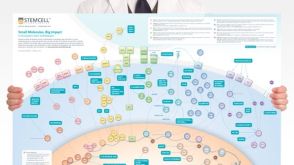 挂图Small Molecules, Big Impact in Pluripotent Stem Cell Research Overview of signaling pathways and small molecules in pluripotent stem cell research
 沪公网安备31010102008431号