若您需要咨询产品或有任何技术问题,请通过官方电话 400 885 9050 或邮箱 info.cn@stemcell.com 与我们联系。

STEMdiff™ 三谱系分化试剂盒

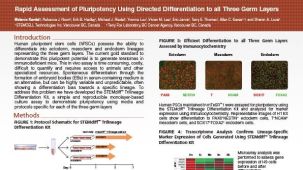
功能检测试剂盒,用于评估人ES和iPS细胞定向分化至三个胚层的多能性
只有 %1
¥9,646.00

产品号 #(选择产品)

产品号 #05230_C

功能检测试剂盒,用于评估人ES和iPS细胞定向分化至三个胚层的多能性

产品优势

  • 可在多种多能性细胞系中实现可重复的三胚层分化
  • 检测结果易于解读
  • 完整、成分明确的培养基
  • 标准化的一周实验流程

产品组分包括

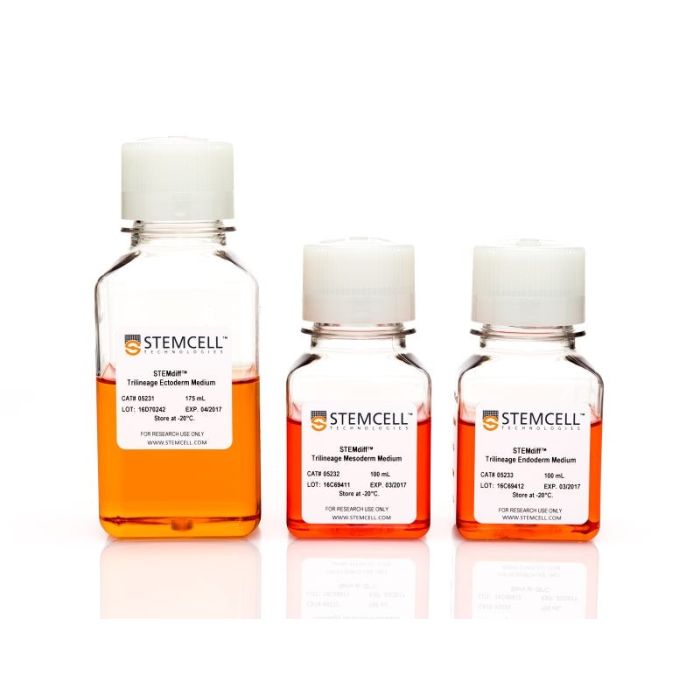
  • STEMdiff™ 三谱系外胚层培养基,175 mL
  • STEMdiff™ 三谱系中胚层培养基,100 mL
  • STEMdiff™ 三谱系内胚层培养基,100 mL
专为您的实验方案打造的产品
要查看实验方案所需的所有配套产品,请参阅《实验方案与技术文档》

总览

STEMdiff™ 三谱系分化试剂盒提供了一种简单的培养检测方法,用于功能性地验证新建或已建立的人胚胎干细胞 (ES) 和诱导多能干细胞 (iPS) 系分化为三个胚层(外胚层、中胚层和内胚层)的能力。该试剂盒包含专门的完整培养基和基于单层细胞的实验方案,可对每个胚层进行平行的体外定向分化实验,并在一周内清晰且可重复地确认三胚层分化潜能。STEMdiff™ 三谱系分化试剂盒设计为终点检测用途,不适用于后续分化或其他应用所需细胞的制备。STEMdiff™ 三谱系分化试剂盒设计为终点检测用途,不适用于后续分化或其他应用所需细胞的制备。本试剂盒已针对在 mTeSR™1、mTeSR™ Plus 或 TeSR™-AOF 培养的细胞进行了优化。


分类
专用培养基
 
细胞类型
多能干细胞
 
种属

 
应用
细胞培养,鉴定,分化,功能学筛选,表型鉴定
 
品牌
STEMdiff
 
研究领域
干细胞生物学
 

产品说明书及文档

请在《产品说明书》中查找相关支持信息和使用说明,或浏览下方更多实验方案。

Document Type
Product Name
Catalog #
Lot #
Language
Catalog #
05230
Lot #
All
Language
English
Document Type
Safety Data Sheet 1
Catalog #
05230
Lot #
All
Language
English
Document Type
Safety Data Sheet 2
Catalog #
05230
Lot #
All
Language
English
Document Type
Safety Data Sheet 3
Catalog #
05230
Lot #
All
Language
English

应用领域

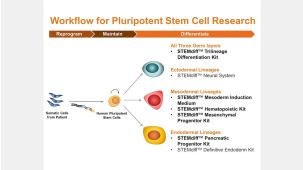
本产品专为以下研究领域设计,适用于工作流程中的高亮阶段。探索这些工作流程,了解更多我们为各研究领域提供的其他配套产品。

相关材料与文献

技术资料 (32)

文献 (37)

Functional characterization of the MED12 p.Arg1138Trp variant in females: implications for neural development and disease mechanism N. C. Shaw et al. Molecular Medicine 2025 Sep

Abstract

Seven female individuals with multiple congenital anomalies, developmental delay and/or intellectual disability have been found to have a genetic variant of uncertain significance in the mediator complex subunit 12 gene ( MED12 c.3412C>T, p.Arg1138Trp). The functional consequence of this genetic variant in disease is undetermined, and insight into disease mechanism is required. We identified a de novo MED12 p.Arg1138Trp variant in a female patient and compared disease phenotypes with six female individuals identified in the literature. To investigate affected biological pathways, we derived two induced pluripotent stem cell (iPSC) lines from the patient: one expressing wildtype MED12 and the other expressing the MED12 p.Arg1138Trp variant. We performed neural disease modelling, transcriptomics and protein analysis, comparing healthy and variant cells. When comparing the two cell lines, we identified altered gene expression in neural cells expressing the variant, including genes regulating RNA polymerase II activity, transcription, pre-mRNA processing, and neural development. We also noted a decrease in MED12L expression. Pathway analysis indicated temporal delays in axon development, forebrain differentiation, and neural cell specification with significant upregulation of pre-ribosome complex gene pathways. In a human neural model, expression of MED12 p.Arg1138Trp altered neural cell development and dysregulated the pre-ribosome complex providing functional evidence of disease aetiology and mechanism in MED12-related disorders. The online version contains supplementary material available at 10.1186/s10020-025-01365-5.
Generation of human induced pluripotent stem cell lines from patients with FGFR2 -linked syndromic craniosynostosis M. Gijsbertsen et al. Disease Models & Mechanisms 2025 Sep

Abstract

Craniosynostosis is a multigenic congenital condition in which one or more calvarial sutures have prematurely fused during the development of the fetus. Pathogenic variants in FGFR2 are associated with the development of syndromic craniosynostosis, such as Crouzon, Apert and Pfeifer syndromes. Investigation of FGFR2 -linked craniosynostosis is hindered by the lack of appropriate in vitro models. Patient-derived human induced pluripotent stem cell (hiPSC) in vitro disease models provide the opportunity to investigate the disease, identify molecular targets for pharmaceutical treatments, and enable the generation of autologous pluripotent stem cell catalogues. Here, we report three patient-derived hiPSC lines carrying the C342Y, S252W or E565G FGFR2 pathogenic variant. The patient hiPSC lines express characteristic pluripotency markers and display distinct phosphorylation profiles under unstimulated conditions. FGFR2 C342Y showed autophosphorylation in the absence of bFGF ligand, although downstream docking proteins PLCγ and FRS2α were not phosphorylated. FGFR2 S252W and FGFR2 E565G hiPSCs showed increased phosphorylation of docking proteins PLCγ and FRS2α, whereas FGFR2 was not phosphorylated. These patient hiPSC lines provide molecular and cellular options to investigate FGFR2 -linked craniosynostosis in the patient-specific genomic context and develop therapeutic modalities.
A stem cell-based toolkit to model Angelman syndrome caused by paternal uniparental disomy of chromosome 15 F. C. Mateus et al. Human Cell 2025 Sep

Abstract

Angelman syndrome is a rare neurodevelopmental disorder caused by the loss of function of the maternally inherited UBE3A gene within the chr15q11-q13 region. This gene is subjected to a tissue-specific form of genomic imprinting leading to the silencing of the paternal allele in neurons. Angelman syndrome can result from various (epi)genetic mechanisms, with paternal uniparental disomy of chromosome 15 (patUPD15) being one of the rarest and least studied due to the absence of suitable models. To address this gap, we generated three independent induced pluripotent stem cell (iPSC) lines from individuals with Angelman syndrome caused by patUPD15, alongside genetically matched unaffected familial controls. Peripheral blood mononuclear cells (PBMCs) were reprogrammed into iPSCs using a non-integrative Sendai virus-based approach expressing the Yamanaka factors. All iPSC lines underwent rigorous quality control, confirming stem cell identity, trilineage differentiation potential, and genetic and epigenetic integrity. This newly established iPSC toolkit provides a powerful platform to investigate the molecular underpinnings of Angelman syndrome caused by patUPD15, paving the way for future translational research and therapeutic development tailored for this understudied form of the disorder. The online version contains supplementary material available at 10.1007/s13577-025-01287-8.

更多信息

更多信息
物种 人类
For related products, including specialized media, matrices, antibodies, cytokines, and small molecules, visit www.stemcell.com/hPSCworkflow, or contact us at techsupport@stemcell.com.
Copyright © 2025 by STEMCELL Technologies. All rights reserved.

在线联系