Daynac M et al. (FEB 2016)
Scientific reports 6 21505
Age-related neurogenesis decline in the subventricular zone is associated with specific cell cycle regulation changes in activated neural stem cells.
Although neural stem cells (NSCs) sustain continuous neurogenesis throughout the adult lifespan of mammals,they progressively exhibit proliferation defects that contribute to a sharp reduction in subventricular neurogenesis during aging. However,little is known regarding the early age-related events in neurogenic niches. Using a fluorescence-activated cell sorting technique that allows for the prospective purification of the main neurogenic populations from the subventricular zone (SVZ),we demonstrated an early decline in adult neurogenesis with a dramatic loss of progenitor cells in 4 month-old young adult mice. Whereas the activated and quiescent NSC pools remained stable up to 12 months,the proliferative status of activated NSCs was already altered by 6 months,with an overall extension of the cell cycle resulting from a specific lengthening of G1. Whole genome analysis of activated NSCs from 2- and 6-month-old mice further revealed distinct transcriptomic and molecular signatures,as well as a modulation of the TGFβ signalling pathway. Our microarray study constitutes a cogent identification of new molecular players and signalling pathways regulating adult neurogenesis and its early modifications.
View Publication
产品类型:
产品号#:
05700
05701
05702
产品名:
NeuroCult™ 基础培养基(小鼠和大鼠)
NeuroCult™ 扩增添加物(小鼠和大鼠)
NeuroCult™扩增试剂盒(小鼠和大鼠)
Verstovsek S et al. ( 2005)
Cancer 104 6 1230--1236
AMN107, a novel aminopyrimidine inhibitor of p190 Bcr-Abl activation and of in vitro proliferation of Philadelphia-positive acute lymphoblastic leukemia cells.
BACKGROUND: Previous studies have shown that patients with Bcr-Abl-positive acute lymphoblastic leukemia (ALL) either have primary disease that is refractory to imatinib mesylate or develop disease recurrence after an initial response. METHODS: The authors investigated the effects of a newly designed Bcr-Abl inhibitor,AMN107,by comparing its in vitro inhibitory potency on p190 Bcr-Abl ALL cell lines with that of imatinib. RESULTS: In two Philadelphia (Ph)-positive ALL cell lines,AMN107 was found to be 30-40 times more potent than imatinib in inhibiting cellular proliferation. AMN107 was also more effective than imatinib in inhibiting phosphorylation of p190 Bcr-Abl tyrosine kinase in cell lines and primary ALL cells. The inhibition of cellular proliferation was associated with the induction of apoptosis in only one of the cell lines. No activity was observed in cell lines lacking the BCR-ABL genotype. CONCLUSIONS: The results of the current study suggest the superior potency of AMN107 compared with imatinib in Ph-positive ALL and support clinical trials of AMN107 in patients with Ph-positive ALL.
View Publication
产品类型:
产品号#:
73302
73304
产品名:
Nilotinib
Nilotinib
Corti S et al. (JAN 2006)
Human molecular genetics 15 2 167--87
Transplanted ALDHhiSSClo neural stem cells generate motor neurons and delay disease progression of nmd mice, an animal model of SMARD1.
Spinal muscular atrophy with respiratory distress type 1 (SMARD1) is an infantile autosomal-recessive motor neuron disease caused by mutations in the immunoglobulin micro-binding protein 2. We investigated the potential of a spinal cord neural stem cell population isolated on the basis of aldehyde dehydrogenase (ALDH) activity to modify disease progression of nmd mice,an animal model of SMARD1. ALDH(hi)SSC(lo) stem cells are self-renewing and multipotent and when intrathecally transplanted in nmd mice generate motor neurons properly localized in the spinal cord ventral horns. Transplanted nmd animals presented delayed disease progression,sparing of motor neurons and ventral root axons and increased lifespan. To further investigate the molecular events responsible for these differences,microarray and real-time reverse transcription-polymerase chain reaction analyses of wild-type,mutated and transplanted nmd spinal cord were undertaken. We demonstrated a down-regulation of genes involved in excitatory amino acid toxicity and oxidative stress handling,as well as an up-regulation of genes related to the chromatin organization in nmd compared with wild-type mice,suggesting that they may play a role in SMARD1 pathogenesis. Spinal cord of nmd-transplanted mice expressed high transcript levels for genes related to neurogenesis such as doublecortin (DCX),LIS1 and drebrin. The presence of DCX-expressing cells in adult nmd spinal cord suggests that both exogenous and endogenous neurogeneses may contribute to the observed nmd phenotype amelioration.
View Publication
产品类型:
产品号#:
01700
01705
01701
01702
产品名:
ALDEFLUOR™ 试剂盒
ALDEFLUOR™ DEAB试剂, 1.5 mM, 1 mL
ALDEFLUOR™检测缓冲液
S. L. Locatelli et al. (OCT 2018)
Clinical cancer research : an official journal of the American Association for Cancer Research
Targeting cancer cells and tumor microenvironment in preclinical and clinical models of Hodgkin lymphoma using the dual PI3K$\delta$/$\gamma$ inhibitor RP6530.
PURPOSE Tumor-associated macrophages (TAMs) and the hyperactivation of phosphoinositide 3-kinase(PI3K)/AKT pathway are involved in the pathogenesis of Hodgkin lymphoma (HL) and affect disease outcome. Since the $\delta$ and $\gamma$ isoforms of PI3K are overexpressed in Hodgkin/Reed-Sternberg (HRS) cells and the tumor microenvironment (TME),we propose that the PI3K$\delta$/$\gamma$ inhibitor RP6530 might affect both HRS cells and TME,ultimately leading to an enhanced antitumor response. EXPERIMENTAL DESIGN HL cell lines (L-540,KM-H2 and L-428) and primary human macrophages were used to investigate the activity of RP6530 in vitro and in vivo in HL cell line xenografts. RESULTS In vitro,RP6530 besides killing and inhibiting the proliferation of HL cells,downregulated lactic acid metabolism,switching the activation of macrophages from an immunosuppressive M2-like phenotype to a more inflammatory M1-like state. By RNA sequencing,we define tumor glycolysis as a specific PI3K$\delta$/$\gamma$-dependent pathway implicated in the metabolic reprogramming of cancer cells. We identify the metabolic regulator Pyruvate Kinase M2 (PKM2) as the main mediator of tumor-induced immunosuppressive phenotype of macrophages. Furthermore,we show in human tumor xenografts that RP6530 repolarizes TAMs into pro-inflammatory macrophages and inhibits tumor vasculature,leading to tumor regression. Interestingly,HL patients experiencing objective responses (CR and PR) in a phase 1 trial using RP6530 showed a significant inhibition of circulating MDSCs and an average mean reduction in serum TARC levels of 40{\%} (range,4-76{\%}). CONCLUSIONS Our results support PI3K$\delta$/$\gamma$ inhibition as a novel therapeutic strategy that targets both malignant cells and the TME to treat HL patients.
View Publication
Obakan P et al. (JAN 2014)
Molecular biology reports 41 1 145--54
Purvalanol A is a strong apoptotic inducer via activating polyamine catabolic pathway in MCF-7 estrogen receptor positive breast cancer cells.
Purvalanol A is a specific CDK inhibitor which triggers apoptosis by causing cell cycle arrest in cancer cells. Although it has strong apoptotic potential,the mechanistic action of Purvalanol A on significant cell signaling targets has not been clarified yet. Polyamines are crucial metabolic regulators affected by CDK inhibition because of their role in cell cycle progress as well. In addition,malignant cells possess impaired polyamine homeostasis with high level of intracellular polyamines. Especially induction of polyamine catabolic enzymes spermidine/spermine N1-acetyltransferase (SSAT),polyamine oxidase (PAO) and spermine oxidase (SMO) induced toxic by-products in correlation with the induction of apoptosis in cancer cells. In this study,we showed that Purvalanol A induced apoptosis in caspase- dependent manner in MCF-7 ER(+) cells,while MDA-MB-231 (ER-) cells were less sensitive against drug. In addition Bcl-2 is a critical target for Purvalanol A,since Bcl-2 overexpressed cells are more resistant to Purvalanol A-mediated apoptosis. Furthermore,exposure of MCF-7 cells to Purvalanol A triggered SSAT and PAO upregulation and the presence of PAO/SMO inhibitor,MDL 72,527 prevented Purvalanol A-induced apoptosis.
View Publication
产品类型:
产品号#:
73772
73774
产品名:
Opyrchal M et al. ( 2014)
International journal of oncology 45 3 1193--1199
Inhibition of Cdk2 kinase activity selectively targets the CD44�?�/CD24�?�/Low stem-like subpopulation and restores chemosensitivity of SUM149PT triple-negative breast cancer cells.
Inflammatory breast cancer (IBC) is an angioinvasive and most aggressive type of advanced breast cancer characterized by rapid proliferation,chemoresistance,early metastatic development and poor prognosis. IBC tumors display a triple-negative breast cancer (TNBC) phenotype characterized by centrosome amplification,high grade of chromosomal instability (CIN) and low levels of expression of estrogen receptor α (ERα),progesterone receptor (PR) and HER-2 tyrosine kinase receptor. Since the TNBC cells lack these receptors necessary to promote tumor growth,common treatments such as endocrine therapy and molecular targeting of HER-2 receptor are ineffective for this subtype of breast cancer. To date,not a single targeted therapy has been approved for non-inflammatory and inflammatory TNBC tumors and combination of conventional cytotoxic chemotherapeutic agents remains the standard therapy. IBC tumors generally display activation of epithelial to mesenchymal transition (EMT) that is functionally linked to a CD44+/CD24-/Low stem-like phenotype. Development of EMT and consequent activation of stemness programming is responsible for invasion,tumor self-renewal and drug resistance leading to breast cancer progression,distant metastases and poor prognosis. In this study,we employed the luminal ER+ MCF-7 and the IBC SUM149PT breast cancer cell lines to establish the extent to which high grade of CIN and chemoresistance were mechanistically linked to the enrichment of CD44+/CD24low/- CSCs. Here,we demonstrate that SUM149PT cells displayed higher CIN than MCF-7 cells characterized by higher percentage of structural and numerical chromosomal aberrations. Moreover,centrosome amplification,cyclin E overexpression and phosphorylation of retinoblastoma (Rb) were restricted to the stem-like CD44+/CD24-/Low subpopulation isolated from SUM149PT cells. Significantly,CD44+/CD24-/Low CSCs displayed resistance to conventional chemotherapy but higher sensitivity to SU9516,a specific cyclin-dependent kinase 2 (Cdk2) inhibitor,demonstrating that aberrant activation of cyclin E/Cdk2 oncogenic signaling is essential for the maintenance and expansion of CD44+/CD24-/Low CSC subpopulation in IBC. In conclusion,our findings propose a novel therapeutic approach to restore chemosensitivity and delay recurrence of IBC tumors based on the combination of conventional chemotherapy with small molecule inhibitors of the Cdk2 cell cycle kinase.
View Publication
产品类型:
产品号#:
73452
产品名:
SU9516
Mary V et al. (DEC 2012)
Toxicology 302 2-3 299--307
Reactive oxygen species sources and biomolecular oxidative damage induced by aflatoxin B1 and fumonisin B1 in rat spleen mononuclear cells.
Aflatoxin B1 (AFB(1)) and fumonisin B1 (FB(1)) are mycotoxins widely found as cereal contaminants. Their immunotoxicities predispose to infectious diseases and may alter the tumor immunosurveillance of human and animals,but the mechanisms underlying have not been fully elucidated,and the induction of oxidative stress has been proposed as a probable mechanism. This work was aimed at evaluating in spleen mononuclear cells (SMC) from Wistar rats the effects of the exposure,in vitro for up to 48 h,to 20 μM AFB(1),10 μM FB(1) and AFB(1)-FB(1) mixture (MIX),over cellular oxidative status,as well as at elucidating the contribution of different reactive oxygen species (ROS) to biomolecular oxidative damage,the biochemical pathways involved,and the probable interaction of both toxins to induce oxidative stress. All the treatments increased total ROS and oxidation of biomolecules,with MIX having the greatest effects. However,only MIX increased superoxide anion radical. The main ROS involved in oxidation of proteins,lipids and DNA appear to be hydrogen peroxide and hydroxyl radical. The mitochondrial complex I and CYP450 were involved in the ROS generation induced by all treatments. The NADPH oxidase system was induced by FB1 and MIX. The arachidonic acid metabolism contributed to the ROS formation induced by AFB(1) and MIX. These results demonstrate that an interaction between AFB(1) and FB(1) occur in the oxidative stress induction,and show the biochemical pathways involved in ROS generation in SMC. The oxidative stress could mediate the AFB(1) and FB(1) individual and combined immunotoxicities.
View Publication
产品类型:
产品号#:
73682
73684
产品名:
Fumonisin B1
Fumonisin B1
Liu CC et al. (JUN 2016)
Stem cells (Dayton,Ohio) 1--19
Distinct Responses of stem Cells to Telomere Uncapping - a Potential Strategy to Improve the Safety Of Cell Therapy.
In most human somatic cells,the lack of telomerase activity results in progressive telomere shortening during each cell division. Eventually,DNA damage responses triggered by critically short telomeres induce an irreversible cell cycle arrest termed replicative senescence. However,the cellular responses of human pluripotent stem cells to telomere uncapping remain unknown. We generated telomerase knockout human embryonic stem (ES) cells through gene targeting. Telomerase inactivation in ES cells results in progressive telomere shortening. Telomere DNA damage in ES cells and neural progenitor cells induces rapid apoptosis when telomeres are uncapped,in contrast to fibroblast cells that enter a state of replicative senescence. Significantly,telomerase inactivation limits the proliferation capacity of human ES cells without affecting their pluripotency. By targeting telomerase activity,we can functionally separate the two unique properties of human pluripotent stem cells,namely unlimited self-renewal and pluripotency. We show that the potential of ES cells to form teratomas in vivo is dictated by their telomere length. By controlling telomere length of ES cells through telomerase inactivation,we can inhibit teratoma formation and potentially improve the safety of cell therapies involving terminally differentiated cells as well as specific progenitor cells that do not require sustained cellular proliferation in vivo,and thus sustained telomerase activity. This article is protected by copyright. All rights reserved.
View Publication
产品类型:
产品号#:
05850
05857
05870
05875
85850
85857
85870
85875
产品名:
mTeSR™1
mTeSR™1
Li R et al. (NOV 2016)
Cancer research
Macrophage-secreted TNFα and TGFβ1 Influence Migration Speed and Persistence of Cancer Cells in 3D Tissue Culture via Independent Pathways.
The ability of a cancer cell to migrate through the dense extracellular matrix (ECM) within and surrounding the solid tumor is a critical determinant of metastasis. Macrophages enhance invasion and metastasis in the tumor microenvironment but the basis for their effects are not fully understood. Using a microfluidic 3D cell migration assay,we found that the presence of macrophages enhanced the speed and persistence of cancer cell migration through a 3D extracellular matrix in a matrix metalloproteinases (MMP)-dependent fashion. Mechanistic investigations revealed that macrophage-released TNFα and TGFβ1 mediated the observed behaviors by two distinct pathways. These factors synergistically enhanced migration persistence through a synergistic induction of NF-κB-dependent MMP1 expression in cancer cells. In contrast,macrophage-released TGFβ1 enhanced migration speed primarily by inducing MT1-MMP expression. Taken together,our results reveal new insights into how macrophages enhance cancer cell metastasis,and they identify TNFα and TGFβ1 dual blockade as an anti-metastatic strategy in solid tumors.
View Publication
产品类型:
产品号#:
19059
19059RF
产品名:
EasySep™人单核细胞富集试剂盒
RoboSep™ 人单核细胞富集试剂盒含滤芯吸头
Lichterfeld M et al. (SEP 2004)
The Journal of experimental medicine 200 6 701--12
Loss of HIV-1-specific CD8+ T cell proliferation after acute HIV-1 infection and restoration by vaccine-induced HIV-1-specific CD4+ T cells.
Virus-specific CD8(+) T cells are associated with declining viremia in acute human immunodeficiency virus (HIV)1 infection,but do not correlate with control of viremia in chronic infection,suggesting a progressive functional defect not measured by interferon gamma assays presently used. Here,we demonstrate that HIV-1-specific CD8(+) T cells proliferate rapidly upon encounter with cognate antigen in acute infection,but lose this capacity with ongoing viral replication. This functional defect can be induced in vitro by depletion of CD4(+) T cells or addition of interleukin 2-neutralizing antibodies,and can be corrected in chronic infection in vitro by addition of autologous CD4(+) T cells isolated during acute infection and in vivo by vaccine-mediated induction of HIV-1-specific CD4(+) T helper cell responses. These data demonstrate a loss of HIV-1-specific CD8(+) T cell function that not only correlates with progressive infection,but also can be restored in chronic infection by augmentation of HIV-1-specific T helper cell function. This identification of a reversible defect in cell-mediated immunity in chronic HIV-1 infection has important implications for immunotherapeutic interventions.
View Publication
产品类型:
产品号#:
15023
15063
产品名:
RosetteSep™人CD8+ T细胞富集抗体混合物
RosetteSep™人CD8+ T细胞富集抗体混合物
Arbab AS et al. (MAR 2006)
Stem cells (Dayton,Ohio) 24 3 671--8
Magnetic resonance imaging and confocal microscopy studies of magnetically labeled endothelial progenitor cells trafficking to sites of tumor angiogenesis.
UNLABELLED: AC133 cells,a subpopulation of CD34+ hematopoietic stem cells,can transform into endothelial cells that may integrate into the neovasculature of tumors or ischemic tissue. Most current imaging modalities do not allow monitoring of early migration and incorporation of endothelial progenitor cells (EPCs) into tumor neovasculature. The goals of this study were to use magnetic resonance imaging (MRI) to track the migration and incorporation of intravenously injected,magnetically labeled EPCs into the blood vessels in a rapidly growing flank tumor model and to determine whether the pattern of EPC incorporation is related to the time of injection or tumor size. MATERIALS AND METHODS: EPCs labeled with ferumoxide-protamine sulfate (FePro) complexes were injected into mice bearing xenografted glioma,and MRI was obtained at different stages of tumor development and size. RESULTS: Migration and incorporation of labeled EPCs into tumor neovasculature were detected as low signal intensity on MRI at the tumor periphery as early as 3 days after EPC administration in preformed tumors. However,low signal intensities were not observed in tumors implanted at the time of EPC administration until tumor size reached 1 cm at 12 to 14 days. Prussian blue staining showed iron-positive cells at the sites corresponding to low signal intensity on MRI. Confocal microscopy showed incorporation into the neovasculature,and immunohistochemistry clearly demonstrated the transformation of the administered EPCs into endothelial cells. CONCLUSION: MRI demonstrated the incorporation of FePro-labeled human CD34+/AC133+ EPCs into the neovasculature of implanted flank tumors.
View Publication


 EasySep™小鼠TIL(CD45)正选试剂盒





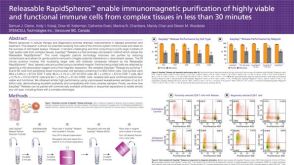 科学海报Releasable RapidSpheres Enable Immunomagnetic Purification of Highly Viable and Functional Immune Cells from Complex Tissues in Less Than 30 Minutes
 沪公网安备31010102008431号