Ramgolam VS et al. (OCT 2009)
Journal of immunology (Baltimore,Md. : 1950) 183 8 5418--27
IFN-beta inhibits human Th17 cell differentiation.
IFN-beta-1a has been used over the past 15 years as a primary therapy for relapsing-remitting multiple sclerosis (MS). However,the immunomodulatory mechanisms that provide a therapeutic effect against this CNS inflammatory disease are not yet completely elucidated. The effect of IFN-beta-1a on Th17 cells,which play a critical role in the development of the autoimmune response,has not been extensively studied in humans. We have investigated the effect of IFN-beta-1a on dendritic cells (DCs) and naive CD4(+)CD45RA(+) T cells derived from untreated MS patients and healthy controls in the context of Th17 cell differentiation. We report that IFN-beta-1a treatment down-regulated the expression of IL-1beta and IL-23p19 in DCs,whereas it induced the gene expression of IL-12p35 and IL-27p28. We propose that IFN-beta-1a-mediated up-regulation of the suppressor of cytokine signaling 3 expression,induced via STAT3 phosphorylation,mediates IL-1beta and IL-23 down-regulation,while IFN-beta-1a-induced STAT1 phosphorylation induces IL-27p28 expression. CD4(+)CD45RA(+) naive T cells cocultured with supernatants from IFN-beta-1a-treated DCs exhibited decreased gene expression of the Th17 cell markers retinoic acid-related orphan nuclear hormone receptor c (RORc),IL-17A,and IL-23R. A direct IFN-beta-1a treatment of CD45RA(+) T cells cultured in Th17-polarizing conditions also down-regulated RORc,IL-17A,and IL-23R,but up-regulated IL-10 gene expression. Studies of the mechanisms involved in the Th17 cell differentiation suggest that IFN-beta-1a inhibits IL-17 and induces IL-10 secretion via activated STAT1 and STAT3,respectively. IFN-beta's suppression of Th17 cell differentiation may represent its most relevant mechanism of selective suppression of the autoimmune response in MS.
View Publication
Osakada F et al. (JAN 2009)
Nature protocols 4 6 811--24
Stepwise differentiation of pluripotent stem cells into retinal cells.
Embryonic stem (ES) cells are pluripotent cells derived from the inner cell mass of blastocyst-stage embryos. They can maintain an undifferentiated state indefinitely and can differentiate into derivatives of all three germ layers,namely ectoderm,endoderm and mesoderm. Although much progress has been made in the propagation and differentiation of ES cells,induction of photoreceptors has generally required coculture with or transplantation into developing retinal tissue. Here,we describe a protocol for generating retinal cells from ES cells by stepwise treatment with defined factors. This method preferentially induces photoreceptor and retinal pigment epithelium (RPE) cells from mouse and human ES cells. In our protocol,differentiation of RPE and photoreceptors from mouse ES cells requires 28 d and the differentiation of human ES cells into mature RPE and photoreceptors requires 120 and 150 d,respectively. This differentiation system and the resulting pluripotent stem cell-derived retinal cells will facilitate the development of transplantation therapies for retinal diseases,drug testing and in vitro disease modeling. It will also improve our understanding of the development of the central nervous system,especially the eye.
View Publication
产品类型:
产品号#:
72082
产品名:
DAPT
Ols ML et al. (OCT 2016)
Immunity
Dendritic Cells Regulate Extrafollicular Autoreactive B Cells via T Cells Expressing Fas and Fas Ligand.
The extrafollicular (EF) plasmablast response to self-antigens that contain Toll-like receptor (TLR) ligands is prominent in murine lupus models and some bacterial infections,but the inhibitors and activators involved have not been fully delineated. Here,we used two conventional dendritic cell (cDC) depletion systems to investigate the role of cDCs on a classical TLR-dependent autoreactive EF response elicited in rheumatoid-factor B cells by DNA-containing immune complexes. Contrary to our hypothesis,cDC depletion amplified rather than dampened the EF response in Fas-intact but not Fas-deficient mice. Further,we demonstrated that cDC-dependent regulation requires Fas and Fas ligand (FasL) expression by T cells,but not Fas expression by B cells. Thus,cDCs activate FasL-expressing T cells that regulate Fas-expressing extrafollicular helper T (Tefh) cells. These studies reveal a regulatory role for cDCs in B cell plasmablast responses and provide a mechanistic explanation for the excess autoantibody production observed in Fas deficiency.
View Publication
J. Liu et al. (Nov 2025)
Journal of Biomedical Science 32 5
Human coronavirus OC43 infection in human cerebral organoids: novel insights on pathogenesis and potential therapeutic interventions
Since the COVID-19 pandemic,there has been a documented rise in the incidence of neurological manifestations among individuals complicated with encephalitis or myelitis. The spectrum of neurological symptoms associated with HCoVs infections is expanding. However,the infection characteristics and pathogenesis of seasonal HCoVs to the central nervous system remain obscure. No pharmacological agents have demonstrated the capacity to specifically and efficaciously mitigate the neurological symptoms induced by HCoVs infections to date. Methods: We developed human cerebral organoids (HCOs) derived from human induced pluripotent stem cells and established a blood–brain barrier (BBB) HCOs co-culture model. We subjected these models to seasonal human coronavirus (HCoV) infections to investigate the viral characteristics within the central nervous system (CNS). Utilizing RNA sequencing,we conducted a preliminary exploration of the mechanisms underlying virus-induced inflammatory responses in the CNS. Furthermore,we assessed the efficacy of antiviral and anti-inflammatory drugs using the HCO model. Results: Our results showed that among seasonal coronaviruses,HCoV-OC43 replicates efficiently within the organoids,primarily targeting neurons and astrocytes,and disrupts the barrier function of the BBB. RNA sequencing analysis revealed that HCoV-OC43 infection triggers an inflammatory response through the TNF and NF-κB signaling pathways,leading to cell death,impaired neuronal function,and disrupted interneuron signaling. Interestingly,Bardoxolone methyl (CDDO-Me) demonstrated antiviral effects comparable to remdesivir,reducing both inflammation and cell death. Conclusions: Conclusively,HCOs infected with HCoV-OC43 offer valuable insights into the pathogenesis of HCoVs in central nervous system (CNS),and might serve as a tool for developing novel therapeutic strategies for HCoVs infections,including COVID-19,especially on exploring treatment candidates.Graphical abstract
View Publication
产品类型:
产品号#:
100-0276
100-1130
产品名:
mTeSR™ Plus
mTeSR™ Plus
C. Li et al. (Dec 2024)
Nature Communications 15
Human respiratory organoids sustained reproducible propagation of human rhinovirus C and elucidation of virus-host interaction
The lack of a robust system to reproducibly propagate HRV-C,a family of viruses refractory to cultivation in standard cell lines,has substantially hindered our understanding of this common respiratory pathogen. We sought to develop an organoid-based system to reproducibly propagate HRV-C,and characterize virus-host interaction using respiratory organoids. We demonstrate that airway organoids sustain serial virus passage with the aid of CYT387-mediated immunosuppression,whereas nasal organoids that more closely simulate the upper airway achieve this without any intervention. Nasal organoids are more susceptible to HRV-C than airway organoids. Intriguingly,upon HRV-C infection,we observe an innate immune response that is stronger in airway organoids than in nasal organoids,which is reproduced in a Poly(I:C) stimulation assay. Treatment with α-CDHR3 and antivirals significantly reduces HRV-C viral growth in airway and nasal organoids. Additionally,an organoid-based immunofluorescence assay is established to titrate HRV-C infectious particles. Collectively,we develop an organoid-based system to reproducibly propagate the poorly cultivable HRV-C,followed by a comprehensive characterization of HRV-C infection and innate immunity in physiologically active respiratory organoids. The organoid-based HRV-C infection model can be extended for developing antiviral strategies. More importantly,our study has opened an avenue for propagating and studying other uncultivable human and animal viruses. Subject terms: Virus-host interactions,Viral pathogenesis,Respiratory tract diseases
View Publication
Cell-culture assays reveal the importance of retroviral vector design for insertional genotoxicity.
Retroviral vectors with long terminal repeats (LTRs),which contain strong enhancer/promoter sequences at both ends of their genome,are widely used for stable gene transfer into hematopoietic cells. However,recent clinical data and mouse models point to insertional activation of cellular proto-oncogenes as a dose-limiting side effect of retroviral gene delivery that potentially induces leukemia. Self-inactivating (SIN) retroviral vectors do not contain the terminal repetition of the enhancer/promoter,theoretically attenuating the interaction with neighboring cellular genes. With a new assay based on in vitro expansion of primary murine hematopoietic cells and selection in limiting dilution,we showed that SIN vectors using a strong internal retroviral enhancer/promoter may also transform cells by insertional mutagenesis. Most transformed clones,including those obtained after dose escalation of SIN vectors,showed insertions upstream of the third exon of Evi1 and in reverse orientation to its transcriptional orientation. Normalizing for the vector copy number,we found the transforming capacity of SIN vectors to be significantly reduced when compared with corresponding LTR vectors. Additional modifications of SIN vectors may further increase safety. Improved cell-culture assays will likely play an important role in the evaluation of insertional mutagenesis.
View Publication
产品类型:
产品号#:
09850
28600
产品名:
L-Calc™有限稀释软件
D. R. McHugh et al. ( 2018)
PloS one 13 6 e0199573
A G542X cystic fibrosis mouse model for examining nonsense mutation directed therapies.
Nonsense mutations are present in 10{\%} of patients with CF,produce a premature termination codon in CFTR mRNA causing early termination of translation,and lead to lack of CFTR function. There are no currently available animal models which contain a nonsense mutation in the endogenous Cftr locus that can be utilized to test nonsense mutation therapies. In this study,we create a CF mouse model carrying the G542X nonsense mutation in Cftr using CRISPR/Cas9 gene editing. The G542X mouse model has reduced Cftr mRNA levels,demonstrates absence of CFTR function,and displays characteristic manifestations of CF mice such as reduced growth and intestinal obstruction. Importantly,CFTR restoration is observed in G542X intestinal organoids treated with G418,an aminoglycoside with translational readthrough capabilities. The G542X mouse model provides an invaluable resource for the identification of potential therapies of CF nonsense mutations as well as the assessment of in vivo effectiveness of these potential therapies targeting nonsense mutations.
View Publication


 EasySep™小鼠TIL(CD45)正选试剂盒






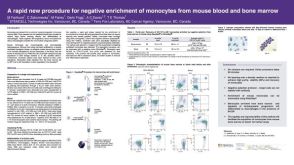 科学海报Procedure for Negative Enrichment of Monocytes from Mouse Blood and Bone Marrow


 沪公网安备31010102008431号