Selective elimination of leukemic CD34(+) progenitor cells by cytotoxic T lymphocytes specific for WT1.
Hematologic malignancies such as acute and chronic myeloid leukemia are characterized by the malignant transformation of immature CD34(+) progenitor cells. Transformation is associated with elevated expression of the Wilm's tumor gene encoded transcription factor (WT1). Here we demonstrate that WT1 can serve as a target for cytotoxic T lymphocytes (CTL) with exquisite specificity for leukemic progenitor cells. HLA-A0201- restricted CTL specific for WT1 kill leukemia cell lines and inhibit colony formation by transformed CD34(+) progenitor cells isolated from patients with chronic myeloid leukemia (CML),whereas colony formation by normal CD34(+) progenitor cells is unaffected. Thus,the tissue-specific transcription factor WT1 is an ideal target for CTL-mediated purging of leukemic progenitor cells in vitro and for antigen-specific therapy of leukemia and other WT1-expressing malignancies in vivo.
View Publication
产品类型:
产品号#:
04535
04545
产品名:
MethoCult™ H4535 Enriched,不含EPO
MethoCult™ H4535 Enriched,不含EPO
Sullivan JP et al. (DEC 2010)
Cancer research 70 23 9937--48
Aldehyde dehydrogenase activity selects for lung adenocarcinoma stem cells dependent on notch signaling.
Aldehyde dehydrogenase (ALDH) is a candidate marker for lung cancer cells with stem cell-like properties. Immunohistochemical staining of a large panel of primary non-small cell lung cancer (NSCLC) samples for ALDH1A1,ALDH3A1,and CD133 revealed a significant correlation between ALDH1A1 (but not ALDH3A1 or CD133) expression and poor prognosis in patients including those with stage I and N0 disease. Flow cytometric analysis of a panel of lung cancer cell lines and patient tumors revealed that most NSCLCs contain a subpopulation of cells with elevated ALDH activity,and that this activity is associated with ALDH1A1 expression. Isolated ALDH(+) lung cancer cells were observed to be highly tumorigenic and clonogenic as well as capable of self-renewal compared with their ALDH(-) counterparts. Expression analysis of sorted cells revealed elevated Notch pathway transcript expression in ALDH(+) cells. Suppression of the Notch pathway by treatment with either a γ-secretase inhibitor or stable expression of shRNA against NOTCH3 resulted in a significant decrease in ALDH(+) lung cancer cells,commensurate with a reduction in tumor cell proliferation and clonogenicity. Taken together,these findings indicate that ALDH selects for a subpopulation of self-renewing NSCLC stem-like cells with increased tumorigenic potential,that NSCLCs harboring tumor cells with ALDH1A1 expression have inferior prognosis,and that ALDH1A1 and CD133 identify different tumor subpopulations. Therapeutic targeting of the Notch pathway reduces this ALDH(+) component,implicating Notch signaling in lung cancer stem cell maintenance.
View Publication
产品类型:
产品号#:
01700
01705
01702
产品名:
ALDEFLUOR™ 试剂盒
ALDEFLUOR™ DEAB试剂, 1.5 mM, 1 mL
ALDEFLUOR™检测缓冲液
Zhang Y et al. (JUN 2013)
Blood 121 24 4906--16
AML1-ETO mediates hematopoietic self-renewal and leukemogenesis through a COX/β-catenin signaling pathway.
Developing novel therapies that suppress self-renewal of leukemia stem cells may reduce the likelihood of relapses and extend long-term survival of patients with acute myelogenous leukemia (AML). AML1-ETO (AE) is an oncogene that plays an important role in inducing self-renewal of hematopoietic stem/progenitor cells (HSPCs),leading to the development of leukemia stem cells. Previously,using a zebrafish model of AE and a whole-organism chemical suppressor screen,we have discovered that AE induces specific hematopoietic phenotypes in embryonic zebrafish through a cyclooxygenase (COX)-2 and β-catenin-dependent pathway. Here,we show that AE also induces expression of the Cox-2 gene and activates β-catenin in mouse bone marrow cells. Inhibition of COX suppresses β-catenin activation and serial replating of AE(+) mouse HSPCs. Genetic knockdown of β-catenin also abrogates the clonogenic growth of AE(+) mouse HSPCs and human leukemia cells. In addition,treatment with nimesulide,a COX-2 selective inhibitor,dramatically suppresses xenograft tumor formation and inhibits in vivo progression of human leukemia cells. In summary,our data indicate an important role of a COX/β-catenin-dependent signaling pathway in tumor initiation,growth,and self-renewal,and in providing the rationale for testing potential benefits from common COX inhibitors as a part of AML treatments.
View Publication
产品类型:
产品号#:
70002
70002.1
70002.2
70002.3
70002.4
70002.5
产品名:
Carlsten M et al. (OCT 2009)
Journal of immunology (Baltimore,Md. : 1950) 183 8 4921--30
Primary human tumor cells expressing CD155 impair tumor targeting by down-regulating DNAM-1 on NK cells.
The activating NK cell receptor DNAX accessory molecule-1 (DNAM-1) contributes to tumor immune surveillance and plays a crucial role in NK cell-mediated recognition of several types of human tumors,including ovarian carcinoma. Here,we have analyzed the receptor repertoire and functional integrity of NK cells in peritoneal effusions from patients with ovarian carcinoma. Relative to autologous peripheral blood NK cells,tumor-associated NK cells expressed reduced levels of the DNAM-1,2B4,and CD16 receptors and were hyporesponsive to HLA class I-deficient K562 cells and to coactivation via DNAM-1 and 2B4. Moreover,tumor-associated NK cells were also refractory to CD16 receptor stimulation,resulting in diminished Ab-dependent cellular cytotoxicity against autologous tumor cells. Coincubation of NK cells with ovarian carcinoma cells expressing the DNAM-1 ligand CD155 led to reduction of DNAM-1 expression. Therefore,NK cell-mediated rejection of ovarian carcinoma may be limited by perturbed DNAM-1 expression on tumor-associated NK cells induced by chronic ligand exposure. Thus,these data support the notion that tumor-induced alterations of activating NK cell receptor expression may hamper immune surveillance and promote tumor progression.
View Publication
产品类型:
产品号#:
18259
18259RF
18289
18289RF
18551
18551RF
18561
产品名:
Eden JA (JUL 2010)
Menopause (New York,N.Y.) 17 4 801--10
Human breast cancer stem cells and sex hormones--a narrative review.
OBJECTIVE: The aim of this narrative review was to evaluate the role of cancer stem cells (CSCs) and sex steroids in the pathophysiology of human breast cancer. METHODS: A key-word search was performed using the Scopus database. Preference was given to studies using human cells and tissues. RESULTS: Long-term estrogen-progestin hormone therapy is known to increase breast cancer risk,although the mechanisms are poorly understood. In the last few years,it has become clear that many human breast cancers contain CSCs,which may be responsible for much of the tumor's malignant behavior. Very recently,the impact of estrogen,progesterone,and progestins on breast CSCs and their progeny has been studied and clarified. Most breast CSCs are estrogen receptor negative and progesterone receptor negative,although some intermediary progenitor forms have hormone receptors,especially progesterone receptor. Most mature human breast cancer cellsare estrogen receptor positive and can thus be stimulated by estrogen. Breast CSCs usually elaborate CD44+,CD24j/low and/or ALDEFLUOR+ cell markers and are lineage markers negative. One of the main roles of progesterone and progestin seems to be on certain breast cancer stem intermediate forms,inducing them to revert back to a more primitive breast CSC form. CONCLUSIONS: As the pathophysiology of human breast CSC is clarified,it is probable that this will lead to novel,effective breast cancer treatments and,perhaps,new breast cancer preventive agents. This research may also lead to safer hormone therapy regimens.
View Publication
产品类型:
产品号#:
01700
01705
01702
产品名:
ALDEFLUOR™ 试剂盒
ALDEFLUOR™ DEAB试剂, 1.5 mM, 1 mL
ALDEFLUOR™检测缓冲液
Todaro M et al. (NOV 2010)
Cancer research 70 21 8874--85
Tumorigenic and metastatic activity of human thyroid cancer stem cells.
Thyroid carcinoma is the most common endocrine malignancy and the first cause of death among endocrine cancers. We show that the tumorigenic capacity in thyroid cancer is confined in a small subpopulation of stem-like cells with high aldehyde dehydrogenase (ALDH(high)) activity and unlimited replication potential. ALDH(high) cells can be expanded indefinitely in vitro as tumor spheres,which retain the tumorigenic potential upon delivery in immunocompromised mice. Orthotopic injection of minute numbers of thyroid cancer stem cells recapitulates the behavior of the parental tumor,including the aggressive metastatic features of undifferentiated thyroid carcinomas,which are sustained by constitutive activation of cMet and Akt in thyroid cancer stem cells. The identification of tumorigenic and metastagenic thyroid cancer cells may provide unprecedented preclinical tools for development and preclinical validation of novel targeted therapies.
View Publication
产品类型:
产品号#:
01700
01705
01702
产品名:
ALDEFLUOR™ 试剂盒
ALDEFLUOR™ DEAB试剂, 1.5 mM, 1 mL
ALDEFLUOR™检测缓冲液
Kuroki MM et al. ( 2005)
Anticancer Research 25 6A 3733--9
Preparation of human IgG and IgM monoclonal antibodies for MK-1/Ep-CAM by using human immunoglobulin gene-transferred mouse and gene cloning of their variable regions.
For antibody-based therapy of cancer,monoclonal antibodies (mAbs) of human origin are superior to mouse,mouse/human chimeric or humanized mAbs,because of their minimum immunogenicity to humans and their efficient collaboration with human effector cells. In the present study,human mAbs were prepared against a pancarcinoma antigen,MK-1 (Ep-CAM),using a genetically-engineered mouse (KM mouse) that contains the human immunoglobulin genes. Spleen cells from KM mice,immunized with recombinant MK-1,were fused with P3-U1 mouse myeloma cells. Of 44 anti-MK-1 clones analyzed,two were of IgG4 and the others of IgM clones. Although the two IgG4 clones were suggested to recognize the same antigenic determinant or two closely located determinants,their VK regions were encoded by different light-chain genes while their VH sequences were identical. The two IgG4 and one of the IgM clones tested revealed antibody-dependent cell-mediated cytotoxicity and complement-dependent cytotoxicity,respectively,against MK-1-expressing cells in vitro,suggesting that these fully human mAbs produced against MK-1 and their V-region genes,which are applicable for the preparation of engineered antibody fragments that may be useful for antibody-based therapy of cancer.
View Publication
产品类型:
产品号#:
03800
03801
03802
03803
03804
03805
03806
产品名:
ClonaCell™-HY杂交瘤试剂盒
ClonaCell™-HY培养基A
ClonaCell™-HY 培养基 B
ClonaCell™-HY 培养基 C
ClonaCell™-HY 培养基 D
ClonaCell™-HY 培养基 E
ClonaCell™-HY PEG
Fang B et al. (APR 2005)
Blood 105 7 2733--40
Identification of human chronic myelogenous leukemia progenitor cells with hemangioblastic characteristics.
Overwhelming evidence from leukemia research has shown that the clonal population of neoplastic cells exhibits marked heterogeneity with respect to proliferation and differentiation. There are rare stem cells within the leukemic population that possess extensive proliferation and self-renewal capacity not found in the majority of the leukemic cells. These leukemic stem cells are necessary and sufficient to maintain the leukemia. Interestingly,the BCR/ABL fusion gene,which is present in chronic myelogenous leukemia (CML),was also detected in the endothelial cells of patients with CML,suggesting that CML might originate from hemangioblastic progenitor cells that can give rise to both blood cells and endothelial cells. Here we isolated fetal liver kinase-1-positive (Flk1+) cells carrying the BCR/ABL fusion gene from the bone marrow of 17 Philadelphia chromosome-positive (Ph+) patients with CML and found that these cells could differentiate into malignant blood cells and phenotypically defined endothelial cells at the single-cell level. These findings provide direct evidence for the first time that rearrangement of the BCR/ABL gene might happen at or even before the level of hemangioblastic progenitor cells,thus resulting in detection of the BCR/ABL fusion gene in both blood and endothelial cells.
View Publication
Altered B-cell receptor signaling kinetics distinguish human follicular lymphoma B cells from tumor-infiltrating nonmalignant B cells.
The B-cell receptor (BCR) transmits life and death signals throughout B-cell development,and altered BCR signaling may be required for survival of B-lymphoma cells. We used single-cell signaling profiles to compare follicular lymphoma (FL) B cells and nonmalignant host B cells within individual patient biopsies and identified BCR-mediated signaling events specific to lymphoma B cells. Expression of CD20,Bcl-2,and BCR light chain isotype (kappa or lambda) distinguished FL tumor B-cell and nontumor host B-cell subsets within FL patient biopsies. BCR-mediated signaling via phosphorylation of Btk,Syk,Erk1/2,and p38 occurred more rapidly in tumor B cells from FL samples than in infiltrating nontumor B cells,achieved greater levels of per-cell signaling,and sustained this level of signaling for hours longer than nontumor B cells. The timing and magnitude of BCR-mediated signaling in nontumor B cells within an FL sample instead resembled that observed in mature B cells from the peripheral blood of healthy subjects. BCR signaling pathways that are potentiated specifically in lymphoma cells should provide new targets for therapeutic attention.
View Publication
产品类型:
产品号#:
09850
产品名:
Daniels TR et al. (NOV 2007)
Molecular cancer therapeutics 6 11 2995--3008
Conjugation of an anti transferrin receptor IgG3-avidin fusion protein with biotinylated saporin results in significant enhancement of its cytotoxicity against malignant hematopoietic cells.
We have previously developed an antibody fusion protein composed of a mouse/human chimeric IgG3 specific for the human transferrin receptor genetically fused to avidin (anti-hTfR IgG3-Av) as a universal delivery system for cancer therapy. This fusion protein efficiently delivers biotinylated FITC into cancer cells via TfR-mediated endocytosis. In addition,anti-hTfR IgG3-Av alone exhibits intrinsic cytotoxic activity and interferes with hTfR recycling,leading to the rapid degradation of the TfR and lethal iron deprivation in certain malignant B-cell lines. We now report on the cytotoxic effects of a conjugate composed of anti-hTfR IgG3-Av and biotinylated saporin 6 (b-SO6),a toxin derived from the plant Saponaria officinalis that inhibits protein synthesis. Conjugation of anti-hTfR IgG3-Av with b-SO6 enhances the cytotoxic effect of the fusion protein in sensitive cells and also overcomes the resistance of malignant cells that show low sensitivity to the fusion protein alone. Our results show for the first time that loading anti-hTfR IgG3-Av with a biotinylated toxin enhances the cytotoxicity of the fusion protein alone. These results suggest that anti-hTfR IgG3-Av has great potential as a therapeutic agent for a wide range of applications due to its intrinsic cytotoxic activity plus its ability to deliver biotinylated molecules into cancer cells.
View Publication
产品类型:
产品号#:
18357
18357RF
产品名:
Zhu X et al. (JUL 2010)
Molecular cancer therapeutics 9 7 2131--41
Identification of internalizing human single-chain antibodies targeting brain tumor sphere cells.
Glioblastoma multiforme (GBM) is the most common and aggressive form of primary brain tumor for which there is no curative treatment to date. Resistance to conventional therapies and tumor recurrence pose major challenges to treatment and management of this disease,and therefore new therapeutic strategies need to be developed. Previous studies by other investigators have shown that a subpopulation of GBM cells can grow as neurosphere-like cells when cultured in restrictive medium and exhibits enhanced tumor-initiating ability and resistance to therapy. We report here the identification of internalizing human single-chain antibodies (scFv) targeting GBM tumor sphere cells. We selected a large naive phage antibody display library on the glycosylation-dependent CD133 epitope-positive subpopulation of GBM cells grown as tumor spheres and identified internalizing scFvs that target tumor sphere cells broadly,as well as scFvs that target the CD133-positive subpopulation. These scFvs were found to be efficiently internalized by GBM tumor sphere cells. One scFv GC4 inhibited self-renewal of GBM tumor sphere cells in vitro. We have further developed a full-length human IgG1 based on this scFv,and found that it potently inhibits proliferation of GBM tumor sphere cells and GBM cells grown in regular nonselective medium. Taken together,these results show that internalizing human scFvs targeting brain tumor sphere cells can be readily identified from a phage antibody display library,which could be useful for further development of novel therapies that target subpopulations of GBM cells to combat recurrence and resistance to treatment.
View Publication


 EasySep™小鼠TIL(CD45)正选试剂盒





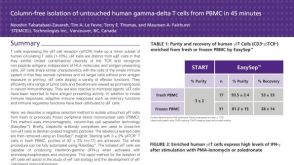 科学海报Immunomagnetic Cell Isolation of Human Gamma-Delta T Cells from PBMC
 沪公网安备31010102008431号