Human Immune Cytokines
Infographic of key cytokines for expansion, differentiation and characterization of major immune cell types
Booty MG et al. (FEB 2016)
Journal of Immunology 196 4 1822--31
Multiple Inflammatory Cytokines Converge To Regulate CD8+ T Cell Expansion and Function during Tuberculosis.
The differentiation of effector CD8(+) T cells is a dynamically regulated process that varies during different infections and is influenced by the inflammatory milieu of the host. In this study,we define three signals regulating CD8(+) T cell responses during tuberculosis by focusing on cytokines known to affect disease outcome: IL-12,type I IFN,and IL-27. Using mixed bone marrow chimeras,we compared wild-type and cytokine receptor knockout CD8(+) T cells within the same mouse following aerosol infection with Mycobacterium tuberculosis. Four weeks postinfection,IL-12,type 1 IFN,and IL-27 were all required for efficient CD8(+) T cell expansion in the lungs. We next determined if these cytokines directly promote CD8(+) T cell priming or are required only for expansion in the lungs. Using retrogenic CD8(+) T cells specific for the M. tuberculosis Ag TB10.4 (EsxH),we observed that IL-12 is the dominant cytokine driving both CD8(+) T cell priming in the lymph node and expansion in the lungs; however,type I IFN and IL-27 have nonredundant roles supporting pulmonary CD8(+) T cell expansion. Thus,IL-12 is a major signal promoting priming in the lymph node,but a multitude of inflammatory signals converge in the lung to promote continued expansion. Furthermore,these cytokines regulate the differentiation and function of CD8(+) T cells during tuberculosis. These data demonstrate distinct and overlapping roles for each of the cytokines examined and underscore the complexity of CD8(+) T cell regulation during tuberculosis.
View Publication
产品类型:
产品号#:
19853
19853RF
产品名:
EasySep™小鼠CD8+ T细胞分选试剂盒
RoboSep™ 小鼠CD8+ T细胞分选试剂盒
Muntasell A et al. (JUN 2010)
Blood 115 25 5170--9
Inhibition of NKG2D expression in NK cells by cytokines secreted in response to human cytomegalovirus infection.
The NKG2D receptor activates natural killer (NK) cell cytotoxicity and cytokine production on recognition of self-molecules induced by cellular stress under different conditions such as viral infections. The importance of NKG2D in the immune response to human cytomegalovirus (HCMV) is supported by the identification of several viral molecules that prevent the expression of NKG2D ligands by infected cells. In this study we report that,paradoxically,a significant,selective,and transient reduction of NKG2D expression on NK cells is detected during HCMV infection of peripheral blood mononuclear cells if needed. Antagonizing type I interferon (IFN),interleukin-12 (IL-12),and IFNgamma prevented HCMV-induced down-regulation of surface NKG2D. Moreover,treatment of purified NK cells with recombinant IFNbeta1 and IL-12 mimicked the effect,supporting a direct role of these cytokines in regulating NKG2D surface expression in NK cells. The loss of NKG2D expression selectively impaired NK-cell cytotoxicity against cells expressing NKG2D ligands but preserved the response triggered through other activating receptors. These results support that down-regulation of NKG2D expression on NK cells by cytokines with a key role in antiviral immune response may constitute a physiologic mechanism to control NK-cell reactivity against normal cells expressing NKG2D ligands in the context of inflammatory responses to viral infections.
View Publication
产品类型:
产品号#:
19055
19055RF
产品名:
EasySep™人NK细胞富集试剂盒
RoboSep™ 人NK细胞富集试剂盒含滤芯吸头
Jeffery LE et al. (NOV 2009)
Journal of immunology (Baltimore,Md. : 1950) 183 9 5458--67
1,25-Dihydroxyvitamin D3 and IL-2 combine to inhibit T cell production of inflammatory cytokines and promote development of regulatory T cells expressing CTLA-4 and FoxP3.
The active form of vitamin D,1,25-dihydroxyvitamin D(3) (1,25(OH)(2)D(3)),has potent immunomodulatory properties that have promoted its potential use in the prevention and treatment of infectious disease and autoimmune conditions. A variety of immune cells,including macrophages,dendritic cells,and activated T cells express the intracellular vitamin D receptor and are responsive to 1,25(OH)(2)D(3.) Despite this,how 1,25(OH)(2)D(3) regulates adaptive immunity remains unclear and may involve both direct and indirect effects on the proliferation and function of T cells. To further clarify this issue,we have assessed the effects of 1,25(OH)(2)D(3) on human CD4(+)CD25(-) T cells. We observed that stimulation of CD4(+)CD25(-) T cells in the presence of 1,25(OH)(2)D(3) inhibited production of proinflammatory cytokines including IFN- gamma,IL-17,and IL-21 but did not substantially affect T cell division. In contrast to its inhibitory effects on inflammatory cytokines,1,25(OH)(2)D(3) stimulated expression of high levels of CTLA-4 as well as FoxP3,the latter requiring the presence of IL-2. T cells treated with 1,25(OH)(2)D(3) could suppress proliferation of normally responsive T cells,indicating that they possessed characteristics of adaptive regulatory T cells. Our results suggest that 1,25(OH)(2)D(3) and IL-2 have direct synergistic effects on activated T cells,acting as potent anti-inflammatory agents and physiologic inducers of adaptive regulatory T cells.
View Publication
产品类型:
产品号#:
14052
产品名:
Newman SL et al. (FEB 2006)
Journal of immunology (Baltimore,Md. : 1950) 176 3 1806--13
Human macrophages do not require phagosome acidification to mediate fungistatic/fungicidal activity against Histoplasma capsulatum.
Histoplasma capsulatum (Hc) is a facultative intracellular fungus that modulates the intraphagosomal environment to survive within macrophages (Mphi). In the present study,we sought to quantify the intraphagosomal pH under conditions in which Hc yeasts replicated or were killed. Human Mphi that had ingested both viable and heat-killed or fixed yeasts maintained an intraphagosomal pH of approximately 6.4-6.5 over a period of several hours. These results were obtained using a fluorescent ratio technique and by electron microscopy using the 3-(2,4-dinitroanilo)-3'-amino-N-methyldipropylamine reagent. Mphi that had ingested Saccharomyces cerevisae,a nonpathogenic yeast that is rapidly killed and degraded by Mphi,also maintained an intraphagosomal pH of approximately 6.5 over a period of several hours. Stimulation of human Mphi fungicidal activity by coculture with chloroquine or by adherence to type 1 collagen matrices was not reversed by bafilomycin,an inhibitor of the vacuolar ATPase. Human Mphi cultured in the presence of bafilomycin also completely degraded heat-killed Hc yeasts,whereas mouse peritoneal Mphi digestion of yeasts was completely reversed in the presence of bafilomycin. However,bafilomycin did not inhibit mouse Mphi fungistatic activity induced by IFN-gamma. Thus,human Mphi do not require phagosomal acidification to kill and degrade Hc yeasts,whereas mouse Mphi do require acidification for fungicidal but not fungistatic activity.
View Publication


 EasySep™小鼠TIL(CD45)正选试剂盒




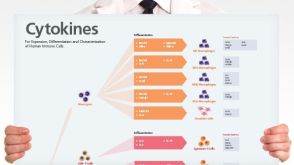 挂图Human Immune Cytokines Infographic of key cytokines for expansion, differentiation and characterization of major immune cell types
 沪公网安备31010102008431号