Tan BSN et al. (JUN 2016)
Mechanisms of development 141 32--39
Regulation of amino acid transporters in pluripotent cell populations in the embryo and in culture; novel roles for sodium-coupled neutral amino acid transporters.
The developmental outcomes of preimplantation mammalian embryos are regulated directly by the surrounding microenvironment,and inappropriate concentrations of amino acids,or the loss of amino acid-sensing mechanisms,can be detrimental and impact further development. A specific role for l-proline in the differentiation of embryonic stem (ES) cells,a cell population derived from the blastocyst,has been shown in culture. l-proline acts as a signalling molecule,exerting its effects through cell uptake and subsequent metabolism. Uptake in ES cells occurs predominantly through the sodium-coupled neutral amino acid transporter 2,Slc38a2 (SNAT2). Dynamic expression of amino acid transporters has been shown in the early mammalian embryo,reflecting functional roles for amino acids in embryogenesis. The expression of SNAT2 and family member Slc38a1 (SNAT1) was determined in mouse embryos from the 2-cell stage through to the early post-implantation pre-gastrulation embryo. Key changes in expression were validated in cell culture models of development. Both transporters showed temporal dynamic expression patterns and changes in intracellular localisation as differentiation progressed. Changes in transporter expression likely reflect different amino acid requirements during development. Findings include the differential expression of SNAT1 in the inner and outer cells of the compacted morula and nuclear localisation of SNAT2 in the trophectoderm and placental lineages. Furthermore,SNAT2 expression was up-regulated in the epiblast prior to primitive ectoderm formation,an expression pattern consistent with a role for the transporter in later developmental decisions within the pluripotent lineage. We propose that the differential expression of SNAT2 in the epiblast provides evidence for an l-proline-mediated mechanism contributing to the regulation of embryonic development.
View Publication
Delivery of Proteases in Aqueous Two-Phase Systems Enables Direct Purification of Stem Cell Colonies from Feeder Cell Co-Cultures for Differentiation into Functional Cardiomyocytes
Patterning of bioactive enzymes with subcellular resolution is achieved by dispensing droplets of dextran (DEX) onto polyethylene glycol (PEG)-covered cells though a glass capillary needle connected to a pneumatic pump. This technique is applied to purify colonies of induced pluripotent stem cells (iPSCs) from mouse embryonic fibroblast (MEF) feeder cultures and inefficiently induced iPSC colonies by selectively dissociating the iPSCs with proteases.
View Publication
产品类型:
产品号#:
05850
05857
05870
05875
85850
85857
85870
85875
产品名:
mTeSR™1
mTeSR™1
Xu Q et al. (AUG 2003)
Blood 102 3 972--80
Survival of acute myeloid leukemia cells requires PI3 kinase activation.
The mechanisms that regulate the growth and survival of acute myeloid leukemia (AML) cells are largely unknown. We hypothesized that constitutive activation of phosphatidyl-inositide 3 kinase (PI3 kinase) could regulate survival in primary cells from patients with AML. Here we demonstrate that Akt,a critical substrate of PI3 kinase,is activated in AML blasts. In a short-term culture system,most AML patient samples showed a dose-dependent decrease in survival after incubation with the PI3 kinase inhibitor LY294002. This decrease in survival was partially due to the induction of apoptosis. Furthermore,we have shown that p70 S6 kinase and 4EBP-1,downstream mediators of Akt signaling,also are phosphorylated in AML blasts. Phosphorylation of these proteins is inhibited by the mTOR inhibitor RAD001. Incubation of AML blasts with RAD001 induces only a small decrease in survival of the cells; however,when combined with Ara-C,RAD001 enhances the toxicity of Ara-C. These results demonstrate that constitutive activation of the PI3 kinase pathway is necessary for the survival of AML blasts and that targeting of this pathway with pharmacologic inhibitors may be of clinical benefit in treatment of AML.
View Publication
产品类型:
产品号#:
09500
产品名:
BIT 9500血清替代物
Walker A et al. (JAN 2010)
Nature communications 1 6 71
Non-muscle myosin II regulates survival threshold of pluripotent stem cells.
Human pluripotent stem (hPS) cells such as human embryonic stem (hES) and induced pluripotent stem (hiPS) cells are vulnerable under single cell conditions,which hampers practical applications; yet,the mechanisms underlying this cell death remain elusive. In this paper,we demonstrate that treatment with a specific inhibitor of non-muscle myosin II (NMII),blebbistatin,enhances the survival of hPS cells under clonal density and suspension conditions,and,in combination with a synthetic matrix,supports a fully defined environment for self-renewal. Consistent with this,genetically engineered mouse embryonic stem cells lacking an isoform of NMII heavy chain (NMHCII),or hES cells expressing a short hairpin RNA to knock down NMHCII,show greater viability than controls. Moreover,NMII inhibition increases the expression of self-renewal regulators Oct3/4 and Nanog,suggesting a mechanistic connection between NMII and self-renewal. These results underscore the importance of the molecular motor,NMII,as a novel target for chemically engineering the survival and self-renewal of hPS cells.
View Publication
产品类型:
产品号#:
05850
05857
05870
05875
72402
72404
85850
85857
85870
85875
产品名:
(-)-Blebbistatin
(-)-Blebbistatin
mTeSR™1
mTeSR™1
Sandt C et al. (JAN 2012)
PLoS ONE 7 4 e30743
Identification of spectral modifications occurring during reprogramming of somatic cells.
Recent technological advances in cell reprogramming by generation of induced pluripotent stem cells (iPSC) offer major perspectives in disease modelling and future hopes for providing novel stem cells sources in regenerative medicine. However,research on iPSC still requires refining the criteria of the pluripotency stage of these cells and exploration of their equivalent functionality to human embryonic stem cells (ESC). We report here on the use of infrared microspectroscopy to follow the spectral modification of somatic cells during the reprogramming process. We show that induced pluripotent stem cells (iPSC) adopt a chemical composition leading to a spectral signature indistinguishable from that of embryonic stem cells (ESC) and entirely different from that of the original somatic cells. Similarly,this technique allows a distinction to be made between partially and fully reprogrammed cells. We conclude that infrared microspectroscopy signature is a novel methodology to evaluate induced pluripotency and can be added to the tests currently used for this purpose.
View Publication
Conversion of adult endothelium to immunocompetent haematopoietic stem cells.
Developmental pathways that orchestrate the fleeting transition of endothelial cells into haematopoietic stem cells remain undefined. Here we demonstrate a tractable approach for fully reprogramming adult mouse endothelial cells to haematopoietic stem cells (rEC-HSCs) through transient expression of the transcription-factor-encoding genes Fosb,Gfi1,Runx1,and Spi1 (collectively denoted hereafter as FGRS) and vascular-niche-derived angiocrine factors. The induction phase (days 0-8) of conversion is initiated by expression of FGRS in mature endothelial cells,which results in endogenous Runx1 expression. During the specification phase (days 8-20),RUNX1(+) FGRS-transduced endothelial cells commit to a haematopoietic fate,yielding rEC-HSCs that no longer require FGRS expression. The vascular niche drives a robust self-renewal and expansion phase of rEC-HSCs (days 20-28). rEC-HSCs have a transcriptome and long-term self-renewal capacity similar to those of adult haematopoietic stem cells,and can be used for clonal engraftment and serial primary and secondary multi-lineage reconstitution,including antigen-dependent adaptive immune function. Inhibition of TGFβ and CXCR7 or activation of BMP and CXCR4 signalling enhanced generation of rEC-HSCs. Pluripotency-independent conversion of endothelial cells into autologous authentic engraftable haematopoietic stem cells could aid treatment of haematological disorders.
View Publication
Parfitt DA et al. (JUN 2016)
Cell stem cell 18 6 769--781
Identification and Correction of Mechanisms Underlying Inherited Blindness in Human iPSC-Derived Optic Cups
Summary Leber congenital amaurosis (LCA) is an inherited retinal dystrophy that causes childhood blindness. Photoreceptors are especially sensitive to an intronic mutation in the cilia-related gene CEP290,which causes missplicing and premature termination,but the basis of this sensitivity is unclear. Here,we generated differentiated photoreceptors in three-dimensional optic cups and retinal pigment epithelium (RPE) from iPSCs with this common CEP290 mutation to investigate disease mechanisms and evaluate candidate therapies. iPSCs differentiated normally into RPE and optic cups,despite abnormal CEP290 splicing and cilia defects. The highest levels of aberrant splicing and cilia defects were observed in optic cups,explaining the retinal-specific manifestation of this CEP290 mutation. Treating optic cups with an antisense morpholino effectively blocked aberrant splicing and restored expression of full-length CEP290,restoring normal cilia-based protein trafficking. These results provide a mechanistic understanding of the retina-specific phenotypes in CEP290 LCA patients and potential strategies for therapeutic intervention.
View Publication


 EasySep™小鼠TIL(CD45)正选试剂盒





 技术公告Extracellular Vesicle Generation from Mesenchymal Stromal Cells Using MesenCult™-ACF Plus
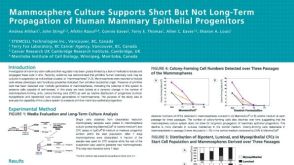 科学海报Mammosphere Culture Supports Short But Not Long-Term Propagation of Human Mammary Epithelial Progenitors


 沪公网安备31010102008431号