Liu X et al. (NOV 2017)
Nature methods 14 11 1055--1062
Comprehensive characterization of distinct states of human naive pluripotency generated by reprogramming.
Recent reports on the characteristics of naive human pluripotent stem cells (hPSCs) obtained using independent methods differ. Naive hPSCs have been mainly derived by conversion from primed hPSCs or by direct derivation from human embryos rather than by somatic cell reprogramming. To provide an unbiased molecular and functional reference,we derived genetically matched naive hPSCs by direct reprogramming of fibroblasts and by primed-to-naive conversion using different naive conditions (NHSM,RSeT,5iLAF and t2iLGöY). Our results show that hPSCs obtained in these different conditions display a spectrum of naive characteristics. Furthermore,our characterization identifies KLF4 as sufficient for conversion of primed hPSCs into naive t2iLGöY hPSCs,underscoring the role that reprogramming factors can play for the derivation of bona fide naive hPSCs.
View Publication
产品类型:
产品号#:
05970
产品名:
Wang H-CC et al. (OCT 2014)
Cancer Informatics 13 Suppl 5 25--35
Profiling the microRNA Expression in Human iPS and iPS-derived Retinal Pigment Epithelium.
The purpose of this study is to characterize the microRNA (miRNA) expression profiles of induced pluripotent stem (iPS) cells and retinal pigment epithelium (RPE) derived from induced pluripotent stem cells (iPS-RPE). MiRNAs have been demonstrated to play critical roles in both maintaining pluripotency and facilitating differentiation. Gene expression networks accountable for maintenance and induction of pluripotency are linked and share components with those networks implicated in oncogenesis. Therefore,we hypothesize that miRNA expression profiling will distinguish iPS cells from their iPS-RPE progeny. To identify and analyze differentially expressed miRNAs,RPE was derived from iPS using a spontaneous differentiation method. MiRNA microarray analysis identified 155 probes that were statistically differentially expressed between iPS and iPS-RPE cells. Up-regulated miRNAs including miR-181c and miR-129-5p may play a role in promoting differentiation,while down-regulated miRNAs such as miR-367,miR-18b,and miR-20b are implicated in cell proliferation. Subsequent miRNA-target and network analysis revealed that these miRNAs are involved in cellular development,cell cycle progression,cell death,and survival. A systematic interrogation of temporal and spatial expression of iPS-RPE miRNAs and their associated target mRNAs will provide new insights into the molecular mechanisms of carcinogenesis,eye differentiation and development.
View Publication
产品类型:
产品号#:
05850
05857
05870
05875
85850
85857
85870
85875
产品名:
mTeSR™1
mTeSR™1
Lee Y-LL et al. (NOV 2015)
Human reproduction (Oxford,England) 30 11 2614--2626
Establishment of a novel human embryonic stem cell-derived trophoblastic spheroid implantation model.
STUDY QUESTION Can human embryonic stem cell-derived trophoblastic spheroids be used to study the early stages of implantation? SUMMARY ANSWER We generated a novel human embryonic stem cell-derived trophoblastic spheroid model mimicking human blastocysts in the early stages of implantation. WHAT IS KNOWN ALREADY Both human embryos and choriocarcinoma cell line derived spheroids can attach onto endometrial cells and are used as models to study the early stages of implantation. However,human embryos are limited and the use of cancer cell lines for spheroid generation remains sub-optimal for research. STUDY DESIGN,SIZE,DURATION Experimental induced differentiation of human embryonic stem cells into trophoblast and characterization of the trophoblast. PARTICIPANTS/MATERIALS,SETTING,METHODS Trophoblastic spheroids (BAP-EB) were generated by inducing differentiation of a human embryonic stem cell line,VAL3 cells with bone morphogenic factor-4,A83-01 (a TGF-$\$),and PD173074 (a FGF receptor-3 inhibitor) after embryoid body formation. The expressions of trophoblastic markers and hCG levels were studied by real-time PCR and immunohistochemistry. BAP-EB attachment and invasion assays were performed on different cell lines and primary endometrial cells. MAIN RESULTS AND THE ROLE OF CHANCE After 48 h of induced differentiation,the BAP-EB resembled early implanting human embryos in terms of size and morphology. The spheroids derived from embryonic stem cells (VAL3),but not from several other cell lines studied,possessed a blastocoel-like cavity. BAP-EB expressed several markers of trophectoderm of human blastocysts on Day 2 of induced differentiation. In the subsequent days of differentiation,the cells of the spheroids differentiated into trophoblast-like cells expressing trophoblastic markers,though at levels lower than that in the primary trophoblasts or in a choriocarcinoma cell line. On Day 3 of induced differentiation,BAP-EB selectively attached onto endometrial epithelial cells,but not other non-endometrial cell lines or an endometrial cell line that had lost its epithelial character. The attachment rates of BAP-EB was significantly higher on primary endometrial epithelial cells (EEC) taken from 7 days after hCG induction of ovulation (hCG+7 day) when compared with that from hCG+2 day. The spheroids also invaded through Ishikawa cells and the primary endometrial stromal cells in the co-culture. LIMITATIONS,REASONS FOR CAUTION The attachment rates of BAP-EB were compared between EEC obtained from Day 2 and Day 7 of the gonadotrophin stimulated cycle,but not the natural cycles. WIDER IMPLICATIONS OF THE FINDINGS BAP-EB have the potential to be used as a test for predicting endometrial receptivity in IVF cycles and provide a novel approach to study early human implantation,trophoblastic cell differentiation and trophoblastic invasion into human endometrial cells.
View Publication
Raouf A et al. (JUL 2008)
Cell stem cell 3 1 109--18
Transcriptome analysis of the normal human mammary cell commitment and differentiation process.
Mature mammary epithelial cells are generated from undifferentiated precursors through a hierarchical process,but the molecular mechanisms involved,particularly in the human mammary gland,are poorly understood. To address this issue,we isolated highly purified subpopulations of primitive bipotent and committed luminal progenitor cells as well as mature luminal and myoepithelial cells from normal human mammary tissue and compared their transcriptomes obtained using three different methods. Elements unique to each subset of mammary cells were identified,and changes that accompany their differentiation in vivo were shown to be recapitulated in vitro. These include a stage-specific change in NOTCH pathway gene expression during the commitment of bipotent progenitors to the luminal lineage. Functional studies further showed NOTCH3 signaling to be critical for this differentiation event to occur in vitro. Taken together,these findings provide an initial foundation for future delineation of mechanisms that perturb primitive human mammary cell growth and differentiation.
View Publication
产品类型:
产品号#:
05601
产品名:
EpiCult™-B 人培养基
Archibald PRT et al. (AUG 2016)
Bioprocess and Biosystems Engineering 1--12
Comparability of automated human induced pluripotent stem cell culture: a pilot study
Consistent and robust manufacturing is essential for the translation of cell therapies,and the utilisation automation throughout the manufacturing process may allow for improvements in quality control,scalability,reproducibility and economics of the process. The aim of this study was to measure and establish the comparability between alternative process steps for the culture of hiPSCs. Consequently,the effects of manual centrifugation and automated non-centrifugation process steps,performed using TAP Biosystems' CompacT SelecT automated cell culture platform,upon the culture of a human induced pluripotent stem cell (hiPSC) line (VAX001024c07) were compared. This study,has demonstrated that comparable morphologies and cell diameters were observed in hiPSCs cultured using either manual or automated process steps. However,non-centrifugation hiPSC populations exhibited greater cell yields,greater aggregate rates,increased pluripotency marker expression,and decreased differentiation marker expression compared to centrifugation hiPSCs. A trend for decreased variability in cell yield was also observed after the utilisation of the automated process step. This study also highlights the detrimental effect of the cryopreservation and thawing processes upon the growth and characteristics of hiPSC cultures,and demonstrates that automated hiPSC manufacturing protocols can be successfully transferred between independent laboratories.
View Publication
产品类型:
产品号#:
05850
05857
05870
05875
85850
85857
85870
85875
产品名:
mTeSR™1
mTeSR™1
Griesi-Oliveira K et al. (NOV 2014)
Molecular psychiatry 20 March 1--16
Modeling non-syndromic autism and the impact of TRPC6 disruption in human neurons.
An increasing number of genetic variants have been implicated in autism spectrum disorders (ASDs),and the functional study of such variants will be critical for the elucidation of autism pathophysiology. Here,we report a de novo balanced translocation disruption of TRPC6,a cation channel,in a non-syndromic autistic individual. Using multiple models,such as dental pulp cells,induced pluripotent stem cell (iPSC)-derived neuronal cells and mouse models,we demonstrate that TRPC6 reduction or haploinsufficiency leads to altered neuronal development,morphology and function. The observed neuronal phenotypes could then be rescued by TRPC6 complementation and by treatment with insulin-like growth factor-1 or hyperforin,a TRPC6-specific agonist,suggesting that ASD individuals with alterations in this pathway may benefit from these drugs. We also demonstrate that methyl CpG binding protein-2 (MeCP2) levels affect TRPC6 expression. Mutations in MeCP2 cause Rett syndrome,revealing common pathways among ASDs. Genetic sequencing of TRPC6 in 1041 ASD individuals and 2872 controls revealed significantly more nonsynonymous mutations in the ASD population,and identified loss-of-function mutations with incomplete penetrance in two patients. Taken together,these findings suggest that TRPC6 is a novel predisposing gene for ASD that may act in a multiple-hit model. This is the first study to use iPSC-derived human neurons to model non-syndromic ASD and illustrate the potential of modeling genetically complex sporadic diseases using such cells.Molecular Psychiatry advance online publication,11 November 2014; doi:10.1038/mp.2014.141.
View Publication
Chung S-KK et al. (JUL 2014)
Protein and Cell 5 7 544--551
Functional analysis of the acetylation of human p53 in DNA damage responses
As a critical tumor suppressor,p53 is inactivated in human cancer cells by somatic gene mutation or disruption of pathways required for its activation. Therefore,it is critical to elucidate the mechanism underlying p53 activation after genotoxic and cellular stresses. Accumulating evidence has indicated the importance of posttranslational modifications such as acetylation in regulating p53 stability and activity. However,the physiological roles of the eight identified acetylation events in regulating p53 responses remain to be fully understood. By employing homologous recombination,we introduced various combinations of missense mutations (lysine to arginine) into eight acetylation sites of the endogenous p53 gene in human embryonic stem cells (hESCs). By determining the p53 responses to DNA damage in the p53 knock-in mutant hESCs and their derivatives,we demonstrate physiological importance of the acetylation events within the core domain (K120 and K164) and at the C-terminus (K370/372/373/381/382/386) in regulating human p53 responses to DNA damage.
View Publication
产品类型:
产品号#:
05850
05857
05870
05875
85850
85857
85870
85875
产品名:
mTeSR™1
mTeSR™1
Mandegar MA et al. (APR 2016)
Cell Stem Cell 18 4 541--553
CRISPR Interference Efficiently Induces Specific and Reversible Gene Silencing in Human iPSCs
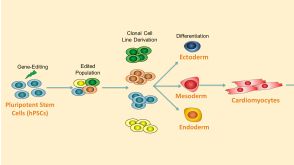
Developing technologies for efficient and scalable disruption of gene expression will provide powerful tools for studying gene function,developmental pathways,and disease mechanisms. Here,we develop clustered regularly interspaced short palindromic repeat interference (CRISPRi) to repress gene expression in human induced pluripotent stem cells (iPSCs). CRISPRi,in which a doxycycline-inducible deactivated Cas9 is fused to a KRAB repression domain,can specifically and reversibly inhibit gene expression in iPSCs and iPSC-derived cardiac progenitors,cardiomyocytes,and T lymphocytes. This gene repression system is tunable and has the potential to silence single alleles. Compared with CRISPR nuclease (CRISPRn),CRISPRi gene repression is more efficient and homogenous across cell populations. The CRISPRi system in iPSCs provides a powerful platform to perform genome-scale screens in a wide range of iPSC-derived cell types,dissect developmental pathways,and model disease.
View Publication


 EasySep™小鼠TIL(CD45)正选试剂盒







 沪公网安备31010102008431号