Hasehira K et al. (JUN 2016)
Glycoconjugate Journal 1--10
Structural and quantitative evidence of ??2???6-sialylated N-glycans as markers of the differentiation potential of human mesenchymal stem cells
Human somatic stem cells such as mesenchymal stem cells (hMSCs) have the capacity to differentiate into mesenchymal tissue lineages and to alter immune regulatory functions. As such,they hold promise for use in stem cell-based therapies. However,no method is currently available to evaluate the actual differentiation capacity of hMSCs prior to cell transplantation. Previously,we performed a comprehensive glycan profiling of adipose-derived hMSCs using high-density lectin microarray and demonstrated that $$2-6-sialylation is a marker of the differentiation potential of these cells. Nevertheless,no information was available about the structural details of these of $$2-6-sialylated glycans. Here we used high performance liquid chromatography (HPLC) analysis combined with mass spectrometry (MS) to perform a structural and quantitative glycome analysis targeting both N- and O-glycans derived from early (with differentiation ability) and late (without differentiation ability) passages of adipose tissue-derived hMSCs. Findings in these cells were compared with those from human induced pluripotent stem cells (hiPSCs),human dermal fibroblasts (hFibs) and cartilage tissue-derived chondrocytes. A higher percentage of $$2-6-sialylated N-glycans was detected in early passage cells (24-28 % of sialylated N-glycans) compared with late passage cells (13-15 %). A major $$2-6-sialylated N-glycan structure detected in adipose-derived hMSCs was that of mono-sialylated biantennary N-glycan. Similar results were obtained for the cartilage tissue-derived chondrocytes,Yub621c (28 % for passage 7 and 5 % for passage 28). In contrast,no significant differences were observed between early and late passage hMSCs with respect to $$2-6-sialylated O-glycan percentages. These results demonstrate that levels of $$2-6-sialylated N-glycans,but not O-glycans,could be used as markers of the differential potential of hMSCs.
View Publication
产品类型:
产品号#:
05850
05857
05870
05875
85850
85857
85870
85875
产品名:
mTeSR™1
mTeSR™1
Musah S et al. (SEP 2014)
Proceedings of the National Academy of Sciences of the United States of America 111 38 13805--10
Substratum-induced differentiation of human pluripotent stem cells reveals the coactivator YAP is a potent regulator of neuronal specification.
Physical stimuli can act in either a synergistic or antagonistic manner to regulate cell fate decisions,but it is less clear whether insoluble signals alone can direct human pluripotent stem (hPS) cell differentiation into specialized cell types. We previously reported that stiff materials promote nuclear localization of the Yes-associated protein (YAP) transcriptional coactivator and support long-term self-renewal of hPS cells. Here,we show that even in the presence of soluble pluripotency factors,compliant substrata inhibit the nuclear localization of YAP and promote highly efficient differentiation of hPS cells into postmitotic neurons. In the absence of neurogenic factors,the effective substrata produce neurons rapidly (2 wk) and more efficiently (textgreater75%) than conventional differentiation methods. The neurons derived from substrate induction express mature markers and possess action potentials. The hPS differentiation observed on compliant surfaces could be recapitulated on stiff surfaces by adding small-molecule inhibitors of F-actin polymerization or by depleting YAP. These studies reveal that the matrix alone can mediate differentiation of hPS cells into a mature cell type,independent of soluble inductive factors. That mechanical cues can override soluble signals suggests that their contributions to early tissue development and lineage commitment are profound.
View Publication
产品类型:
产品号#:
05850
05857
05870
05875
85850
85857
85870
85875
产品名:
mTeSR™1
mTeSR™1
Bogomazova AN et al. (JAN 2015)
Scientific reports 5 7749
No DNA damage response and negligible genome-wide transcriptional changes in human embryonic stem cells exposed to terahertz radiation.
Terahertz (THz) radiation was proposed recently for use in various applications,including medical imaging and security scanners. However,there are concerns regarding the possible biological effects of non-ionising electromagnetic radiation in the THz range on cells. Human embryonic stem cells (hESCs) are extremely sensitive to environmental stimuli,and we therefore utilised this cell model to investigate the non-thermal effects of THz irradiation. We studied DNA damage and transcriptome responses in hESCs exposed to narrow-band THz radiation (2.3 THz) under strict temperature control. The transcription of approximately 1% of genes was subtly increased following THz irradiation. Functional annotation enrichment analysis of differentially expressed genes revealed 15 functional classes,which were mostly related to mitochondria. Terahertz irradiation did not induce the formation of γH2AX foci or structural chromosomal aberrations in hESCs. We did not observe any effect on the mitotic index or morphology of the hESCs following THz exposure.
View Publication
产品类型:
产品号#:
05850
05857
05870
05875
85850
85857
85870
85875
产品名:
mTeSR™1
mTeSR™1
Xu X et al. ( 2010)
Biotechnology Progress 26 3 827--837
The roles of apoptotic pathways in the low recovery rate after cryopreservation of dissociated human embryonic stem cells
Human embryonic stem (hES) cells have enormous potential for clinical applications. However,one major challenge is to achieve high cell recovery rate after cryopreservation. Understanding how the conventional cryopreservation protocol fails to protect the cells is a prerequisite for developing efficient and successful cryopreservation methods for hES cell lines and banks. We investigated how the stimuli from cryopreservation result in apoptosis,which causes the low cell recovery rate after cryopreservation. The level of reactive oxygen species (ROS) is significantly increased,F-actin content and distribution is altered,and caspase-8 and caspase-9 are activated after cryopreservation. p53 is also activated and translocated into nucleus. During cryopreservation apoptosis is induced by activation of both caspase-8 through the extrinsic pathway and caspase-9 through the intrinsic pathway. However,exactly how the extrinsic pathway is activated is still unclear and deserves further investigation.
View Publication
产品类型:
产品号#:
05850
05857
05870
05875
85850
85857
85870
85875
产品名:
mTeSR™1
mTeSR™1
Ghule PN et al. (MAY 2011)
Journal of cellular physiology 226 5 1149--56
Reprogramming the pluripotent cell cycle: restoration of an abbreviated G1 phase in human induced pluripotent stem (iPS) cells.
Induced pluripotent stem (iPS) cells derived from terminally differentiated human fibroblasts are reprogrammed to possess stem cell like properties. However,the extent to which iPS cells exhibit unique properties of the human embryonic stem (hES) cell cycle remains to be established. hES cells are characterized by an abbreviated G1 phase (∼ 2.5 h) and accelerated organization of subnuclear domains that mediate the assembly of regulatory machinery for histone gene expression [i.e.,histone locus bodies (HLBs)]. We therefore examined cell cycle parameters of iPS cells in comparison to hES cells. Analysis of DNA synthesis [5-bromo-2'-deoxy-uridine (BrdU) incorporation],cell cycle distribution (FACS analysis and Ki67 staining) and subnuclear organization of HLBs [immunofluorescence microscopy and fluorescence in situ hybridization (FISH)] revealed that human iPS cells have a short G1 phase (∼ 2.5 h) and an abbreviated cell cycle (16-18 h). Furthermore,HLBs are formed and reorganized rapidly after mitosis (within 1.5-2 h). Thus,reprogrammed iPS cells have cell cycle kinetics and dynamic subnuclear organization of regulatory machinery that are principal properties of pluripotent hES cells. Our findings support the concept that the abbreviated cell cycle of hES and iPS cells is functionally linked to pluripotency.
View Publication
产品类型:
产品号#:
05850
05857
05870
05875
85850
85857
85870
85875
产品名:
mTeSR™1
mTeSR™1
Inamdar AA et al. (JAN 2012)
Mycopathologia 173 1 13--20
A Model to Evaluate the Cytotoxicity of the Fungal Volatile Organic Compound 1-octen-3-ol in Human Embryonic Stem Cells
Microbial growth in damp indoor environments has been correlated with risks to human health. This study was aimed to determine the cytotoxicity of 1-octen-3-ol (mushroom alcohol")�
View Publication
Varela I et al. (DEC 2014)
Cellular reprogramming 16 6 447--455
Generation of human $\$-thalassemia induced pluripotent cell lines by reprogramming of bone marrow-derived mesenchymal stromal cells using modified mRNA.
Synthetic modified mRNA molecules encoding pluripotency transcription factors have been used successfully in reprogramming human fibroblasts to induced pluripotent stem cells (iPSCs). We have applied this method on bone marrow-derived mesenchymal stromal cells (BM-MSCs) obtained from a patient with $$-thalassemia ($$-thal) with the aim to generate trangene-free $$-thal-iPSCs. Transfection of 10(4) BM-MSCs by lipofection with mRNA encoding the reprogramming factors Oct4,Klf4,Sox2,cMyc,and Lin28 resulted in formation of five iPSC colonies,from which three were picked up and expanded in $$-thal-iPSC lines. After 10 serial passages in vitro,$$-thal-iPSCs maintain genetic stability as shown by array comparative genomic hybridization (aCGH) and are capable of forming embryoid bodies in vitro and teratomas in vivo. Their gene expression profile compared to human embryonic stem cells (ESCs) and BM-MSCs seems to be similar to that of ESCs,whereas it differs from the profile of the parental BM-MSCs. Differentiation cultures toward a hematopoietic lineage showed the generation of CD34(+) progenitors up to 10%,but with a decreased hematopoietic colony-forming capability. In conclusion,we report herein the generation of transgene-free $$-thal-iPSCs that could be widely used for disease modeling and gene therapy applications. Moreover,it was demonstrated that the mRNA-based reprogramming method,used mainly in fibroblasts,is also suitable for reprogramming of human BM-MSCs.
View Publication
产品类型:
产品号#:
04230
05850
05857
05870
05875
07923
60062
60062AD
60062AD.1
60062BT
60062FI
60062FI.1
60062PE
60062PE.1
85850
85857
85870
85875
05270
05275
产品名:
MethoCult™ H4230
Dispase (1 U/mL)
抗人SSEA-4抗体,克隆号MC-813-70,生物素
抗人SSEA-4抗体,克隆号MC-813-70,FITC
抗人SSEA-4抗体, 克隆号MC-813-70,FITC
抗人SSEA-4抗体,克隆号MC-813-70,PE
抗人SSEA-4抗体,克隆号MC-813-70,PE
mTeSR™1
mTeSR™1
STEMdiff™ APEL™2 培养基
STEMdiff™ APEL™2 培养基
Valera E et al. (JAN 2010)
PLoS ONE 5 6 e11167
BMP-2/6 heterodimer is more effective than BMP-2 or BMP-6 homodimers as inductor of differentiation of human embryonic stem cells
Bone Morphogenetic Protein (BMP) signaling pathways are involved in differentiation of stem cells into diverse cell types,and thus BMPs can be used as main guidance molecules for in vitro differentiation of human stem cells.
View Publication
产品类型:
产品号#:
05850
05857
05870
05875
85850
85857
85870
85875
产品名:
mTeSR™1
mTeSR™1
Rizzino A (SEP 2010)
Regenerative medicine 5 5 799--807
Stimulating progress in regenerative medicine: improving the cloning and recovery of cryopreserved human pluripotent stem cells with ROCK inhibitors.
Until recently,culturing human pluripotent stem cells was hampered by three prominent technical problems: a high degree of unwanted cellular stress when the cells are passaged,unacceptably low cloning efficiency and poor recovery of cryopreserved stocks. This review discusses recent developments that address these problems. A major focus of the review is the use of p160 Rho-associated coiled-coil kinase inhibitors for improving both the cloning efficiency and the recovery of cryopreserved human embryonic stem cells and human induced pluripotent stem cells. An underlying theme of this review is that the three problems have a common cause: separation of human pluripotent stem cells from one another increases cellular stress,which greatly decreases their viability unless special steps are taken.
View Publication
产品类型:
产品号#:
05850
05857
05870
05875
85850
85857
85870
85875
产品名:
mTeSR™1
mTeSR™1
Nguyen V et al. ( 2016)
Stem cells international 2016 1346521
A Genomic Study of DNA Alteration Events Caused by Ionizing Radiation in Human Embryonic Stem Cells via Next-Generation Sequencing.
Ionizing radiation (IR) is a known mutagen that is widely employed for medical diagnostic and therapeutic purposes. To study the extent of genetic variations in DNA caused by IR,we used IR-sensitive human embryonic stem cells (hESCs). Four hESC cell lines,H1,H7,H9,and H14,were subjected to IR at 0.2 or 1 Gy dose and then maintained in culture for four days before being harvested for DNA isolation. Irradiation with 1 Gy dose resulted in significant cell death,ranging from 60% to 90% reduction in cell population. Since IR is often implicated as a risk for inducing cancer,a primer pool targeting genomic hotspot" regions that are frequently mutated in human cancer genes was used to generate libraries from irradiated and control samples. Using a semiconductor-based next-generation sequencing approach�
View Publication
产品类型:
产品号#:
05850
05857
05870
05875
07923
85850
85857
85870
85875
产品名:
Dispase (1 U/mL)
mTeSR™1
mTeSR™1
Hyka-Nouspikel N et al. (SEP 2012)
Stem Cells 30 9 1901--10
Deficient DNA damage response and cell cycle checkpoints lead to accumulation of point mutations in human embryonic stem cells
Human embryonic stem cells (hESCs) tend to lose genomic integrity during long periods of culture in vitro and to acquire a cancer-like phenotype. In this study,we aim at understanding the contribution of point mutations to the adaptation process and at providing a mechanistic explanation for their accumulation. We observed that,due to the absence of p21/Waf1/Cip1,cultured hESCs lack proper cell cycle checkpoints and are vulnerable to the kind of DNA damage usually repaired by the highly versatile nucleotide excision repair (NER) pathway. In response to UV-induced DNA damage,the majority of hESCs succumb to apoptosis; however,a subpopulation continues to proliferate,carrying damaged DNA and accumulating point mutations with a typical UV-induced signature. The UV-resistant cells retain their proliferative capacity and potential for pluripotent differentiation and are markedly less apoptotic to subsequent UV exposure. These findings demonstrate that,due to deficient DNA damage response,the modest NER activity in hESCs is insufficient to prevent increased mutagenesis. This provides for the appearance of genetically aberrant hESCs,paving the way for further major genetic changes.
View Publication


 EasySep™小鼠TIL(CD45)正选试剂盒





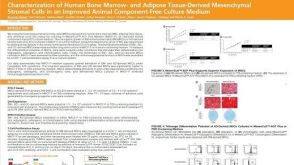 科学海报Characterization of Human Bone Marrow- and Adipose Tissue-Derived Mesenchymal Stromal Cells in an Improved Animal Component-Free Culture Medium
 沪公网安备31010102008431号