Murine plasmacytoid dendritic cells induce effector/memory CD8+ T-cell responses in vivo after viral stimulation.
Like their human counterparts,mouse plasmacytoid dendritic cells (pDCs) play a central role in innate immunity against viral infections,but their capacity to prime T cells in vivo remains unknown. We show here that virus-activated pDCs differentiate into antigen-presenting cells able to induce effector/memory CD8(+) T-cell responses in vivo against both epitopic peptides and endogenous antigen,whereas pDCs activated by synthetic oligodeoxynucleotides containing unmethylated cytosine-guanine motifs (CpG) acquire only the ability to recall antigen-experienced T-cell responses. We also show that immature pDCs are unable to induce effector or regulatory CD8(+) T-cell responses. Thus,murine pDCs take part in both innate and adaptive immune responses by directly priming naive CD8(+) T cells during viral infection.
View Publication
产品号#:
09600
09650
产品名:
StemSpan™ SFEM
StemSpan™ SFEM
Houtenbos I et al. (JUL 2003)
Cancer immunology,immunotherapy : CII 52 7 455--62
Serum-free generation of antigen presenting cells from acute myeloid leukaemic blasts for active specific immunisation.
PURPOSE: Immunotherapy holds promise as a new strategy for the eradication of residual cells in acute myeloid leukaemia (AML). Leukaemic antigen presenting cells (APCs) combining optimal antigen presentation and tumour antigenicity could be used as potent T cell activators. For clinical purposes it is desirable to culture APCs under serum-free conditions. Therefore,we compared morphological,immunophenotypical and functional outcome of the serum-free culture of AML-APCs to their serum-enriched culture. METHODS: AML blasts (n=19) were cultured in the presence of either a cytokine mix or calcium ionophore (CI) for 14 and 2 days,respectively,in FCS-containing medium (FCS),StemSpan serum-free medium (SP) and CellGro serum-free medium (CG). After culture relative yields were calculated and immunophenotypic analysis of APC markers was performed. The mixed leukocyte reaction (MLR) was used to determine T cell stimulating capacity. RESULTS: Serum-free culture of AML-APCs resulted in comparable morphology,relative yields and immunophenotype to serum-enriched culture. By comparing both serum-free media we observed a trend towards a more mature phenotype of CI-cultured AML-APCs in SP. MLR showed that serum-free cultured cells have equal T cell stimulatory capacity in comparison with serum-enriched culture. CONCLUSION: These data show that the serum-free culture of AML-APCs is feasible and that these APCs are comparable to serum-enriched cultured AML-APCs with regard to morphological,immunophenotypical and functional characteristics. These AML-APCs are suitable for the development of active specific immunisation protocols which meet the criteria for good clinical practise (GCP).
View Publication
产品号#:
09600
09650
产品名:
StemSpan™ SFEM
StemSpan™ SFEM
Zhang Z et al. (SEP 2003)
The EMBO journal 22 18 4759--69
Enforced expression of EBF in hematopoietic stem cells restricts lymphopoiesis to the B cell lineage.
Mice deficient in early B cell factor (EBF) are blocked at the progenitor B cell stage prior to immunoglobulin gene rearrangement. The EBF-dependent block in B cell development occurs near the onset of B-lineage commitment,which raises the possibility that EBF may act instructively to specify the B cell fate from uncommitted,multipotential progenitor cells. To test this hypothesis,we transduced enriched hematopoietic progenitor cells with a retroviral vector that coexpressed EBF and the green fluorescent protein (GFP). Mice reconstituted with EBF-expressing cells showed a near complete absence of T lymphocytes. Spleen and peripheral blood samples were textgreater95 and 90% GFP+EBF+ mature B cells,respectively. Both NK and lymphoid-derived dendritic cells were also significantly reduced compared with control-transplanted mice. These data suggest that EBF can restrict lymphopoiesis to the B cell lineage by blocking development of other lymphoid-derived cell pathways.
View Publication
产品号#:
03434
03444
产品名:
MethoCult™ GF M3434
MethoCult™ GF M3434
Hase H et al. (MAR 2004)
Blood 103 6 2257--65
BAFF/BLyS can potentiate B-cell selection with the B-cell coreceptor complex.
The tumor necrosis factor (TNF)-like ligand BAFF/BLyS (B-cell activating factor of the TNF family/B-lymphocyte stimulator) is a potent B-cell survival factor,yet its functional relationship with other B-cell surface molecules such as CD19 and CD40 is poorly understood. We found that follicular dendritic cells (FDCs) in human lymph nodes expressed BAFF abundantly. BAFF up-regulated a B cell-specific transcription factor Pax5/BSAP (Pax5/B cell-specific activator protein) activity and its target CD19,a major component of the B-cell coreceptor complex,and synergistically enhanced CD19 phosphorylation by B-cell antigen receptor (BCR). BAFF further enhanced B-cell proliferation,immunoglobulin G (IgG) production,and reactivity to CD154 by BCR/CD19 coligation and interleukin-15 (IL-15). Our results suggest that BAFF may play an important role in FDC-B-cell interactions through the B-cell coreceptor complex and a possibly sequential link between the T cell-independent and -dependent B-cell responses in the germinal centers.
View Publication
产品号#:
03800
03801
03802
03803
03804
03805
03806
产品名:
ClonaCell™-HY杂交瘤试剂盒
ClonaCell™-HY培养基A
ClonaCell™-HY 培养基 B
ClonaCell™-HY 培养基 C
ClonaCell™-HY 培养基 D
ClonaCell™-HY 培养基 E
ClonaCell™-HY PEG
Nefedova Y et al. (JAN 2004)
Journal of immunology (Baltimore,Md. : 1950) 172 1 464--74
Hyperactivation of STAT3 is involved in abnormal differentiation of dendritic cells in cancer.
Abnormal differentiation of myeloid cells is one of the hallmarks of cancer. However,the molecular mechanisms of this process remain elusive. In this study,we investigated the effect of tumor-derived factors on Janus kinase (Jak)/STAT signaling in myeloid cells during their differentiation into dendritic cells. Tumor cell conditioned medium induced activation of Jak2 and STAT3,which was associated with an accumulation of immature myeloid cells. Jak2/STAT3 activity was localized primarily in these myeloid cells,which prevented the differentiation of immature myeloid cells into mature dendritic cells. This differentiation was restored after removal of tumor-derived factors. Inhibition of STAT3 abrogated the negative effects of these factors on myeloid cell differentiation,and overexpression of STAT3 reproduced the effects of tumor-derived factors. Thus,this is a first demonstration that tumor-derived factors may affect myeloid cell differentiation in cancer via constitutive activation of Jak2/STAT3.
View Publication
Distinct signals control the hematopoiesis of lymphoid-related dendritic cells.
The molecular and cellular requirements for the development of different populations of human dendritic cells (DC) were studied. Conditions were defined that support DC production from lymphoid progenitors but that fail to induce DC formation from peripheral monocytes. The production of these lymphoid-related DC was severely blocked when hematopoietic progenitors overexpressed Ik7,a mutant dominant-negative Ikaros protein. In contrast,Ik7 did not block the formation of DC in conditions supporting the development of monocyte-derived DC. Furthermore,Ik7 did not block the formation of monocyte/macrophages and enhanced granulopoiesis. One of the molecular mechanisms mediated by Ik7 appears to be down-regulation of the flt3-receptor mRNA. Thus,distinct signals control the formation of DC demonstrating that some aspects of DC diversity are determined in part by distinct molecular cues at the hematopoietic level. (Blood. 2000;95:128-137)
View Publication
产品号#:
04431
产品名:
MethoCult™ H4431
Figueroa G et al. (OCT 2016)
Journal of visualized experiments : JoVE 116
Characterization of Human Monocyte-derived Dendritic Cells by Imaging Flow Cytometry: A Comparison between Two Monocyte Isolation Protocols.
Dendritic cells (DCs) are antigen presenting cells of the immune system that play a crucial role in lymphocyte responses,host defense mechanisms,and pathogenesis of inflammation. Isolation and study of DCs have been important in biological research because of their distinctive features. Although they are essential key mediators of the immune system,DCs are very rare in blood,accounting for approximately 0.1 - 1% of total blood mononuclear cells. Therefore,alternatives for isolation methods rely on the differentiation of DCs from monocytes isolated from peripheral blood mononuclear cells (PBMCs). The utilization of proper isolation techniques that combine simplicity,affordability,high purity,and high yield of cells is imperative to consider. In the current study,two distinct methods for the generation of DCs will be compared. Monocytes were selected by adherence or negatively enriched using magnetic separation procedure followed by differentiation into DCs with IL-4 and GM-CSF. Monocyte and MDDC viability,proliferation,and phenotype were assessed using viability dyes,MTT assay,and CD11c/ CD14 surface marker analysis by imaging flow cytometry. Although the magnetic separation method yielded a significant higher percentage of monocytes with higher proliferative capacity when compared to the adhesion method,the findings have demonstrated the ability of both techniques to simultaneously generate monocytes that are capable of proliferating and differentiating into viable CD11c+ MDDCs after seven days in culture. Both methods yielded textgreater 70% CD11c+ MDDCs. Therefore,our results provide insights that contribute to the development of reliable methods for isolation and characterization of human DCs.
View Publication


 EasySep™小鼠TIL(CD45)正选试剂盒





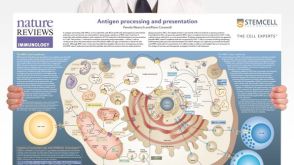 挂图Antigen Processing and Presentation Overview of the mechanisms by which antigens are processed and presented to T cells

 沪公网安备31010102008431号